


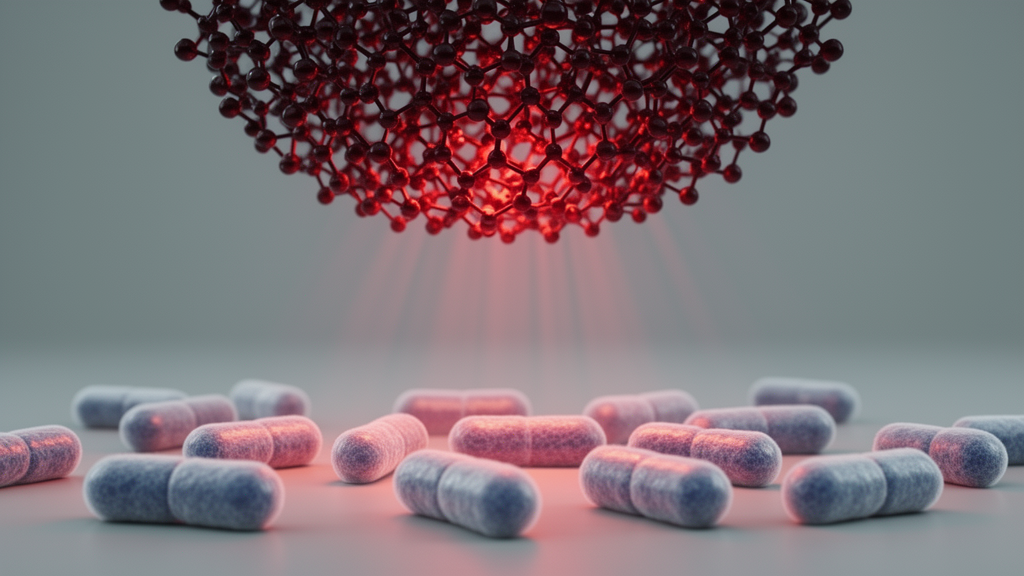
Antibiotic resistance has become one of the most pressing threats to global health, quietly eroding the effectiveness of the drugs that once made bacterial infections routine to treat. Conventional antibiotics work by attacking specific molecular targets, interfering with protein function, blocking cell wall synthesis, or disrupting metabolic pathways. Bacteria, however, evolve rapidly, and the mechanisms they deploy against these drugs—efflux pumps, inactivating enzymes, and target modification—are now widespread. A comprehensive review published in Advanced Science argues that a very different kind of weapon, built from one of nature’s most familiar molecules, could change the terms of that fight: porous materials constructed from porphyrins, the light-absorbing rings at the heart of hemoglobin and chlorophyll.
The appeal of porphyrins lies in their photophysics. These conjugated macrocycles, built around 18 π electrons, absorb light strongly across the ultraviolet and visible ranges and can act as photosensitizers. When illuminated, a photosensitizer is excited to a higher energy state and transfers either energy or electrons to nearby oxygen, generating reactive oxygen species such as singlet oxygen and superoxide anions. These reactive species attack bacterial membranes, proteins, and nucleic acids simultaneously. Because the damage is multi-site rather than targeted at a single molecule, the standard resistance strategies that defeat antibiotics are largely ineffective. Photothermal therapy offers a complementary route, using porphyrins to convert light into local heat that destroys cells, while sonodynamic therapy achieves similar chemistry using ultrasound instead of light, reaching tissues that light cannot penetrate.
Free porphyrin molecules, however, have a serious flaw: their flat aromatic rings stack together through strong π interactions, causing aggregation that quenches their photosensitizing ability and limits solubility. The solution, the review explains, is to lock porphyrins into porous frameworks where they are held apart, ordered, and functional. The authors classify these materials into four families defined by their bonding. Porphyrin-based metal–organic frameworks, or PMOFs, link porphyrin ligands such as TCPP to metal ions or clusters through coordination bonds, yielding crystalline networks with large surface areas and tunable pores. Porphyrin-based covalent organic frameworks, PCOFs, connect purely organic building blocks through reversible covalent bonds, typically imine or boronate linkages, producing robust, ordered channels. Hydrogen-bonded organic frameworks, PHOFs, assemble under mild conditions through weaker, reversible interactions, while amorphous porphyrin-based porous polymers, APPPs, sacrifice crystallinity for simplicity, scalability, and extremely high porphyrin loading.
Each family brings distinct advantages and trade-offs. PMOFs prevent photosensitizer aggregation, facilitate mass transport, and embed intrinsic metal functionality, but their stability depends heavily on the metal–ligand combination. Zirconium-based PMOFs are prized for their strong coordination and resistance to degradation, while copper and iron variants display peroxidase-like activity that converts hydrogen peroxide into toxic hydroxyl radicals. Silver-based frameworks release antibacterial silver ions and boost photocatalysis, scandium nodes suppress electron–hole recombination to raise reactive oxygen yields, and bismuth centers disrupt bacterial redox homeostasis by binding hydrogen sulfide. PCOFs offer high chemical stability and metal-free design, though their photodynamic performance is sensitive to linkage chemistry and stacking. PHOFs are the easiest to assemble but the most fragile in aqueous biological environments, and APPPs, despite their disordered pores, are cheap to make and easy to functionalize.
The sophistication of modern design strategies is striking. Metalation of the porphyrin cavity—inserting zinc, palladium, iron, manganese, or copper into the central ring—can steer the balance between the two photodynamic pathways, favoring either energy transfer to singlet oxygen or electron transfer to radical species. Composite construction goes further: core–shell architectures coat scintillator nanoparticles with porphyrin MOF shells for efficient energy transfer; template growth shapes membranes on cellulose; and metal nanoparticles are grown in situ on framework surfaces by chemical, photo-, or thermal reduction, so that silver or platinum particles work in concert with the porphyrin scaffold. Cascade catalytic systems combine multiple active sites so that one reaction feeds the next, for example converting wound hydrogen peroxide into oxygen, which then fuels photodynamic killing.
The clinical applications described in the review center on the hardest problems in infection medicine. Chronic and diabetic wounds, starved of oxygen and colonized by antibiotic-resistant biofilms, are a prime target. Researchers have shown that the topology of a zirconium porphyrin MOF—how its pores and active sites are arranged—directly determines singlet oxygen output, and that shrinking nanosheets to around 160 nanometers dramatically increases both reactive oxygen production and antibacterial power. One clever platform exploits bacterial iron hunger: a gallium–copper porphyrin MOF releases gallium, which mimics iron, while bacteria surrender their own iron to the porphyrin ring, collapsing their nutritional homeostasis in a strategy the authors call iron nutritional immunity therapy. Other systems pair photodynamic and photothermal killing with anti-inflammatory nanozymes that clean up reactive species once the bacteria are gone, promoting tissue repair.
Bone and oral infections demand deeper penetration, and here sonodynamic therapy dominates, since ultrasound can traverse five to ten centimeters of dense cortical bone. Defect-engineered MOFs with homojunction structures have treated methicillin-resistant Staphylococcus aureus osteomyelitis in animal models, preventing bone destruction without surgery. Piezoelectric heterostructures that generate internal electric fields under ultrasound, red-blood-cell-membrane-coated catalysts that neutralize toxins, and FDA-approved bone-targeting drugs grafted onto sonosensitizers that simultaneously inhibit osteoclasts all illustrate how far the field has moved beyond simple light-activated killing. In periodontitis, a zinc porphyrin MOF eradicated Porphyromonas gingivalis with up to 99.9 percent efficiency within five minutes of red-light exposure, then calmed inflammation after being taken up by macrophages.
Remarkably, the applications extend well beyond the clinic. Food preservation films embedding geraniol-loaded MOFs kept cherry tomatoes fresh for twelve days, while thymol-loaded nanofiber membranes protected grapes and strawberries from spoilage. Smart packaging films that release oregano essential oil for up to 140 hours and signal spoilage through pH-responsive fluorescence are already being prototyped. In agriculture, nanopesticides built from copper porphyrin layers encapsulate fungicides within metal–phenolic networks, improving leaf adhesion and bioavailability against plant pathogenic fungi, and magnesium-doped MOFs outperformed commercial fungicide formulations against rice sheath blight. Self-disinfecting textiles woven with porphyrin COFs retained over 80 percent antibacterial activity after sixteen washing cycles, and silver-modified face masks maintained more than 95 percent antiviral efficiency through repeated washing. Wastewater treatment membranes have achieved over 99 percent bacterial killing and simultaneous heavy-metal removal under sunlight, with recyclability across multiple cycles.
The review’s authors are candid about the obstacles that stand between laboratory success and widespread use. Most syntheses still rely on high-temperature, long-duration solvothermal methods that are hard to scale and produce particles prone to aggregation. Long-term toxicity, metabolic fate, and degradation pathways in living organisms remain insufficiently mapped, and the authors call for biocompatible metals such as zinc and calcium, hydrophilic polymer coatings, and physiologically degradable ligands to address these concerns. Antibacterial testing has focused overwhelmingly on two model bacteria, E. coli and S. aureus, while the real microbial world is far more diverse and increasingly resistant. Selectivity is another unsolved problem: current targeting groups improve bacterial affinity but do not truly distinguish pathogens from beneficial microbes. Mechanistic understanding is also limited by the difficulty of imaging reactions at the material–bacteria interface at pore scale.
Even so, the trajectory is unmistakable. By combining the light-harvesting power of porphyrins with the architectural control of modern porous materials, researchers have assembled a platform that can kill bacteria through multiple simultaneous mechanisms, evade the resistance machinery that defeats antibiotics, deliver drugs on demand, and even monitor its own environment. The authors point toward supramolecular assembly, computational design, and greener synthesis as the next frontiers. If those challenges are met, porphyrin-based porous materials could offer what the antibiotic era increasingly cannot: a way to treat the most stubborn infections without breeding new resistance in the process.
Subject of Research: Porphyrin-based porous materials for light-activated antibacterial therapy
Article Title: Porphyrin‐Based Porous Materials for Antibacterial Applications
Article References: Liang, X.-X., Li, X., Xiong, Y., Wang, X., & Yang, Y.-W. (2026). Porphyrin‐Based Porous Materials for Antibacterial Applications. Advanced Science, Article e78159. https://doi.org/10.1002/advs.78159
Image Credits: AI Generated
DOI: 10.1002/advs.78159
Keywords: porphyrin, antibacterial, antimicrobial resistance, metal-organic frameworks, covalent organic frameworks, photodynamic therapy, photothermal therapy, sonodynamic therapy, reactive oxygen species, wound healing, biofilm, wastewater treatment
Cite Scienmag News
Kristina Jarvis. (October 9, 2026). Porphyrin Frameworks Emerge as Light-Driven Weapons Against Drug-Resistant Bacteria. Scienmag. https://scienmag.com/porphyrin-frameworks-emerge-as-light-driven-weapons-against-drug-resistant-bacteria/
Kristina Jarvis. "Porphyrin Frameworks Emerge as Light-Driven Weapons Against Drug-Resistant Bacteria." Scienmag, 9 October 2026, https://scienmag.com/porphyrin-frameworks-emerge-as-light-driven-weapons-against-drug-resistant-bacteria/. Accessed 9 October 2026.
Kristina Jarvis. "Porphyrin Frameworks Emerge as Light-Driven Weapons Against Drug-Resistant Bacteria." Scienmag. October 9, 2026. https://scienmag.com/porphyrin-frameworks-emerge-as-light-driven-weapons-against-drug-resistant-bacteria/


