


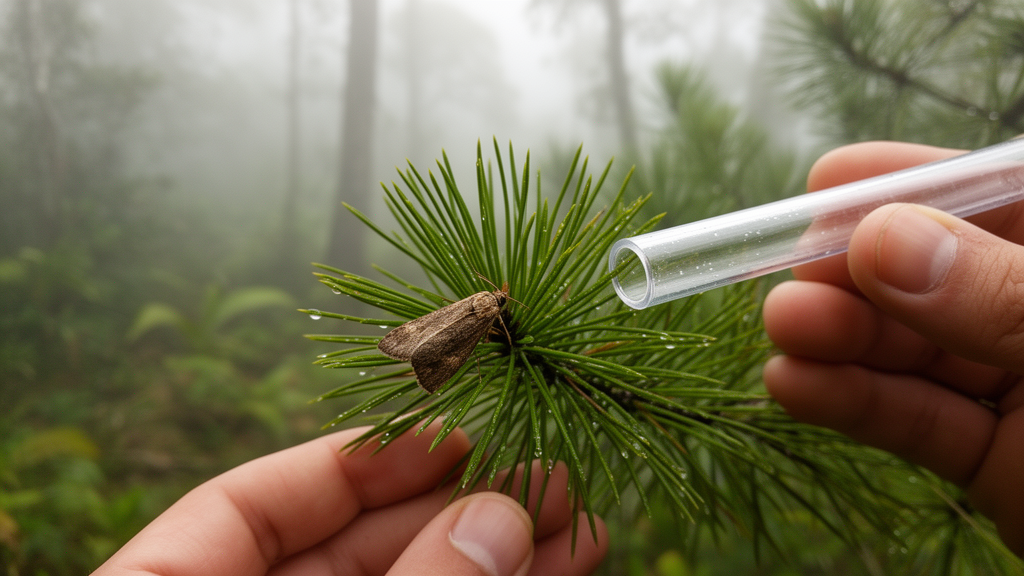
High in the misty pine forests of the Sierra de Bahoruco, on the Caribbean island of Hispaniola, lives a moth so elusive that for nearly two decades after its scientific discovery, only the males were known. Now, researchers have finally described the female and the early life stages of Hispaniodirphia lemaireiana, an endemic saturniid moth, revealing a remarkable life history that includes a surprising host plant and an unusual pupation strategy. The findings, published in Alpine Entomology, fill a major gap in our understanding of one of the Caribbean’s most distinctive silkmoths and shed new light on the ecology of montane ecosystems on the island.
The genus Hispaniodirphia holds a unique distinction: it is the only genus of silkmoths living on Hispaniola, belonging to the subfamily Hemileucinae within the Saturniidae family. Two species are known, both endemic to the island and easily distinguished by their wing patterns. Hispaniodirphia lemaireiana, described by Rougerie and Herbin in 2006, was known from mid-elevation forest habitats between 1300 and 2100 meters above sea level in the Sierra de Bahoruco National Park. Yet despite its presence in these forests, the female of the species and its earlier developmental stages remained entirely unknown to science until now.
The story of the discovery begins with a stroke of fieldwork luck. In August 2007, Jean Haxaire and Odile Paquit organized an eighteen-day entomological expedition to the Dominican Republic, focused on hawkmoths. On August 12, they climbed from Pedernales toward Los Arroyos along the Haitian border, leaving the dry coastal biotopes behind and ascending into the Sierra de Bahoruco, a mountain area wooded mainly with the endemic Hispaniolan pine, Pinus occidentalis. The route was not chosen by chance: in 1990, an expedition organized by the Carnegie Museum had collected a fine series of the species there, which was later described as new to science.
On the night of August 11 to 12, just beyond Los Arroyos at nearly 2000 meters elevation, the target species arrived at their lights almost without interruption from dusk until three in the morning, demonstrating a strong presence at the site. Since the dominant plant was the Hispaniolan pine, it seemed logical to assume this was the host plant. The following morning, in less than two hours, the team dug up about twenty pupae found quite easily at the foot of the trees, buried under less than ten centimeters of humus and pine needles. The pupae were entrusted to the care of Daniel Herbin, but unfortunately none survived to produce adult moths. The crucial insight, however, was that the team now knew how to obtain females, which did not seem to be attracted to ultraviolet lamps.
Building on this foundation, Jiri Hodecek and Jiri Pirkl conducted entomological expeditions to the Dominican Republic in July 2021, June 2023, and May 2024. The expeditions formed part of a larger biodiversity project covering selected families of Lepidoptera, Coleoptera, Heteroptera, parasitoid wasps, Diptera, Auchenorrhyncha, Dermaptera, and Zoraptera. Several adults of Hispaniodirphia lemaireiana were caught at light traps at two localities in Sierra de Bahoruco National Park at 1400 and 2000 meters elevation during all three expeditions. The breakthrough came in June 2023, when hundreds of caterpillars were observed across the forest at 1407 meters, feeding on the endemic pine, and dozens of pupae were collected from beneath the trees.
The caterpillars observed on the pines were all in their final instar, presumed to be the sixth, since hemileucine moths typically undergo six larval stages. The mature larva reaches approximately 60 millimeters in length and is robust, cylindrical, and heavily ornamented with short spines. Its ground color is deep black, densely dotted with small white pin-like spots distributed across the entire body. These spots cluster laterally and dorso-laterally to form two continuous white lines along the sides, while on abdominal segments two to four they often coalesce into a defined transverse white stripe, creating the impression of pale banding. Each segment bears six to eight short, branched scoli, black to dark reddish, tipped with tufts of orange or reddish-brown setae of varying lengths.
The overall appearance of the caterpillar is armored and cryptic, offering camouflage against pine bark and foliage. The head capsule is rounded and entirely black with sparse short setae, while the spiracles, thoracic legs, and prolegs are reddish to orange, providing a striking contrast with the otherwise dark body. The researchers suggest this heavy armoring and crypsis likely functions as an anti-predator adaptation against visually hunting birds, which are common in montane pine forests. Notably, the caterpillars do not appear to form groups; instead, they rest separately, aligned lengthwise on pine twigs or trunks during daylight hours, a behavior that may further reduce detection by predators.
Equally remarkable is the pupation strategy. Unlike other members of the Hemileucinae, whose pupae are often enclosed within silken cocoons, Hispaniodirphia lemaireiana pupates directly in the soil without any cocoon. Pupae were recovered at depths ranging from the surface to approximately ten centimeters underground, particularly in loose, aerated soil beneath pine litter. The male pupa measures 24.6 to 27.5 millimeters long and 10 to 10.6 millimeters wide, while the female pupa is larger at 28.1 to 29.6 millimeters long and 10 to 11.2 millimeters wide. The pupae are dark red with a smooth surface, marked by shallow wrinkles over the forewings and striations along the antennal shafts. This subterranean strategy may aid in desiccation avoidance and thermal buffering in the relatively dry, open pine forest habitat. No evidence of extended diapause was observed in captivity, suggesting a potentially continuous or seasonally flexible development cycle, though further field data are needed to confirm the species’ voltinism.
The successful emergence of the first adult female from these pupae, brought to Switzerland to complete development, finally allowed a formal description. The female’s forewing length ranges from 30 to 37.5 millimeters, and her coloration is strikingly variable, spanning orange, reddish, light brown, dark brown, and nearly black. The head and thorax are brown with reddish tones, and the thorax is densely covered dorsally with long, erect white hair, a distinctive feature absent in the female of the related species Hispaniodirphia plana. The antennae are filiform, slender, and yellowish, lacking the pectinations seen in males. White scales are scattered across the wing surface, though usually less densely than in males, and the discal spot is creamy white and elliptical, never yellowish as in H. plana, providing a reliable diagnostic character.
The host plant association documented in this study is the first ever reported for the genus Hispaniodirphia, and it carries significant evolutionary implications. Larvae were repeatedly documented feeding on Pinus occidentalis, a pine endemic to Hispaniola and dominant in its high-elevation open forests. This association suggests a potential evolutionary adaptation to coniferous habitats, which is rare among the Hemileucinae, most of which typically utilize broadleaf host plants, with only a few exceptions such as certain species in the genus Coloradia. Beyond morphology, these findings contribute essential ecological knowledge for future conservation considerations, particularly as habitat loss and climatic pressures intensify across Hispaniola’s highland ecosystems, making the protection of these montane pine forests and their unique inhabitants an increasingly urgent priority.
Subject of Research: First description of the female and immature stages of the endemic Hispaniolan saturniid moth Hispaniodirphia lemaireiana and its ecology
Article Title: Description of female and early stages of Hispaniodirphia lemaireiana ( Lepidoptera , Saturniidae ) with notes on its ecology
Article References: Description of female and early stages of Hispaniodirphia lemaireiana ( Lepidoptera , Saturniidae ) with notes on its ecology. (n.d.). https://doi.org/10.3897/alpento.10.190802
Image Credits: AI Generated
DOI: 10.3897/alpento.10.190802
Keywords: Hispaniodirphia lemaireiana, Saturniidae, Hemileucinae, Hispaniola, Sierra de Bahoruco, Pinus occidentalis, endemic species, larval morphology, pupation, montane forests, entomology, Caribbean biodiversity
Cite Scienmag News
Drew Townsend. (October 16, 2026). Hidden Life of Hispaniola’s Endemic Pine Moth Finally Revealed. Scienmag. https://scienmag.com/hidden-life-of-hispaniolas-endemic-pine-moth-finally-revealed/
Drew Townsend. "Hidden Life of Hispaniola’s Endemic Pine Moth Finally Revealed." Scienmag, 16 October 2026, https://scienmag.com/hidden-life-of-hispaniolas-endemic-pine-moth-finally-revealed/. Accessed 16 October 2026.
Drew Townsend. "Hidden Life of Hispaniola’s Endemic Pine Moth Finally Revealed." Scienmag. October 16, 2026. https://scienmag.com/hidden-life-of-hispaniolas-endemic-pine-moth-finally-revealed/


