


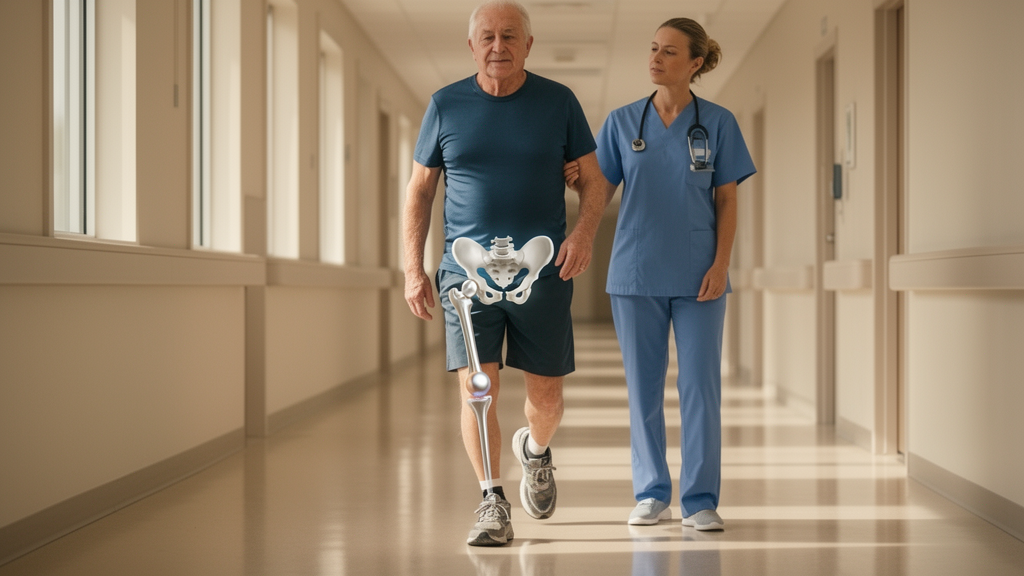
Six months after a total hip replacement, many patients walk with restored stride length, symmetric timing, and full joint range of motion. By every conventional orthopedic measure, they look recovered. Yet a new network analysis of whole-body movement, published in Frontiers in Network Physiology, shows that beneath this surface recovery the body’s coordination architecture remains visibly reorganized—and that one component of healthy movement may actually deteriorate further during the standard six-month recovery window rather than improve.
The study, led by Madhur Mangalam of the University of Nebraska at Omaha with colleagues at the University of Nebraska Medical Center, reanalyzed gait data from 80 healthy adults and 106 patients with unilateral hip osteoarthritis, assessed before and six months after total hip arthroplasty. The dataset originated from a pre-registered clinical trial conducted in Dijon, France, in which overground walking was recorded with eight optoelectronic cameras tracking 34 reflective markers placed across the body. Rather than examining isolated joint angles, the researchers treated the body as an interacting network, computing statistical dependencies between the displacement of every marker pair while mathematically removing the motion of the body’s center of mass.
The central innovation is a signed decomposition. Conventional movement-network analyses take the absolute value of coupling strengths, collapsing positive and negative relationships into a single number. That practice, the authors argue, obscures a mechanically critical distinction. Positive couplings link segments whose displacement amplitudes rise and fall together—covarying coordination, such as the shared rhythm of loading across the body. Negative couplings link segments whose amplitudes trade off: one displaces little while the other displaces a great deal, a signature the researchers call segmental differentiation. A healthy gait requires both modes, but a magnitude-only analysis sees only their sum.
When the signed decomposition was applied, hip osteoarthritis revealed itself as two pathologies in one. The covarying network lost its normal modular structure and small-world organization—the characteristic architecture in which segments cluster into specialized groups while remaining globally connected—while the trading-off network moved in the opposite direction, becoming more locally clustered and more small-world than in healthy walkers. Global efficiency fell in both networks. The authors interpret this pattern as consistent with pain-driven splinting: the body consolidates a few fixed trading-off configurations and rigid covarying motion to avoid displacements that provoke pain.
Surgery, it turns out, acts almost exclusively on one of these two layers. Six months after hip replacement, the covarying network had partially recovered: modularity roughly halved toward healthy values, characteristic path length dropped by about 45 percent, and local clustering measures moved back toward the healthy range. The trading-off network, by contrast, remained essentially stuck. Its local clustering, transitivity, and small-world organization showed no meaningful change between the pre-surgical and six-month assessments, and its global efficiency deficit remained statistically indistinguishable from the pre-surgical value.
The most striking single finding concerns the participation coefficient, a measure of how broadly each segment spreads its trading-off partners across different functional modules of the body. Before surgery, trading-off participation in patients was statistically indistinguishable from healthy adults. By six months after surgery, it had dropped significantly below healthy values—a deficit that emerged during recovery rather than being present beforehand. In other words, as patients recovered under standard post-surgical care, their trading-off relationships became concentrated among an increasingly narrow set of partners. This finding also resolves an apparent paradox in the team’s earlier magnitude-based analysis, in which participation had unexpectedly decreased after surgery: the signed decomposition shows that decrease was driven specifically by the trading-off network while the covarying network partially recovered.
Asymmetry analysis added further nuance. All four asymmetry measures were elevated before surgery on both networks and partially recovered by six months, with the trading-off network carrying the larger disruption in internal and overall asymmetry. Middle asymmetry—side-to-side imbalance in how the limbs couple to the trunk, pelvis, and head—was almost entirely a covarying phenomenon, consistent with the hypothesis that pain-driven splinting biases trunk and pelvis displacement toward the unaffected side. In patients with left-hip osteoarthritis, the researchers observed a previously unreported dissociation: within-limb trading-off densities deteriorated further during the recovery window even as the corresponding covarying densities recovered or even overshot healthy values, suggesting that post-surgical adaptation reinforces cohesive within-limb motion at the cost of segmental differentiation.
Amid these persistent structural deficits, one metric recovered completely. The researchers introduced a node-level sign-balance measure, capturing the proportion of each segment’s total coordination carried by covarying rather than trading-off relationships. Pre-surgical patients showed a small but significant downward shift, carrying proportionally more trading-off coordination per segment than healthy controls. By six months after surgery, sign balance had returned to values statistically indistinguishable from healthy adults—the only metric in the entire analysis to recover fully. Because it is a ratio, it can normalize even while the underlying magnitude and topology of both networks remain altered, making it a coarse-grained recovery indicator that conceals exactly what the separated network analyses reveal.
The clinical implication is a sharpened rehabilitation hypothesis rather than a prescription. Standard post-arthroplasty protocols emphasize strengthening, range of motion, and symmetric bilateral exercises—activities the authors note plausibly align with covarying coupling, the mode already recovering on its own. Comparatively little targets amplitude differentiation between segments. Exercises that explicitly train trunk–pelvis dissociation, split-stance work with contralateral reach, step-ups with opposite-arm drive, and reciprocal arm-swing retraining map naturally onto the observed deficits. Because the trading-off participation deficit emerged during the recovery window rather than before it, the authors suggest that timing may matter, though they caution that their observational design cannot establish whether standard care produces the consolidation or whether earlier intervention would prevent it.
The authors also stress the limits of their kinematic, model-free approach. The networks describe statistical dependencies among segment displacements, not neural drive or muscular coupling, so interpretations such as splinting and motor persistence remain hypotheses consistent with the data rather than demonstrated mechanisms. The six-month window cannot speak to longer-term trajectories, the healthy comparison group was on average younger than the patient cohort, and concurrent pathology outside the operated hip—contralateral degeneration, knee osteoarthritis, lumbar disease—may independently shape whole-body coordination, meaning persistent abnormalities should not necessarily be read as surgical failure. Still, the broader message stands: recovery from hip replacement is not one trajectory but two, and at the mid-recovery checkpoint the lagging one—segmental differentiation—is the mode most closely tied to fluid, unguarded gait. Whether targeted training can reverse its consolidation is now a testable question for future intervention trials.
Subject of Research: Network analysis of whole-body gait coordination before and after total hip arthroplasty for unilateral hip osteoarthritis
Article Title: Network analysis reveals that total hip arthroplasty restores shared segmental motion before segmental differentiation
Article References: Network analysis reveals that total hip arthroplasty restores shared segmental motion before segmental differentiation. (n.d.). https://doi.org/10.3389/fnetp.2026.1916345
Image Credits: AI Generated
DOI: 10.3389/fnetp.2026.1916345
Keywords: hip osteoarthritis, total hip arthroplasty, gait analysis, network physiology, segmental differentiation, covarying coordination, small-world networks, motor recovery, biomechanics, rehabilitation, signed networks, whole-body coordination
Cite Scienmag News
Ophelia Keating. (October 16, 2026). Hip Replacement Heals Shared Motion First, Leaving a Hidden Gait Signature Behind. Scienmag. https://scienmag.com/hip-replacement-heals-shared-motion-first-leaving-a-hidden-gait-signature-behind/
Ophelia Keating. "Hip Replacement Heals Shared Motion First, Leaving a Hidden Gait Signature Behind." Scienmag, 16 October 2026, https://scienmag.com/hip-replacement-heals-shared-motion-first-leaving-a-hidden-gait-signature-behind/. Accessed 16 October 2026.
Ophelia Keating. "Hip Replacement Heals Shared Motion First, Leaving a Hidden Gait Signature Behind." Scienmag. October 16, 2026. https://scienmag.com/hip-replacement-heals-shared-motion-first-leaving-a-hidden-gait-signature-behind/


