


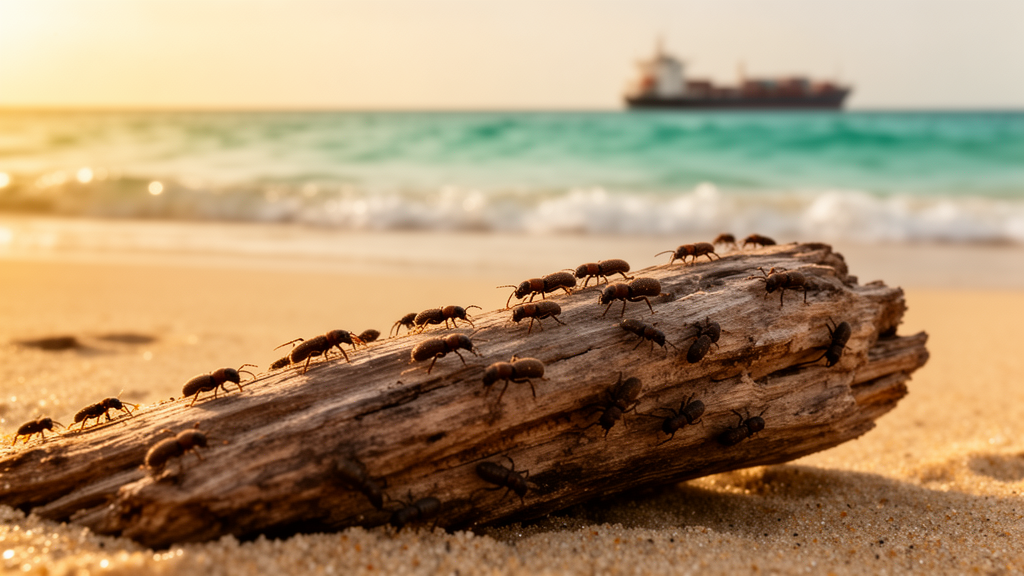
A group of minute bark beetles barely two millimetres long has rewritten part of the story of how life reached Madagascar and mainland Africa. A new taxonomic and biogeographic review of the Afrotropical members of the weevil genus Eidophelus, published in the Deutsche Entomologische Zeitschrift, combines DNA sequences, dissected anatomy and museum type specimens to trace the group’s journey across the Indian Ocean. The study describes a brand-new genus, Proternoporus, resolves a tangle of mislabelled species names, and points to a surprising conclusion: these beetles colonised Africa from the east, not from the African mainland as most insect studies suggest.
Eidophelus, long known under the junior name Scolytogenes, currently contains around 149 species worldwide, concentrated in the Indomalayan, Australasian and Afrotropical regions. The beetles are notoriously difficult to tell apart. Many species look almost identical, with so-called pseudocryptic complexes and substantial variation within single populations. Earlier molecular work had hinted that the relatively low Afrotropical diversity might reflect a recent arrival from further east, but the role of Madagascar in that scenario remained entirely unknown. The new study set out to answer two questions: whether the Afrotropical species form a single evolutionary lineage, and how species on Madagascar relate to those on the African mainland.
To find out, the researcher assembled DNA sequences for 30 species, using four gene fragments: 690 base pairs of the mitochondrial COI gene, 561 base pairs of EF-1α, 435 base pairs of PABP1, and 775 aligned positions of nuclear 28S ribosomal DNA. Because many more Eidophelus species worldwide had only 28S data available, a second, much larger matrix was compiled from GenBank to test alternative scenarios for where the Afrotropical lineages came from. Phylogenetic trees were built in a Bayesian framework, and divergence times were estimated in BEAST using calibrations drawn from earlier phylogenetic studies of the entire bark beetle subfamily Scolytinae.
The combined-gene analysis produced a striking result. Nearly all Afrotropical Eidophelus species formed a single, well-supported clade, with maximal support for the terminal cluster. The only exception was Eidophelus aspericollis, which sat apart alongside the Palearctic species E. imitans, consistent with its status as a likely invasive species. Within the main clade, the Malagasy species E. communis branched off first, while African species were intermixed with the remaining Madagascan species in more terminal positions, a pattern that hints at repeated movement between the island and the mainland.
One specimen tentatively identified as Eidophelus refused to fit. Instead of grouping with the genus, it clustered near Ernoporus and Procryphalus, representing a separate lineage of the tribe Ernoporini on Madagascar. Detailed dissections of mouthparts, the proventriculus, male genitalia and hind wings confirmed that this beetle differed consistently from both Ernoporus and Eidophelus: its first labial palp segment is narrow, its labial ligula is not longer than the first palp segment, the apical plate of the proventriculus is smooth and larger than the posterior part with an open, granulated median suture, and the stigmal patch of the hind wing bears three erect setae rather than two. This lineage is now described as the new genus Proternoporus, containing the new species Proternoporus dimorphus from Montagne d’Ambre in northern Madagascar and Proternoporus devius, moved from its previous genus, from South Africa. The name dimorphus refers to the pronounced differences between the sexes: males carry six large teeth along the front edge of the pronotum, females only four small ones, and males also bear long feather-like setae on the tips of their front legs.
The taxonomic clean-up was equally significant. Three sets of names were sunk as synonyms: Eidophelus grobleri absorbs Cryphalomorphus apicalis, E. spirostachius absorbs Cryphalophilus afer, and E. usagaricus absorbs both Cryphalomorphus hobohmi and C. robustus, because differences among the type specimens fall within the variation seen within single local populations. Conversely, E. similaris, previously treated as a synonym of E. onyanganus, was resurrected as a valid species. DNA from three populations of E. similaris in Cameroon, Uganda and Tanzania showed deep divergence approaching species level, yet no consistent morphological differences could be found, so a single variable species is inferred. E. onyanganus, by contrast, is genetically distinct, larger, and restricted so far to the high altitudes of Mount Cameroon. With these changes, 26 species of Ernoporini are currently recognised as valid in the Afrotropical region, and the paper provides an illustrated identification key with photographs of all of them.
The biogeographic results are where the story takes its most unexpected turn. Ancestral areas were reconstructed in RASP using a Bayesian Binary Method on time trees produced in BEAST. The larger 28S data set pointed to an Australasian origin for the main clade of Afrotropical Eidophelus, while the smaller four-gene analysis suggested an Indomalayan origin. Either way, the direction is from the east. The analyses strongly indicated that the African mainland was colonised twice via Madagascar and nearby Indian Ocean islands. There is a large gap between the stem age of the Madagascar-colonising clade, around 44 million years ago, and its crown age of about 21 million years, but compared with the oldest Eidophelus lineages, dated at 73 to 60 million years, the establishment on Madagascar and in Africa is relatively recent, falling in the early Miocene. That timing rules out any connection to the breakup of Gondwana and instead points to overseas dispersal.
Wind patterns may hold the key. Today, strong trade winds blow over Madagascar in a westerly direction, and this has been the dominant pattern since the mid-Miocene. Before that, Madagascar sat further south, below 30 degrees latitude, and most likely experienced fairly constant easterly winds. Those older winds would have favoured colonisation of Madagascar from Africa, while the more recent westerly regime favours movement from Madagascar and the Oriental region towards Africa. The late arrival of Eidophelus in Africa from Madagascar fits this window precisely, making the genus one of the best-documented examples so far of an eastern origin for Afrotropical bark beetles, in a literature otherwise dominated by dispersal from Africa to the island.
Why would this particular genus succeed at crossing open ocean when so many others fail? The study points to an unusual trait: Eidophelus is disproportionately represented on small Pacific islands with otherwise impoverished faunas dominated by permanent inbreeders. Inbreeding bark beetles disperse as already-inseminated females, so a single female can start a population. Ordinary outbreeding beetles must find a mate after arriving, a serious obstacle for tiny founding populations that also face inbreeding depression. Some Eidophelus appear to cope with these reproductive challenges better than most normally outbreeding bark beetles, giving them a genuine edge as long-distance colonisers. Their broad resource use likely helps too. The documented host records span many plant genera across numerous families, from lianas and leaf petioles to substantial tree trunks, and broods observed in the study ranged from a handful of eggs to as many as 80 to 100 larvae in a large Capurodendron log for the new Proternoporus dimorphus.
The morphological side of the study carries a cautionary message for beetle taxonomy. Species of Eidophelus differ so subtly, and vary so much individually, that identification from external appearance alone is often unreliable; characters such as the arrangement and shape of setae and granules can differ even between siblings. Internal anatomy proved far more decisive for separating genera, and two characters show promise for defining subclades: the presence of spatulate setae on the rear of the pronotum and dense, scale-like ground vestiture on the elytra. The strongly supported Afrotropical clade lacking both features anchors the classification used in the new key. Testing these ideas further will require DNA from additional Afrotropical species, particularly those with scale-like vestiture that may represent yet another, possibly older, colonisation of the continent. For now, the tiny beetles of Madagascar have delivered a rare thing in biogeography: a clear, well-documented case of the current flowing the other way.
Subject of Research: Biogeography and taxonomy of Afrotropical Eidophelus bark beetles
Article Title: From Asia to Africa via Madagascar – a biogeographic and taxonomic review of Afrotropical Eidophelus beetles with discovery of a related new genus in Ernoporini ( Curculionidae , Scolytinae )
Article References: From Asia to Africa via Madagascar – a biogeographic and taxonomic review of Afrotropical Eidophelus beetles with discovery of a related new genus in Ernoporini ( Curculionidae , Scolytinae ). (n.d.). https://doi.org/10.3897/dez.73.193625
Image Credits: AI Generated
Keywords: bark beetles, Eidophelus, Curculionidae, Scolytinae, Madagascar, biogeography, new genus, taxonomy, Ernoporini, phylogenetics, Indian Ocean dispersal, weevils
Cite Scienmag News
Violet Maxwell. (October 16, 2026). Tiny bark beetles reveal an unexpected ocean route from Asia to Africa. Scienmag. https://scienmag.com/tiny-bark-beetles-reveal-an-unexpected-ocean-route-from-asia-to-africa/
Violet Maxwell. "Tiny bark beetles reveal an unexpected ocean route from Asia to Africa." Scienmag, 16 October 2026, https://scienmag.com/tiny-bark-beetles-reveal-an-unexpected-ocean-route-from-asia-to-africa/. Accessed 16 October 2026.
Violet Maxwell. "Tiny bark beetles reveal an unexpected ocean route from Asia to Africa." Scienmag. October 16, 2026. https://scienmag.com/tiny-bark-beetles-reveal-an-unexpected-ocean-route-from-asia-to-africa/


