


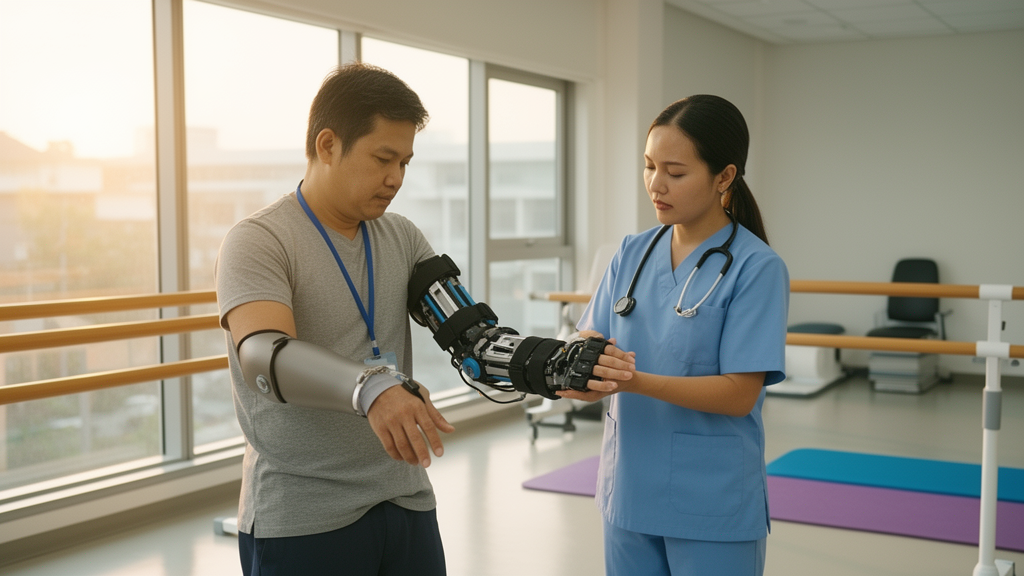
Stroke has quietly become one of Indonesia’s most burdensome health crises, striking more than 640,000 people each year and leaving nearly five million living with its aftermath. A new structured narrative review published in Frontiers in Rehabilitation Sciences examines whether robotic-assisted therapy (RAT), a technology already transforming rehabilitation in wealthy nations, could realistically take root in a developing healthcare system where cost, infrastructure, and workforce constraints collide. The answer, according to researchers led by Ezra B. Wijaya of Binawan University in Jakarta and colleagues at Hualien Tzu Chi Hospital in Taiwan, is a cautious but hopeful yes, provided adoption follows a carefully staged path.
The review synthesized findings from 22 systematic reviews and meta-analyses published between 2015 and 2025, drawing on databases including PubMed, Scopus, PEDro, and the Cochrane Library. Rather than attempting a formal quantitative meta-analysis, the authors chose a narrative synthesis because the underlying studies varied dramatically in device type, treatment intensity, patient characteristics, and outcome measures. Their goal was not simply to ask whether robots work, but whether they could work in Indonesia, a country where geographic decentralization, regional economic inequality, and uneven hospital capacity create vastly different conditions for technology adoption within a single nation.
The clinical evidence they assembled paints a picture of modest but meaningful benefit. Twelve of the included reviews reported statistically significant improvements favoring robotic-assisted therapy over conventional rehabilitation, particularly in gait performance and upper-limb function, with effect sizes ranging from 0.02 to 0.52. Patients using robotic gait trainers, body-weight-supported treadmill systems, and powered exoskeletons showed measurable gains in walking speed, balance as scored on the Berg Balance Scale, and endurance on the 6-Minute Walk Test. Upper-limb devices such as the Armeo and MIT-MANUS systems, which guide repetitive grasping and object manipulation, produced improvements in motor recovery and activities of daily living. Yet the picture was not uniformly positive. Two reviews found no significant advantage over standard physiotherapy, and several others reported mixed results depending on the specific outcome measured.
What makes robotic therapy clinically compelling is its ability to deliver the high-dose, task-specific, repetitive practice that modern neuroscience identifies as the engine of post-stroke recovery. When cerebral blood flow is interrupted by ischemia or vascular rupture, the brain’s capacity for neuroplastic reorganization, the rewiring of neural circuits that restores lost function, depends on intensive, repeated movement practice. Robotic systems excel at providing exactly this kind of training, assisting with gait initiation and limb advancement during overground walking or supporting precise upper-limb movements with real-time biofeedback. Among the studies reviewed, visual feedback appeared in 29 percent of interventions and kinematic feedback in 27 percent, with smaller proportions using proprioceptive, haptic, auditory, or electromyographic signals to guide patients toward correct movement patterns.
The timing of intervention matters enormously. Most studies in the review focused on subacute stroke populations, those in the weeks to months following onset when neuroplasticity is at its peak, followed by chronic-phase patients. Only a small number addressed acute rehabilitation. The authors note that robotic therapy appears most clinically relevant during the subacute phase, when recovery is strongly driven by repeated task practice, and that improvements in specific impairments such as muscle strength and spasticity appear less consistent than broader functional gains. This suggests that robotic therapy is not a universal solution but a tool whose value depends on matching the right device to the right patient at the right stage of recovery.
Translating these clinical benefits into economic reality for Indonesia required a different kind of analysis. The researchers built a scenario-based economic model comparing the incremental cost of robotic rehabilitation against its incremental benefit, expressed as QALY-equivalent outcomes (QEOs). Because no direct utility measures such as EQ-5D were available in the included studies, they used a ratio-based value-transfer approach that scaled published reference values according to observed functional effects, a methodological compromise the authors explicitly flag as exploratory rather than definitive. The resulting incremental cost-effectiveness ratios ranged from US$236.23 to US$752.31 per QEO for upper-limb rehabilitation and from US$558.86 to US$4,890 per QEO for gait-related outcomes.
Most of these estimates fell below Indonesia’s willingness-to-pay threshold of less than US$5,030 per QEO, derived from the country’s gross domestic product per capita, suggesting a favorable economic profile under the model’s assumptions. But the regional analysis revealed a stark divide. Provinces with higher gross regional domestic product per capita, including DKI Jakarta, Kalimantan Timur, and Kalimantan Utara, consistently met the threshold across most therapeutic scenarios. Lower-income provinces showed reduced affordability, particularly for gait-related rehabilitation, highlighting persistent disparities in access to advanced rehabilitation technologies even within a single national health system.
Beyond economics, the review catalogued a dense web of implementation barriers that clinical effectiveness alone cannot overcome. Robotic devices in Indonesia are predominantly imported and must navigate a complex regulatory landscape governed by the Ministry of Health, including medical device registration, conformity with international standards, local authorized representative requirements, and compliance with local content rules under the Ministry of Industry. Reimbursement presents another obstacle: Indonesia’s national health insurance system, BPJS Kesehatan, operates through a diagnosis-related group bundled payment system that does not specify coverage for robotic-assisted rehabilitation, creating uncertainty in cost recovery for hospitals that invest in the technology.
Workforce readiness emerged as perhaps the most fundamental challenge. Successful RAT implementation requires trained rehabilitation professionals, yet structured training opportunities in Indonesia remain limited, producing a persistent skills gap. The authors propose a phased workforce development strategy, beginning with pilot programs and short-term industry-linked training, then integrating robotic rehabilitation competencies into higher education curricula aligned with national qualification frameworks. Accreditation bodies, professional associations, and the Ministry of Health would all play roles in defining competencies, establishing clinical guidelines, and certifying practitioners. Without this human infrastructure, even the most sophisticated hardware would sit idle.
Cultural acceptance adds a final layer of complexity. Patients may initially perceive robotic rehabilitation as intimidating or unnecessary compared to familiar hands-on physiotherapy, while clinicians express concerns about workflow disruption, training requirements, and uncertain clinical value. Prior research identifies perceived usefulness, ease of use, social influence, and digital health literacy as strong predictors of adoption willingness, but no Indonesia-specific empirical study of RAT acceptance among stroke survivors or rehabilitation professionals was identified in this review, leaving a significant evidence gap. The authors conclude that a gradual implementation strategy, beginning with pilot programs in high-volume Class A tertiary hospitals in Jakarta and other well-resourced regions, followed by conditional expansion to selected Class B referral hospitals once clinical outcomes, safety, economic feasibility, and technology acceptance have been demonstrated, offers the most realistic path forward. Clinical effectiveness, they argue, is broadly generalizable, but its translation into routine practice depends entirely on context.
Subject of Research: Clinical effectiveness, economic feasibility, and implementation barriers of robotic-assisted therapy for stroke rehabilitation in Indonesia
Article Title: Implementing robotic-assisted therapy in stroke rehabilitation: a structured narrative review of evidence and technology adoption barriers in Indonesia
Article References: Wijaya, E. B., Thu, P.-W., & Chen, P.-C. (2026). Implementing robotic-assisted therapy in stroke rehabilitation: a structured narrative review of evidence and technology adoption barriers in Indonesia. Frontiers in Rehabilitation Sciences, 7, Article 1942904. https://doi.org/10.3389/fresc.2026.1942904
Image Credits: AI Generated
DOI: 10.3389/fresc.2026.1942904
Keywords: robotic-assisted therapy, stroke rehabilitation, Indonesia, cost-effectiveness, exoskeleton, biofeedback, neuroplasticity, health technology adoption, BPJS reimbursement, workforce training, gait training, upper-limb rehabilitation
Cite Scienmag News
Cassandra Pierce. (October 16, 2026). Robotic Therapy for Stroke Recovery Shows Promise but Faces Steep Barriers in Indonesia. Scienmag. https://scienmag.com/robotic-therapy-for-stroke-recovery-shows-promise-but-faces-steep-barriers-in-indonesia/
Cassandra Pierce. "Robotic Therapy for Stroke Recovery Shows Promise but Faces Steep Barriers in Indonesia." Scienmag, 16 October 2026, https://scienmag.com/robotic-therapy-for-stroke-recovery-shows-promise-but-faces-steep-barriers-in-indonesia/. Accessed 16 October 2026.
Cassandra Pierce. "Robotic Therapy for Stroke Recovery Shows Promise but Faces Steep Barriers in Indonesia." Scienmag. October 16, 2026. https://scienmag.com/robotic-therapy-for-stroke-recovery-shows-promise-but-faces-steep-barriers-in-indonesia/


