


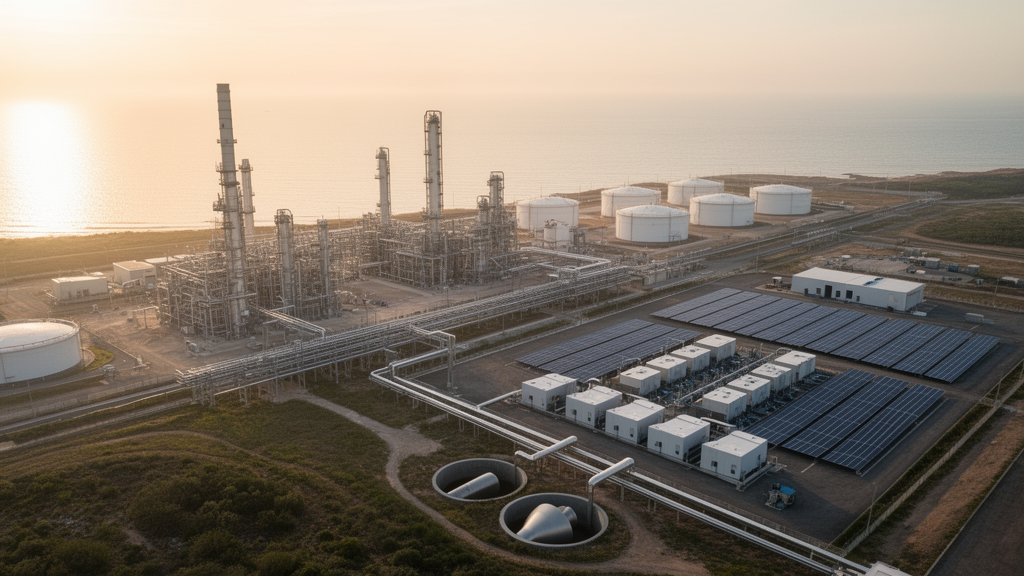
A petrochemical refinery in Vietnam emits roughly four million tons of carbon dioxide every year, and a new study says that with a staged combination of carbon capture, green hydrogen, electrification, and circular economy principles, up to 90 percent of those direct emissions could be eliminated by 2050. The research, published in Frontiers in Chemical Engineering, offers one of the first systematic decarbonization roadmaps for a major industrial emitter in an emerging economy, where data scarcity, infrastructure deficits, and policy uncertainty typically make climate planning far harder than in Europe or North America.
The study was conducted by chemical engineers at Ho Chi Minh City University of Technology and Vietnam National University Ho Chi Minh City, who developed a methodological framework designed to work under confined industrial data availability. Rather than requiring detailed plant-specific emission factors or continuous monitoring systems, the team applied a Tier 1 methodology based on the 2006 Guidelines of the Intergovernmental Panel on Climate Change (IPCC), which uses standard emission factors and net calorific values to estimate direct carbon dioxide from fuel combustion. The approach integrates four sequential elements: a Scope 1 greenhouse gas inventory, identification of emission hotspots, assessment and prioritization of low-carbon technologies, and a scenario-based transition analysis culminating in a long-term roadmap.
The demonstration case, referred to as Petrochemical Refinery Y, is a representative Vietnamese refinery and petrochemical complex processing around 200,000 barrels of crude oil per day, roughly ten million tons annually, at full design capacity. The researchers collected annual feedstock and fuel consumption data for six major process units for the 2025 operating year, covering fuel oil, fuel gas, and petroleum coke use. The assessment boundary was defined according to the Greenhouse Gas Protocol, focusing exclusively on Scope 1 emissions, the direct emissions from onsite combustion and process reactions, while excluding indirect Scope 2 and value-chain Scope 3 emissions that fall outside the refinery’s operational control.
The carbon accounting produced a strikingly concentrated emission profile. The residue fluid catalytic cracking (RFCC) unit, which burns coke deposited on catalyst to crack heavy hydrocarbons into lighter products, emerged as the largest single source, responsible for 1,026,315 tons of carbon dioxide per year, or 25.95 percent of the refinery’s total. Coke combustion alone contributed 65.3 percent of the RFCC’s emissions, reflecting the enormous energy demand of processing heavy Middle Eastern crude. The electricity and steam generation systems ranked second at 957,191 tons, or 24.20 percent, followed closely by the hydrogen generation unit at 827,810 tons, or 20.93 percent, where steam reforming of LPG produces the high-purity hydrogen needed for hydrotreating and reforming but releases carbon dioxide as an unavoidable by-product. Together, these three units account for more than 70 percent of the refinery’s direct emissions, meaning that targeting just three facilities offers the greatest leverage for refinery-wide abatement.
The remaining units, the crude distillation unit, the hydrotreating unit, and the continuous catalyst regeneration reformer, contributed 425,289, 399,095, and 318,959 tons of carbon dioxide respectively, mainly from burning fuel oil and refinery fuel gas. When normalized against throughput, the refinery’s emission intensity works out to approximately 54.17 kilograms of carbon dioxide per barrel of crude processed, which sits above the commonly reported average of 30 to 50 kilograms per barrel. The researchers attribute this partly to the complexity of the petrochemical configuration, noting that Vietnam’s Dung Quat Refinery, a simpler fuels-focused plant, emits around 33.72 kilograms per barrel. The similarity in emission structures between the two Vietnamese refineries, with RFCC and energy generation dominating in both cases, suggests the accounting method reliably reflects operational reality.
To translate the quantified emission profile into actionable strategy, the team evaluated feasible green solutions for each hotspot, drawing on international case studies from companies including Petrobras, Eni, BP, and ExxonMobil. For the RFCC unit, the options include co-processing biogenic feedstocks, such as fast pyrolysis bio-oil blended with vacuum gas oil at rates of 5 to 20 percent, which Petrobras demonstrated at pilot scale with reduced coke yield and slightly improved gasoline output. Switching supplementary fuel oil to natural gas, enabled by Vietnam’s expanding LNG infrastructure including the Thi Vai terminal, could cut combustion emissions by up to 30 percent. Advanced process control and heat integration offer cost-effective near-term gains; at Motiva in Texas, upgraded heat recovery cut energy use by 18 percent and emissions by 17 percent. For deeper abatement, amine-based post-combustion capture can be retrofitted onto the RFCC flue gas, a configuration proven at a Canadian refinery that reduced 85 percent of its RFCC emissions.
The electricity and steam generation unit, which supplies energy to the entire refinery, represents the most suitable entry point for renewable integration. Heat recovery steam generators could recover thermal energy from turbine exhaust, a measure European refineries have used to cut emissions by 10 to 15 percent, equivalent to roughly 144,000 to 191,000 tons of carbon dioxide per year at Refinery Y. Onsite solar and wind installations in the Nghi Son Economic Zone, where average solar irradiation reaches 4.2 to 4.8 kilowatt-hours per square meter per day and coastal wind speeds run 6.0 to 6.5 meters per second, could supply renewable electricity for pumps, compressors, and fans. For the hydrogen generation unit, the decisive long-term option is switching from gray hydrogen produced by steam methane reforming to green hydrogen generated by water electrolysis powered by renewables; replacing at least 30 percent of current production could reduce emissions by 25 to 35 percent, though green hydrogen currently costs two to three times more than its fossil-derived counterpart.
Based on this technology assessment, the researchers constructed a four-phase roadmap toward carbon neutrality by 2050. Phase 1, running from 2025 to 2030, deploys commercially mature measures including advanced process control, predictive maintenance, furnace optimization, heat integration, and hydrogen network optimization, achieving 8 to 15 percent cumulative reduction for an investment of 30 to 50 million dollars with payback of roughly two to three years. Phase 2, from 2030 to 2040, pivots from operational optimization to structural energy change through electrification of pumps, compressors, and heaters, renewable electricity supply, battery storage, and direct power purchase agreements, reaching 21 to 34 percent cumulative reduction for 150 to 250 million dollars. Phase 3, from 2035 to 2045, introduces bio-oil co-processing in the RFCC, pilot green hydrogen production with 10 to 20 megawatt electrolyzers, and pilot-scale carbon capture on the RFCC, adding 13 to 23 percent more reduction for 200 to 300 million dollars. Phase 4, from 2040 to 2050, completes the transition with full-scale carbon capture, utilization, and storage (CCUS) expansion to the RFCC and hydrogen units, industrial green hydrogen above 100 megawatts, direct air capture, and residual carbon offsets, delivering the final 80 to 90 percent cumulative reduction for 740 to 960 million dollars.
Scenario analysis indicates that cumulative emission reductions ranging from 80 percent under conservative assumptions to 90 percent under optimistic ones may be achievable, with the bounding scenarios derived by weighting each measure’s within-unit efficiency, supported by cited literature ranges, against that unit’s share of total baseline emissions. The residual gap to net zero is closed explicitly through direct air capture and carbon offsets rather than left implicit. The researchers also quantified the economic characteristics of each technology, revealing a steep gradient in abatement cost: advanced process control costs under 20 dollars per ton of carbon dioxide, heat integration runs 10 to 40 dollars, electrification 30 to 70 dollars, bio-feedstock co-processing 45 to 75 dollars, green hydrogen 100 to 250 dollars, full-scale CCUS 60 to 100 dollars, and direct air capture 300 to 600 dollars per ton. This cost hierarchy underpins the phased sequencing, ensuring cheap, mature measures come first while expensive, less mature technologies wait for cost declines and infrastructure development.
The study also confronts the practical constraints that will shape Vietnam’s industrial transition. CCUS deployment remains constrained by the absence of a commercial carbon dioxide transport and storage network, despite previous geological assessments indicating significant offshore storage potential in sedimentary basins such as the Cuu Long, Nam Con Son, Malay-Tho Chu, and Song Hong, with an estimated theoretical capacity of 11.8 gigatons. Detailed site characterization, monitoring protocols, and liability regulations remain undeveloped. Electrification and green hydrogen production will substantially increase refinery electricity demand, and while Vietnam’s Power Development Plan VIII targets rapid renewable expansion, stable renewable electricity availability remains uncertain in the short term due to transmission constraints and curtailment. Water availability poses another challenge: electrolyzers typically require 9 to 15 liters of high-purity water per kilogram of hydrogen produced, meaning commercial-scale green hydrogen would demand expanded purification capacity and improved recycling systems. Beyond Refinery Y, the framework is designed as a transparent, transferable basis for decarbonization planning in other refineries across Vietnam and in similar developing countries where site-specific data are restricted, bridging the gap between emission assessment and transition strategy while supporting national climate commitments, including Vietnam’s pledge at COP26 to reach net-zero emissions by 2050.
Subject of Research: A strategic decarbonization roadmap for a petrochemical refinery in Vietnam: integration of CCUS, green hydrogen, and the circular economy
Article Title: A strategic decarbonization roadmap for a petrochemical refinery in Vietnam: integration of CCUS, green hydrogen, and the circular economy
Article References: Ngo, T. H. T., Dam, H. N., & Dao, T. T. K. (2026). A strategic decarbonization roadmap for a petrochemical refinery in Vietnam: integration of CCUS, green hydrogen, and the circular economy. Frontiers in Chemical Engineering, 8, Article 1870346. https://doi.org/10.3389/fceng.2026.1870346
Image Credits: AI Generated
DOI: 10.3389/fceng.2026.1870346
Keywords: strategic, decarbonization, roadmap, petrochemical, refinery, Vietnam, integration, CCUS, green, hydrogen, circular, economy
Cite Scienmag News
Sloane Callahan. (October 16, 2026). Vietnam refinery maps 2050 net-zero path with CCUS and green hydrogen. Scienmag. https://scienmag.com/vietnam-refinery-maps-2050-net-zero-path-with-ccus-and-green-hydrogen/
Sloane Callahan. "Vietnam refinery maps 2050 net-zero path with CCUS and green hydrogen." Scienmag, 16 October 2026, https://scienmag.com/vietnam-refinery-maps-2050-net-zero-path-with-ccus-and-green-hydrogen/. Accessed 16 October 2026.
Sloane Callahan. "Vietnam refinery maps 2050 net-zero path with CCUS and green hydrogen." Scienmag. October 16, 2026. https://scienmag.com/vietnam-refinery-maps-2050-net-zero-path-with-ccus-and-green-hydrogen/


