


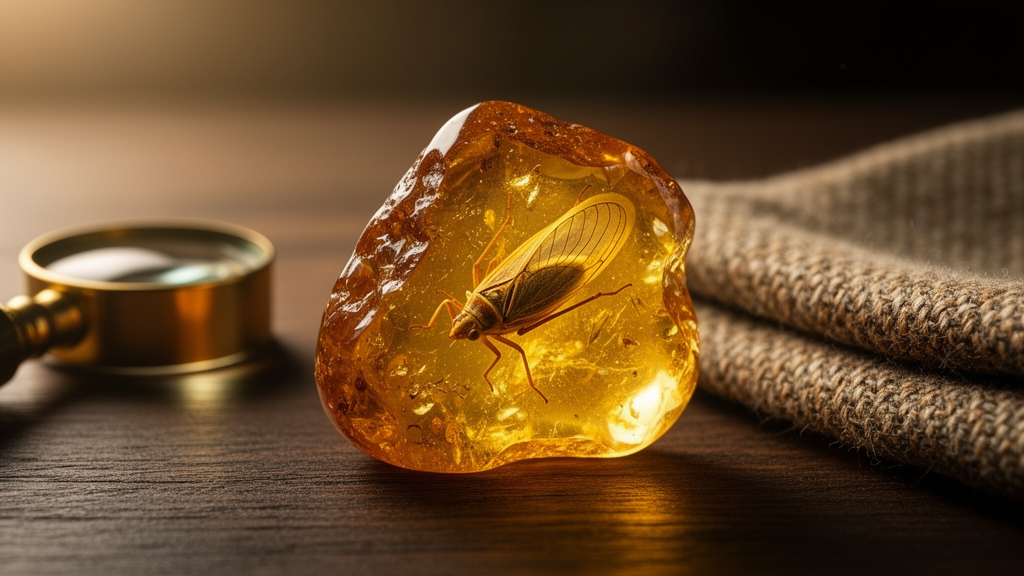
A tiny grasshopper-like insect sealed in honey-yellow amber roughly 49 to 44 million years ago has turned out to be the first member of its entire suborder ever found in Baltic amber, and it is shaking up what scientists thought they knew about monkey hoppers. The specimen, a well-preserved male described as Baltoparalethus alessioboninoi gen. et sp. nov., belongs to the superfamily Eumastacoidea, a group of orthopterans commonly known as monkey hoppers for their lively, jerky movements. The discovery, published in the Journal of Orthoptera Research, extends the known age of the family Episactidae back by about 25 million years and offers a rare window into the deep-time geography of a lineage that today survives only in scattered tropical refuges.
Monkey hoppers are anything but obscure among living insects. The superfamily Eumastacoidea includes more than 1,000 described species and occurs on every continent except Europe and Antarctica. Yet despite this modern abundance, their fossil record is remarkably thin. The oldest known occurrence, Archaeomastax jurassicus from the Karabastau Formation of Kazakhstan, dates to roughly 161.5 to 149 million years ago and is known only from fore- and hindwings. Four Cretaceous species are known, including two from Myanmar amber, and about 11 species have been described from the Paleocene and Eocene, many of them represented solely by isolated wing remains or body fragments that reveal little about the animals’ overall appearance.
That is what makes the new Baltic amber specimen so extraordinary. Amber is prized by paleoentomologists because it entombs insects in astonishing three-dimensional detail, preserving structures that would be crushed or lost in conventional rock fossils. Baltic amber, formed from the resin of vast Eocene forests and concentrated in the glauconite-rich Blue Earth horizon of the Sambian Peninsula, is one of the world’s most famous deposits, with an estimated total mass of around 100,000 tonnes. Until now, 21 species of Orthoptera had been described from Baltic amber, spanning pygmy grasshoppers, crickets, camel crickets, weta-like stenopelmatoids and katydids, but not a single member of the Acridomorpha, the lineage that contains true grasshoppers and their relatives, had ever appeared.
The newly described fossil was collected on the Baltic Sea coast at Yantarny, formerly Palmnicken, on the Sambia Peninsula in Russia’s Kaliningrad Region, and acquired in 2025 by the Back to the Past Museum in Cancún, Mexico. The honey-yellow piece measures just 27 by 25 by 9 millimetres and has been polished to give a clear view of its occupant. Alongside the grasshopper, the amber contains stellate hairs, beetles and flies, a snapshot of the Eocene forest floor. The left side of the insect is partially obscured by verlumung, a white coating of microscopic air bubbles that formed during decomposition, but the right side and dorsal surfaces are clean enough for detailed study.
Imaging the specimen demanded serious technical effort. Researchers mounted the amber in a borosilicate Petri dish immersed in 99.5 percent vegetable glycerol, whose refractive index closely matches that of amber, minimising optical distortion from the curved surface. Photographs were taken with a Sony a7R II mirrorless camera fitted with 114 and 208 millimetre tube lenses, using a reversed Schneider Componon 50 millimetre lens for full-body views and a Mitutoyo QV 2.5x microscope objective for details. The rig, mounted on a vertical motorised rail, captured 70 to 80 frames per view at step sizes of 90 and 15 micrometres, which were then stacked and retouched with Helicon Focus software. Because of the specimen’s size, two separate image stacks were assembled into a mosaic covering the whole animal.
The result is an almost perfectly preserved male, about 8 millimetres long from the front of the head to the tip of the cerci, with a suite of diagnostic features clearly visible. The antennae consist of 11 flagellomeres, the distalmost bearing the antennal organ. Prominent lateral carinae run along the fastigium and frons of the head, fusing at their transition and forming a supraclypeal trapezium at the base of the frons. The hind legs are built for leaping, with a slender metafemur 4.6 millimetres long and a metatibia armed dorsally with 19 spines of variable size. All tarsi are three-segmented, and between the claws of each foot sits a large round arolium, an adhesive pad characteristic of the group. Crucially, the animal is entirely wingless, or apterous.
The wingless condition, together with a non-membranous male subgenital plate, a well-developed median ocellus, a triangular supra-anal plate and a tapering terminal antenna segment, led the authors to tentatively assign the specimen to the family Episactidae and the subfamily Episactinae. The tentativeness is deliberate. The most important diagnostic character for classifying monkey hoppers, the structure of the male internal genitalia, is generally unavailable in fossils, so all fossil Eumastacoidea must for now be placed within extant subfamilies only provisionally. The genus name Baltoparalethus nods to both its Baltic origin and its resemblance to the living Episactinae genus Paralethus, while the species honours Alessio Bonino, son of the study’s senior author.
Only two other fossil monkey hopper genera share the wingless condition: Paleomastacris from Miocene Dominican amber, roughly 25 to 30 million years younger, and Burmeumastax from mid-Cretaceous Myanmar amber. Baltoparalethus differs from Paleomastacris in having more antennal flagellomeres, 11 versus 8, and in having a subgenital plate that is not divided into two equal triangular parts. The authors suggest these differences may capture a transitional state in the evolution of the family. Compared with Burmeumastax, the new genus lacks the apical upward fold of the subgenital plate seen in the Myanmar insect and shows a simpler, single-plated abdominal structure. One open question remains: the holotype might actually be a nymph, since no wing pads are visible and the genital morphology of fossil monkey hoppers at different developmental stages is poorly understood.
The biogeographic implications may be the most striking part. Living Episactidae have a puzzlingly patchy distribution: members of the subfamily Episactinae occur in Central America and parts of China, while two other subfamilies are confined to Madagascar and Hispaniola, and Teicophryinae occur in southern Mexico as far north as Baja California. Because all Episactidae are wingless and thus poor long-distance dispersers, this fragmented pattern has long hinted at a once much wider range. Finding Baltoparalethus in eastern Europe, a region where Eumastacoidea are entirely absent today and far from any living Episactidae, confirms that suspicion. The family appears to have been a far more common component of Paleogene orthopteran communities than its modern remnant distribution suggests.
The discovery also reshapes the family’s evolutionary chronology. With Baltoparalethus in hand, Episactidae now has a possible oldest occurrence in the Eocene, predating the previous oldest record by about 25 million years. If current placements of fossil monkey hoppers hold, four of the seven extant families of Eumastacoidea were already present before the end-Cretaceous extinction. Yet much remains murky. Molecular phylogenies have produced conflicting results: one study frequently recovered Chorotypidae as the most basal lineage, consistent with its Jurassic fossil record, while broader orthopteran analyses have variously placed Episactidae at the base of one clade or nested deeply within the group, close to the stick-grasshopper family Proscopiidae. Two families, Morabidae and Euschmidtiidae, still have no described fossils at all, which is surprising for the latter given that its 239 living species make up about 22 percent of all monkey hopper diversity. The tiny amber-bound hopper from Yantarny thus does more than add a name to a catalogue; it shows how a single exquisitely preserved fossil can complement molecular data, extend a family’s timeline by tens of millions of years, and remind researchers how much of the monkey hoppers’ story is still waiting in the resin of ancient forests.
Subject of Research: A fossil monkey hopper from Eocene Baltic amber extending the known record of Episactidae
Article Title: The first monkey hopper ( Orthoptera , Eumastacoidea ) from Eocene Baltic amber
Article References: Schall, O.-K. O., Husemann, M., & Bonino, E. (2026). The first monkey hopper (Orthoptera, Eumastacoidea) from Eocene Baltic amber. Journal of Orthoptera Research, 35(2), 267-276. https://doi.org/10.3897/jor.35.188742
Image Credits: AI Generated
Keywords: Baltic amber, Eumastacoidea, monkey hoppers, Episactidae, Orthoptera, Eocene, paleontology, fossil insects, Baltoparalethus alessioboninoi, amber inclusions, biogeography, evolution
Cite Scienmag News
Gavin Prescott. (October 16, 2026). Monkey Hopper Trapped in Baltic Amber Rewrites the Insect’s Family History. Scienmag. https://scienmag.com/monkey-hopper-trapped-in-baltic-amber-rewrites-the-insects-family-history/
Gavin Prescott. "Monkey Hopper Trapped in Baltic Amber Rewrites the Insect’s Family History." Scienmag, 16 October 2026, https://scienmag.com/monkey-hopper-trapped-in-baltic-amber-rewrites-the-insects-family-history/. Accessed 16 October 2026.
Gavin Prescott. "Monkey Hopper Trapped in Baltic Amber Rewrites the Insect’s Family History." Scienmag. October 16, 2026. https://scienmag.com/monkey-hopper-trapped-in-baltic-amber-rewrites-the-insects-family-history/


