


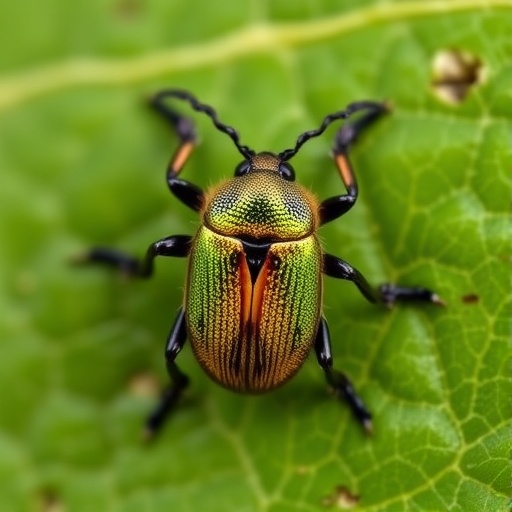
In a groundbreaking exploration of the intricate interactions between insect herbivores, their gut microbiota, and host plants, researchers have unveiled a novel mechanism driving oviposition behavior in beetles. Published in Nature Communications in 2026, the study led by Li, C., Sun, Z., Zhang, Y., and colleagues delves into how gut bacteria influence mature leaf oviposition preferences through a sophisticated plant-mediated feedback loop, reshaping our understanding of insect-plant ecology and offering promising avenues for pest management.
Oviposition, the process by which female insects select sites to lay eggs, is a critical determinant of progeny survival, influencing population dynamics and ecosystem health. Traditionally, oviposition choices were attributed primarily to the insect’s sensory cues and environmental factors. However, recent advances increasingly highlight the role of symbiotic microorganisms, particularly gut bacteria, in modulating insect behavior and physiology. This study marks a significant step in elucidating how these microbes manipulate plant-insect communication channels to shape oviposition preferences.
The researchers focused on a model system involving a phytophagous beetle species renowned for its selective oviposition on mature leaves of specific host plants. By integrating microbiological, molecular, and ecological techniques, the team systematically dissected the contributions of gut bacterial communities to oviposition site selection. Their experiments established that beetle gut bacteria do not merely coexist passively but actively prime the insects’ preferences, steering them towards mature leaves suitable for offspring development.
Central to this phenomenon is a complex plant-mediated feedback mechanism. Gut bacteria influence insect physiology to alter feeding behavior, which in turn modulates plant biochemical responses. When beetles harboring their native gut microbiota feed on leaves, they trigger plant defense pathways, leading to the production of specific secondary metabolites and volatile organic compounds that further reinforce beetle oviposition preference. This cyclical interaction amplifies the attraction of beetles to mature leaves, creating a feedback loop that enhances reproductive success.
Molecular analysis revealed that gut bacterial metabolites act as signaling molecules that recalibrate the beetle’s chemosensory system. These shifts increase the sensitivity of olfactory and gustatory receptors to leaf-derived cues associated with maturity and health, highlighting a microbiome-dependent sensory plasticity in insect herbivores. Intriguingly, antibiotic treatment that disrupted the gut microbiota diminished this preference, underscoring the functional importance of these symbionts.
In exploring plant responses, transcriptomic profiling revealed upregulation of genes involved in secondary metabolite biosynthesis and defense signaling in leaves exposed to beetle feeding. Notably, these plant responses differ depending on whether the beetle’s gut microbiota remains intact, indicating the presence of microbial effectors in feeding saliva or frass that modulate plant perception. Plants appear to “recognize” the biochemical signatures associated with gut bacteria, leading to adaptive shifts in their metabolic output.
The ecological significance of this gut bacteria-plant-insect axis extends beyond the immediate host, influencing community-level interactions. By biasing oviposition towards mature leaves, beetles optimize larval performance, which in turn affects herbivory patterns and plant fitness. Moreover, this interaction may have cascading effects on predators and parasitoids that exploit beetle larvae, hinting at a multilayered web of interactions driven partly by microbial mediation.
From an applied perspective, this discovery opens innovative strategies for pest control. Manipulating gut microbiota or disrupting microbiome-induced plant signaling pathways could alter pest oviposition behaviors, reducing damage to crop plants without relying on conventional pesticides. Such sustainable approaches align with the increasing demand for ecologically sound agricultural practices and integrated pest management programs.
The study also raises compelling questions about the coevolution of insects, their symbiotic microorganisms, and host plants. The evolution of gut bacteria capable of modulating insect behavior and plant responses likely represents a finely tuned mutualism, benefiting all partners through enhanced survival and reproduction. Future research may uncover similar interactions across a broader range of herbivorous insects and plant species, potentially redefining paradigms in chemical ecology and symbiosis.
Technological advancements played a pivotal role in unraveling these mechanisms. High-throughput sequencing, metabolomics, and behavioral assays enabled comprehensive characterization of microbial communities, plant metabolites, and insect responses at unprecedented resolution. The integration of these datasets allowed researchers to construct a holistic narrative that bridges molecular biology, sensory ecology, and ecosystem science.
The implications of gut microbial influence extend notably to insect sensory neurobiology. The study suggests that bacterial metabolites can fine-tune neuronal pathways that govern species-specific behaviors, potentially providing a model for understanding microbiota-brain interactions beyond entomology. This interkingdom signaling invites broader investigation into microbiome roles in animal behavior and adaptation.
Moreover, the dynamic interplay between beetles, their gut bacteria, and plants exemplifies nature’s complexity, emphasizing that ecological phenomena cannot be fully comprehended without considering microbial symbionts. As microbial research expands, ecological models must increasingly incorporate microbiota as active players shaping environment-organism interactions.
In conclusion, Li and colleagues’ meticulous work has illuminated a sophisticated mechanism by which gut bacteria prime and reinforce oviposition preferences in beetles through plant-mediated feedback. This discovery not only advances fundamental knowledge in insect-plant-microbe interactions but also holds practical promise for sustainable agriculture and pest management. As we continue to unravel microbiome functions, such interkingdom dialogues may redefine biological control and ecological resilience in a rapidly changing world.
Cite Scienmag News
Morgan Morrow. (May 26, 2026). Gut Bacteria Shape Beetle Leaf-Laying Choices. Scienmag. https://scienmag.com/gut-bacteria-shape-beetle-leaf-laying-choices/
Morgan Morrow. "Gut Bacteria Shape Beetle Leaf-Laying Choices." Scienmag, 26 May 2026, https://scienmag.com/gut-bacteria-shape-beetle-leaf-laying-choices/. Accessed 4 September 2026.
Morgan Morrow. "Gut Bacteria Shape Beetle Leaf-Laying Choices." Scienmag. May 26, 2026. https://scienmag.com/gut-bacteria-shape-beetle-leaf-laying-choices/


