


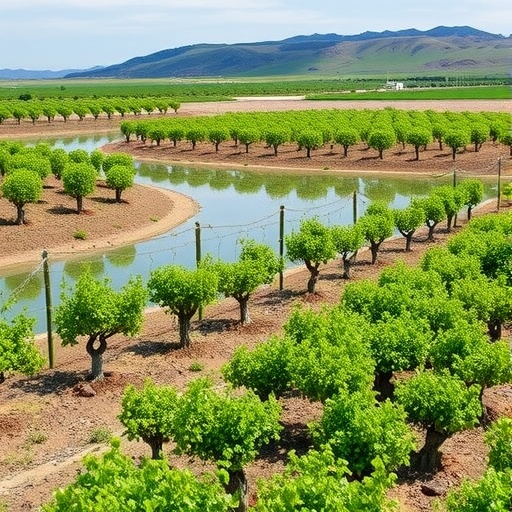
In the sun-drenched Mediterranean region, where agriculture has thrived for millennia, a quiet but profound transformation is underway that could reshape the landscape of food production and water resources management. A recent study published in Communications Earth & Environment unveils how the rapid expansion of greenhouse agriculture is altering water use patterns in Mediterranean catchments, highlighting the complex challenges at the intersection of food security and water sustainability in this climate-sensitive area.
The innovation of greenhouse farming has long been celebrated for its ability to enhance crop yields and extend growing seasons, enabling farmers in water-scarce regions to produce food more efficiently. However, the study led by la Cecilia et al. reveals an unintended consequence: the intensive water demand driven by expanding greenhouse infrastructures is significantly impacting local aquifers and surface water bodies, threatening the delicate hydrological balance of Mediterranean catchments. Such dynamics are not merely an environmental issue but are deeply intertwined with regional socio-economic stability and future viability of agricultural practices in the area.
Mediterranean catchments, defined by their semi-arid climate, episodic rainfall, and highly seasonal water availability, are particularly vulnerable to alterations in land use and water management. The paper emphasizes that the proliferation of greenhouses—often equipped with advanced climate control systems—necessitates consistent and sometimes excessive irrigation. This dependency on augmented water input contrasts starkly with the traditional open-field cultivation, which relies more heavily on the natural precipitation regime. Consequently, the transformation from open fields to greenhouse complexes translates to a fundamental shift in water consumption patterns that has yet to be fully quantified or integrated into regional water policies.
A central finding from the research is the spatial heterogeneity of water use change induced by greenhouse expansion. Some Mediterranean catchments, where greenhouses occupy substantial parts of the landscape, have experienced sharp increases in groundwater extraction. Over time, this has led to declining water tables and increased risk of aquifer depletion, phenomena that have cascading effects on both ecosystems and agricultural sustainability. Such water shortage can provoke conflict among competing users, including urban centers, traditional farmers, and environmental stakeholders, making the balancing act between food production and water availability increasingly precarious.
The study employs high-resolution hydrological models coupled with detailed land use data to simulate current and future water demand scenarios linked to greenhouse development. These models incorporate climate projections, enabling a nuanced understanding of how changing temperature and precipitation patterns might exacerbate water stress. The integration of such multidisciplinary tools marks a critical advancement in addressing the localized impacts of agricultural intensification within broader climate variability contexts.
Notably, the paper explores irrigation water sources and their sustainability under current extraction regimes. In many Mediterranean catchments, groundwater remains the dominant supply, sourced through wells that tap into often limited aquifers. As greenhouse farming intensifies, the pressure on these subterranean reserves escalates. The authors point out that this trend is unsustainable in the longer term, demanding urgent redesign of water governance frameworks to ensure equitable allocation without compromising resource resilience.
The implications for food security are profound. Mediterranean countries rely heavily on agriculture not only for domestic consumption but also for export revenues. Greenhouses, by enhancing crop quality and extending availability, contribute positively to these economic goals. However, the hidden water costs associated with these systems pose a threat to the very foundation of agricultural productivity. If water resources continue to dwindle, farmers may face increasing restrictions or costs, thereby undermining the food supply chain they currently support.
The researchers advocate for a holistic approach that reconciles food production with water conservation. This means adopting water-saving irrigation technologies, implementing integrated catchment management plans, and promoting crops with lower water footprints suitable for greenhouse cultivation. Furthermore, the study stresses the importance of policy measures that incentivize sustainable water use, including pricing reforms, regulation of groundwater withdrawal, and investment in water recycling systems within agricultural enterprises.
A particularly compelling dimension of the investigation involves the socio-political context. Water conflicts in Mediterranean nations are not uncommon, often reflecting broader issues of governance, equity, and rural livelihoods. The intensification of greenhouse agriculture, if unregulated, could exacerbate these tensions. Recognizing this, the authors call for participatory governance models that involve local communities, farmers, scientists, and policymakers to negotiate water allocation and land use decisions collaboratively.
Climate change compounds these challenges by introducing additional uncertainty into water availability. Rising temperatures increase evapotranspiration rates, thereby elevating crop water demand, while shifting precipitation patterns may disrupt the timing and quantity of surface water flows. In such a scenario, dependence on groundwater—which is slower to replenish—means that current water use increases will be even more impactful. The research underlines the urgent need to integrate climate adaptation into agricultural planning, especially in vulnerable Mediterranean catchments.
The study also delves into technological innovations within greenhouse agriculture that could mitigate water demand. Precision irrigation systems, sensor networks for soil moisture monitoring, and closed-loop water recycling are among the emerging solutions that can optimize water use efficiency. Yet, adoption of these technologies requires capital investment and technical expertise, which may be challenging for smaller producers. Hence, policy frameworks that lower entry barriers and provide incentives could accelerate the transition toward sustainable greenhouse water management.
In conclusion, the expansion of greenhouses in Mediterranean catchments is a double-edged sword: it holds promise for enhancing food production but simultaneously threatens critical water resources fundamental to regional resilience. The findings by la Cecilia et al. serve as a clarion call to regional authorities, agricultural stakeholders, and environmental advocates to act decisively. Without coordinated efforts to balance water use with food demands, the impressive gains in agricultural productivity risk being undermined by the degradation of the very resource they depend on.
The Mediterranean basin, as a hotspot for climate vulnerabilities and biodiversity, encapsulates the broader global dilemma of how to sustain intensifying agricultural production amid growing water scarcity. This research exemplifies the necessity of multidisciplinary approaches and anticipatory governance to safeguard both food and water security. As Mediterranean livelihoods and cultures are tightly woven with their natural environments, failures to heed these warnings could have far-reaching consequences beyond the fields and aquifers.
Ultimately, this study highlights the urgency of innovative, integrated strategies that marry agricultural advancement with water stewardship. It calls for a paradigm shift in how we perceive water use in modern agriculture—no longer as an unlimited input but as a precious, shared resource requiring deliberate, science-based management to ensure enduring prosperity in a warming world.
Cite Scienmag News
Violet Maxwell. (April 17, 2026). Greenhouse Growth Impacts Water, Food Security in Mediterranean. Scienmag. https://scienmag.com/greenhouse-growth-impacts-water-food-security-in-mediterranean/
Violet Maxwell. "Greenhouse Growth Impacts Water, Food Security in Mediterranean." Scienmag, 17 April 2026, https://scienmag.com/greenhouse-growth-impacts-water-food-security-in-mediterranean/. Accessed 4 September 2026.
Violet Maxwell. "Greenhouse Growth Impacts Water, Food Security in Mediterranean." Scienmag. April 17, 2026. https://scienmag.com/greenhouse-growth-impacts-water-food-security-in-mediterranean/


