


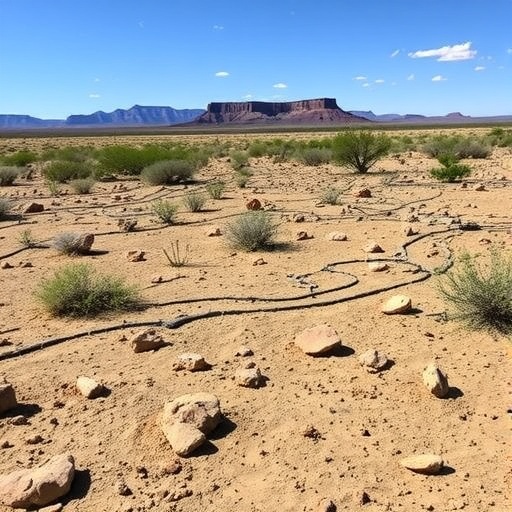
In the vast expanses of Earth’s arid landscapes lies a fragile and vital ecosystem component known as biological soil crusts, or biocrusts. These intricate, thin microbial layers composed predominantly of cyanobacteria, lichens, mosses, and algae perform indispensable roles in stabilizing soils, facilitating nutrient cycling, and influencing hydrological dynamics. Emerging research led by Estelle Couradeau, a pioneering soil scientist at Penn State, is set to unravel the complex interactions between biocrust microbiomes and increasingly erratic temperature fluctuations driven by climate change. Hers is a groundbreaking investigation underpinned by a $1.6 million award granted by the U.S. National Science Foundation’s Faculty Early Career Development (CAREER) program, marking a significant stride towards understanding the resilience and adaptability of these critical soil communities.
Biocrusts have long been recognized as the “living skin” of arid ecosystems—delicate biological constructs that safeguard dryland soils from erosion while contributing to soil fertility through nitrogen fixation and organic carbon accumulation. Despite their ecological significance, biocrusts face escalating threats from global climate anomalies, particularly fluctuating temperature regimes. Unlike past climate studies that focused mainly on mean temperature increases, recent findings underscore that transient thermal extremes and variability may exert a stronger selective pressure on microbial diversity and function than steady warming. Couradeau’s research addresses this nuanced challenge by interrogating how biocrust microbes metabolically adjust or genetically adapt to these rapid temperature oscillations.
The urgency of this inquiry is accentuated by troubling environmental data: drylands, encompassing roughly 40% of Earth’s terrestrial surface, are undergoing widespread degradation, with approximately 70% of these soils losing their functional integrity. Desertification processes exact a heavy toll, transforming productive land into barren, eroding terrain at astonishing rates of up to 57 acres per minute globally. The implications of biocrust decline ripple beyond localized ecosystems, influencing atmospheric dust dynamics, global nitrogen and carbon cycles, and, ultimately, human health across vulnerable populations. It is projected that the coverage of these microbial soil communities will diminish by 25 to 40 percent in the next six decades, heightening the risk of cascading environmental instability.
Central to Couradeau’s project is an innovative mesocosm experimental framework designed to mimic real-world thermal fluctuation scenarios within controlled environments. By utilizing sealed mason jars to recreate temperature cycles that biocrusts encounter in situ, her team will meticulously monitor microbial responses using a suite of advanced methods: metagenomics to catalogue community shifts, metatranscriptomics to parse active gene expression, and enzyme assays to quantify functional activity. This integrative approach aims to identify the critical thresholds—the “tipping points”—beyond which biocrust microbial communities may lose resilience, signifying irreversible damage to their ecological functions.
To enhance the global applicability of the findings, the team will correlate their experimental data with analysis of an expansive, multinational biocrust dataset derived from the BIODESERT global survey initiative, led by the European Research Council. This dataset encompasses biocrust samples from diverse latitudinal and climatic gradients, thereby providing an unparalleled opportunity to discern universal patterns versus region-specific microbial adaptations to thermal stress. Such comparative analyses will elucidate whether laboratory-identified tipping points manifest in natural ecosystems and inform predictive models for future climate scenarios.
A particularly novel and technically sophisticated aspect of the research involves the deployment of microfluidic “SoilChips,” developed in collaboration with Edith Hammer from Lund University. These devices create transparent, microscale observation chambers that faithfully replicate soil micro-environments, permitting continuous live imaging of microbial behavior under varying temperature regimes. This cutting-edge technology allows the team to directly observe the metabolic trade-offs undertaken by the keystone cyanobacterium Microcoleus, a primary biocrust engineer that coordinates soil cohesion and nutrient input. Insights into Microcoleus’s physiological adaptability will provide mechanistic understanding at the cellular level, revealing how thermal stress modulates microbial function and survival.
Beyond fundamental research, Couradeau’s project embodies a strong educational and translational vision. Partnering with educational experts at Penn State and high schools across arid regions of the western United States, the team will integrate SoilChip technology into classroom curricula. This initiative empowers students to conduct their own experiments on microbial thermal tolerance, simultaneously cultivating scientific literacy and contributing valuable biocrust microbiome data via citizen science. By democratizing access to these novel tools and datasets, the program aims to foster the next generation of soil scientists equipped to address pressing environmental challenges.
In tandem with teaching innovations, the project will launch “Breaking Ground,” an online portrait gallery featuring biocrust researchers from around the world. This platform serves to spotlight diverse role models within the soil science community, raise awareness about the importance of microbial soil research, and inspire broader interest in this essential yet often overlooked field. By consolidating the research community’s presence, the gallery will enhance networking opportunities and promote career pathways for aspiring scientists focused on dryland sustainability.
The multidisciplinary and multinational collaboration supporting this research includes experts from Saudi Arabia’s KAUST, Northern Arizona University, University of Almeria in Spain, the U.S. Geological Survey, and other renowned institutions. Contributions from high school educators further extend the project’s reach, ensuring that this pivotal scientific endeavor remains anchored in both community engagement and rigorous scholarship. Collectively, this team embodies a comprehensive approach to tackling the complex nexus of climate variability, microbial ecology, and ecosystem resilience.
As these studies commence this August, the insights anticipated from Couradeau’s group hold the promise of fundamentally enhancing our understanding of biocrusts’ functional stability in the face of climate change. Such knowledge is urgently needed to inform restoration strategies for degraded drylands, optimize biocrust inoculant production for ecosystem rehabilitation, and devise land management policies tailored to preserving the delicate soil-microbe symbiosis. Ultimately, safeguarding these microscopic architects of ecosystem integrity will play a crucial role in maintaining terrestrial productivity and ecosystem services under an increasingly volatile global climate.
In summary, Estelle Couradeau’s ambitious research, supported by significant NSF funding, encapsulates a dynamic and innovative approach to revealing the hidden impacts of thermal fluctuations on biocrust microbiomes. By bridging controlled experiments, global data synthesis, cutting-edge imaging technologies, and educational outreach, this project represents a major advance in soil microbial ecology with far-reaching implications for dryland conservation and climate resilience. It highlights the critical need to understand and protect the “living skin” that sustains some of the world’s most vulnerable ecosystems.
News Publication Date: Not specified.
Web References:
– Estelle Couradeau’s Penn State profile: https://ecosystems.psu.edu/directory/efc5279
– BIODESERT global survey dataset: https://biodesert.maestrelab.com/
Cite Scienmag News
Violet Maxwell. (May 29, 2026). Soil Scientist Receives $1.6 Million NSF Grant to Investigate the ‘Living Skin’ of Arid Ecosystems. Scienmag. https://scienmag.com/soil-scientist-receives-1-6-million-nsf-grant-to-investigate-the-living-skin-of-arid-ecosystems/
Violet Maxwell. "Soil Scientist Receives $1.6 Million NSF Grant to Investigate the ‘Living Skin’ of Arid Ecosystems." Scienmag, 29 May 2026, https://scienmag.com/soil-scientist-receives-1-6-million-nsf-grant-to-investigate-the-living-skin-of-arid-ecosystems/. Accessed 4 September 2026.
Violet Maxwell. "Soil Scientist Receives $1.6 Million NSF Grant to Investigate the ‘Living Skin’ of Arid Ecosystems." Scienmag. May 29, 2026. https://scienmag.com/soil-scientist-receives-1-6-million-nsf-grant-to-investigate-the-living-skin-of-arid-ecosystems/


