


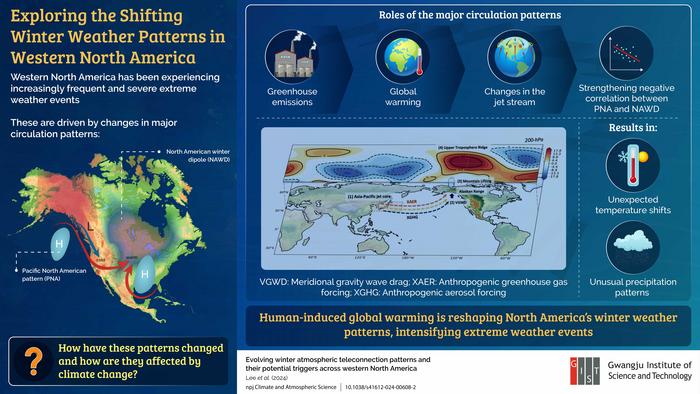
Western North America seems to be experiencing more extreme weather events more frequently. From scorching droughts to torrential floods, the climate is changing rapidly, with no signs of slowing down. From 2011 to 2015, California and neighboring states experienced extended periods of drought, while 2017 saw heavy rains trigger catastrophic floods.

Credit: Jin-Ho Yoon from GIST
Western North America seems to be experiencing more extreme weather events more frequently. From scorching droughts to torrential floods, the climate is changing rapidly, with no signs of slowing down. From 2011 to 2015, California and neighboring states experienced extended periods of drought, while 2017 saw heavy rains trigger catastrophic floods.
These events are linked to specific weather patterns. The atmosphere is like a network of interconnected pathways that determine how weather systems move and interact across the globe. In the Northern Hemisphere, there are three such major teleconnection patterns that affect winter conditions: the Pacific North American pattern (PNA), the North Atlantic Oscillation (NAO), and the North American winter dipole (NAWD). However, the understanding of how these patterns change over time and their connection to climate change remains limited.
To better understand this phenomenon, a group of scientists led by Professor of Earth Sciences and Environmental Engineering Jin-Ho Yoon and including Ph.D. student Jueun Lee from the Gwangju Institute of Science and Technology recently conducted a study to examine the reasons behind changes in these patterns. Their findings have been published in npj Climate and Atmospheric Science on 7 March 2024.
The scientists employed a sophisticated Community Earth System model that there is a regular influence of the NAWD for over 70 years (1951-2020), which is in contrast with the fluctuating influence from PNA and minor impacts from NAO. Furthermore, in recent years, there has been a strengthening negative correlation between the PNA and the NAWD: as one exhibits a positive phase, the other tends to exhibit a negative phase. “This projected intensification of large-scale atmospheric circulation in a warming climate is expected to likely escalate extreme hydroclimatic events in mid-latitude regions like California near western North America,” explains Dr. Yoon.
The weather system is like a network of dominos, where one piece can trigger a chain reaction and set off a series of unforeseen events. Using extensive models and numerical simulations, the scientists deduced that these changes in how the PNA and the NAWD interact can be traced back to variations in the jet stream, a band-like flow of air high up in the atmosphere. As the climate warms, the jet stream changes, influencing patterns such as the PNA and the NAWD.
The study notably shows that greenhouse gas emissions play a significant role in driving the shifts. “Climate models consider a range of factors affecting the atmosphere, including changes in greenhouse gas concentrations resulting from human activities. By running simulations with and without the influence of greenhouse gases, we can compare the results and see how they differ,” explains Dr. Yoon. The scientists observed an association between higher greenhouse gas levels and the variations in the jet stream: the gases drive the northward drift of the Asia-Pacific jet core. Aided by mountain-related lifting over the Alaskan Range, contributing to the formation of potent high-pressure systems in the vicinity. This phenomenon strengthens the winter stationary wave throughout western North America.
Simply put, the study shows that the rise in temperatures caused by greenhouse gases is changing how air moves in the atmosphere. This, in turn, affects the weather patterns that influence winter conditions in western North America and contribute to recent more frequent extreme weather events.
This research thus highlights the urgent need to address climate change.
***
Reference
About the Gwangju Institute of Science and Technology (GIST)
The Gwangju Institute of Science and Technology (GIST) is a research-oriented university situated in Gwangju, South Korea. Founded in 1993, GIST has become one of the most prestigious schools in South Korea. The university aims to create a strong research environment to spur advancements in science and technology and to promote collaboration between international and domestic research programs. With its motto of “A Proud Creator of Future Science and Technology,” GIST has consistently received one of the highest university rankings in Korea.
About the authors
Jin-Ho Yoon is a Professor of Earth Sciences and Environmental Engineering at GIST, Korea. He earned his Ph.D. in Atmospheric Sciences from Iowa State University in the United States in 2004. The research team led by Prof. Yoon at GIST is dedicated to deciphering and forecasting the patterns of weather and climate extremes amidst the ongoing global climate changes. His research extends to the study of interactions between aerosols, clouds, and precipitation, to deepen the understanding of cloud properties and distribution. Before coming to GIST, he was a scientist at the Pacific Northwest National Laboratory in the United States.
Jueun Lee is a Ph.D. student at GIST, Korea. He belongs to the Climate Analysis and Modeling (CAM) Laboratory. His research aims to understand the changes in climate variability and the behavior of the atmosphere to predict how our planet’s weather patterns change in the near future.
Journal
npj Climate and Atmospheric Science
Method of Research
Computational simulation/modeling
Subject of Research
Not applicable
Article Title
Evolving winter atmospheric teleconnection patterns and their potential triggers across western North America
Article Publication Date
7-Mar-2024
COI Statement
The authors declare no competing interests
Cite Scienmag News
Russell Cooper. (April 4, 2024). GIST researchers find the link between human activity and shifting weather patterns in western North America. Scienmag. https://scienmag.com/gist-researchers-find-the-link-between-human-activity-and-shifting-weather-patterns-in-western-north-america/
Russell Cooper. "GIST researchers find the link between human activity and shifting weather patterns in western North America." Scienmag, 4 April 2024, https://scienmag.com/gist-researchers-find-the-link-between-human-activity-and-shifting-weather-patterns-in-western-north-america/. Accessed 3 September 2026.
Russell Cooper. "GIST researchers find the link between human activity and shifting weather patterns in western North America." Scienmag. April 4, 2024. https://scienmag.com/gist-researchers-find-the-link-between-human-activity-and-shifting-weather-patterns-in-western-north-america/

