


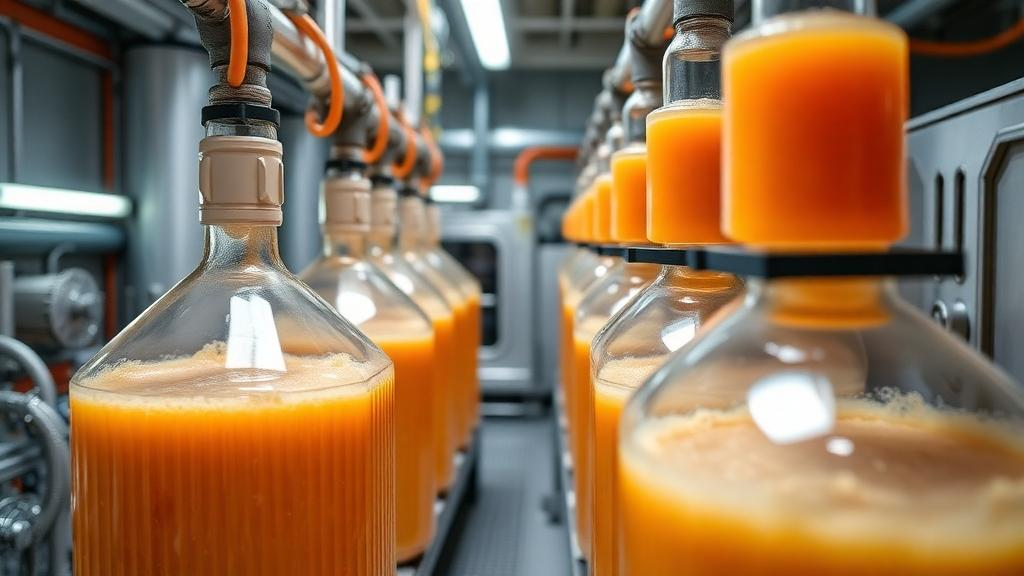
Carotenoids are everywhere in our lives, even if most of us never notice them. They are the pigments that make tomatoes red, carrots orange, and salmon pink, and they are also some of the most valuable molecules in the food, cosmetic, and pharmaceutical industries. A new review published in Blue Biotechnology by Neha Arora of Skidmore College and Prem Pritam of the Indian Institute of Technology Bombay maps out how scientists are turning ordinary yeast into microscopic pigment factories, using metabolomics to find the bottlenecks in cellular metabolism and CRISPR-Cas9 gene editing to remove them. The goal is ambitious: to make natural carotenoids like beta-carotene, lycopene, astaxanthin, and zeaxanthin cheaply and sustainably, without relying on petrochemical synthesis or land-hungry crop extraction.
The commercial stakes are enormous. The global carotenoid market was valued at 1.44 billion dollars in 2019 and is projected to reach 1.84 billion dollars by 2027, driven by demand for natural antioxidants, pro-vitamin A supplements, and clean-label colorants. Humans cannot synthesize carotenoids themselves, so they must come from diet or supplementation. Beta-carotene, with its two beta-ionone rings, carries full pro-vitamin A activity and supports vision, immune function, and reproduction. Astaxanthin, meanwhile, is a particularly fierce neutralizer of reactive oxygen species, outperforming lutein, lycopene, and beta-carotene in antioxidant assays. These health credentials explain why the pigments command premium prices in nutraceutical and skincare formulations.
Today, most carotenoids come from three routes: chemical synthesis, plant extraction, and microbial fermentation. Chemical synthesis relies on substrates such as acetone, butadiene, and methanol, generating hazardous waste and producing mixtures of stereoisomers, some of which are biologically inactive and face stricter regulatory scrutiny. Plant extraction suffers from low productivity, seasonal variability, and heavy demands on land and water. Fermentation, by contrast, offers year-round production, modest water and nutrient requirements, and the ability to grow microbes on cheap substrates such as lignocellulosic hydrolysates and waste biomass. Companies including DSM Nutritional Products, Cyanotech, AstaReal, Algatech, and Novozymes already use microbial fermentation to produce carotenoids at industrial scale, underscoring that the technology is not merely a laboratory curiosity.
Yeasts are especially attractive hosts because many strains are generally recognized as safe, they grow rapidly in bioreactors, and their genetics and metabolism are exceptionally well characterized. Some yeasts, such as Rhodotorula and Xanthophyllomyces species, naturally produce carotenoids, while workhorse organisms like Saccharomyces cerevisiae and Yarrowia lipolytica do not, but can be engineered to do so. The biosynthetic route runs through the mevalonate pathway: two molecules of acetyl-CoA are condensed to acetoacetyl-CoA, converted through HMG-CoA to mevalonate, and then processed into isopentenyl diphosphate and its isomer dimethylallyl pyrophosphate. These five-carbon building blocks are stitched together into farnesyl pyrophosphate and geranylgeranyl pyrophosphate, the immediate precursors of carotenoids. Phytoene synthase then catalyzes the first colored step, and a cascade of desaturases, cyclases, hydroxylases, and ketolases converts phytoene into lycopene, beta-carotene, zeaxanthin, and ultimately astaxanthin.
Engineering these pathways has produced striking results. Overexpressing the GGS1 gene in Yarrowia lipolytica using CRISPR-Cas9 integration raised beta-carotene titers from 17.1 to 40.4 milligrams per liter, and engineered strains have achieved beta-carotene contents of 4 percent of dry cell weight, several times the concentration found in carrots. Adding extra copies of the ERG13 gene, which encodes HMG-CoA synthase, boosted beta-carotene titers by 259 percent relative to wild type, while duplicating the erg10 gene increased production by 46.9 percent. Feeding hydrophobic substrates such as oleic acid or waste oil helps too, because beta-oxidation of fatty acids raises intracellular acetyl-CoA, the fundamental carbon skeleton from which all carotenoids are built.
Enzyme engineering adds another layer of control. Lycopene cyclase normally suffers from substrate inhibition, diverting flux away from beta-carotene, so researchers screened fifty variants of a bifunctional phytoene synthase/lycopene cyclase and identified a mutant, Y27R, that lost the inhibition entirely. That single change directed carotenoid flux completely toward beta-carotene, yielding an extraordinary 39.5 grams per liter in Yarrowia lipolytica. Directed evolution and adaptive laboratory evolution have also delivered: combining atmospheric and room temperature plasma mutagenesis with hydrogen peroxide-driven selection produced a Saccharomyces cerevisiae strain that reached 404.78 milligrams per liter of astaxanthin in a 5-liter fermenter, the highest reported titer in that organism.
Because carotenoids are hydrophobic molecules stored in lipid bodies, lipid engineering has become a powerful lever. Deleting the POX1 through POX6 beta-oxidation genes and the GUT2 glycerol-3-phosphate dehydrogenase gene in Yarrowia lipolytica enlarged intracellular lipid droplets, expanding storage capacity and pushing lycopene yields to 16 milligrams per gram of dry cell weight in fed-batch culture. Overexpressing lipid synthesis genes such as PAH1, DGA1, and a mutated ACC1 in S. cerevisiae raised both triacylglycerol and lycopene accumulation, confirming a direct correlation between fat storage and pigment yield. Even cell morphology matters: reverting filamentous Yarrowia growth back to yeast form by deleting the CLA4 and MHY1 genes increased beta-carotene production to 7.6 grams per liter, while expanding the endoplasmic reticulum through INO2 overexpression boosted terpene synthesis dramatically.
Yet even the best engineered strains hit ceilings, and this is where metabolomics enters the story. Metabolomic profiling, using techniques such as gas chromatography-mass spectrometry, HPLC-MS, and UPLC-MS/MS, measures the actual chemical state of a cell, capturing the end products of gene expression and regulation more faithfully than transcriptomic or proteomic data. In one study, comparative metabolomics of a recombinant beta-carotene-producing S. cerevisiae strain revealed significant depletion of amino acid, carbohydrate, and TCA cycle intermediates, showing that carotenoid synthesis drains core metabolism. Supplementing the culture with acetate during exponential growth restored intracellular pools and raised beta-carotene production by 39.3 percent. In Rhodosporidium toruloides, time-dependent metabolomics of three strains grown on glycerol showed that the best producer, CBS 5490, achieved 28.5 milligrams per liter by downregulating TCA cycle and amino acid metabolism, effectively redirecting energy and flux toward carotenoid and fatty acid synthesis.
Metabolomics has also illuminated how environmental conditions shape production. In Rhodosporidiobolus colostri, lowering the cultivation temperature to 16 degrees Celsius increased total carotenoids from 17.1 to 29.0 milligrams per liter, and integrated transcriptomic and metabolomic analysis suggested that reduced TCA cycle flux freed acetyl-CoA for beta-carotene and torulene biosynthesis. In engineered lycopene-producing Yarrowia lipolytica, metabolomic comparison with the wild type revealed that lycopene accumulation reshaped fructose and mannose metabolism, the citrate cycle, and glycerophospholipid metabolism, and pointed to shortages of glycerol backbone intermediates rather than fatty acids as the limiting factor for lipid storage. Such insights convert blind strain engineering into rational design, telling researchers precisely which genes to tune and which metabolites to replenish.
The review’s authors argue that cost remains the decisive barrier to commercialization. Expensive carbon sources like glucose inflate fermentation costs, so future work will focus on agricultural byproducts, lignocellulosic biomass, and industrial waste streams as feedstocks, alongside stress-tolerant strains that withstand high temperature, low pH, and high oxygen. Downstream innovations such as enzyme-based cell lysis, membrane extraction, and supercritical CO2 processing promise to cut solvent use and recovery costs. Engineering transporters to export carotenoids could eliminate the need for cell disruption altogether, and hybrid pathways combining the yeast mevalonate route with the bacterial MEP pathway could balance precursor supply and ATP demand. With life cycle assessments and regulatory frameworks still to be established, yeast-derived carotenoids stand at the threshold of replacing synthetic pigments, offering a vision of color and nutrition brewed sustainably in stainless steel tanks rather than extracted from fields or synthesized in chemical plants.
Subject of Research: Metabolomics-guided metabolic engineering of yeasts for cost-effective carotenoid biosynthesis
Article Title: Unlocking yeast’s palette: leveraging metabolomics and gene editing approaches for cost effective carotenoid production
Article References: Arora, N., & Pritam, P. (2025). Unlocking yeast’s palette: leveraging metabolomics and gene editing approaches for cost effective carotenoid production. Blue Biotechnology, 2(1), Article 5. https://doi.org/10.1186/s44315-025-00028-8
Image Credits: AI Generated
DOI: 10.1186/s44315-025-00028-8
Keywords: carotenoids, yeast, metabolomics, CRISPR-Cas9, metabolic engineering, synthetic biology, beta-carotene, astaxanthin, lycopene, Yarrowia lipolytica, Saccharomyces cerevisiae, fermentation
Cite Scienmag News
Juliet Wilcox. (October 2, 2026). Gene-edited yeast turns fermentation vats into carotenoid factories. Scienmag. https://scienmag.com/gene-edited-yeast-turns-fermentation-vats-into-carotenoid-factories/
Juliet Wilcox. "Gene-edited yeast turns fermentation vats into carotenoid factories." Scienmag, 2 October 2026, https://scienmag.com/gene-edited-yeast-turns-fermentation-vats-into-carotenoid-factories/. Accessed 4 October 2026.
Juliet Wilcox. "Gene-edited yeast turns fermentation vats into carotenoid factories." Scienmag. October 2, 2026. https://scienmag.com/gene-edited-yeast-turns-fermentation-vats-into-carotenoid-factories/


