


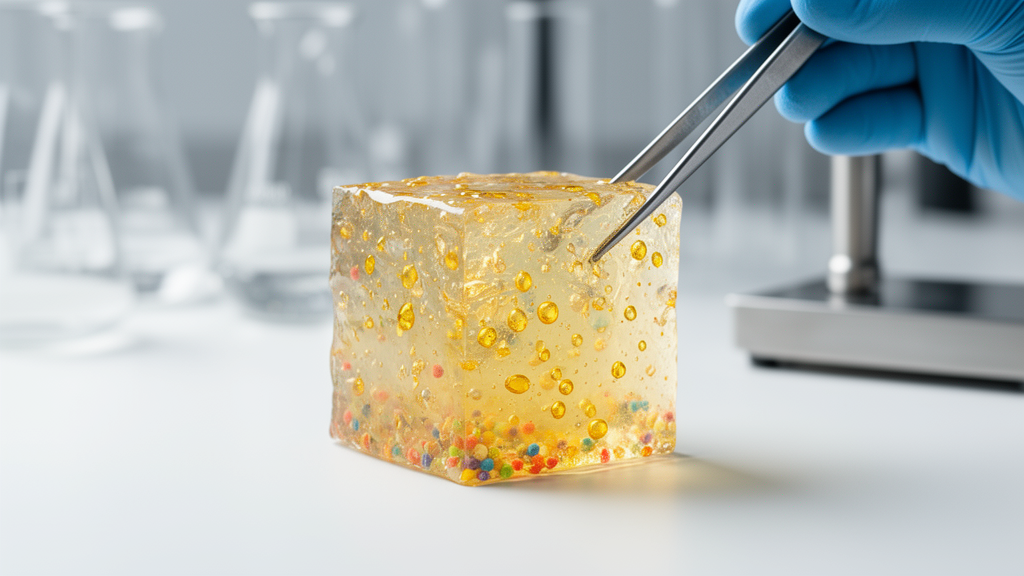
For decades, the food industry has faced an uncomfortable paradox: the very fats that give chocolate its snap, pastry its flakiness, and plant-based burgers their juicy succulence are the same saturated and trans fats that raise LDL cholesterol, drive inflammation, and increase the risk of heart disease, obesity, type 2 diabetes, and stroke. Hydrogenation and tropical oils like palm oil solved the texture problem brilliantly while creating a public health crisis. Now, a comprehensive review published in Frontiers in Soft Matter by Rakhi Pandey and Garima Mathur of Jaypee Institute of Information Technology in Noida, India, maps out how a new generation of soft matter materials—oleogels and hydrogels—could finally break that trade-off, structuring liquid oils and water into semi-solid foods that behave like fat but digest like something far healthier.
The principle behind these systems is deceptively simple. Instead of chemically altering oil molecules the way hydrogenation does, oleogelation physically entraps edible oils within three-dimensional networks built by tiny amounts of gelators—waxes, fatty acids, monoglycerides, or phytosterols. The unsaturated fatty acid profile of olive, flaxseed, or sunflower oil remains intact, yet the liquid gains solid-like characteristics. Hydrogels work the same trick with water, using hydrophilic polymer chains from alginate, pectin, carrageenan, gelatin, or whey protein to hold large quantities of aqueous phase without dissolving. The result is a semi-solid matrix whose architecture, not its chemistry, determines how it feels in the mouth and how it breaks down in the gut.
The review draws a sharp technical distinction between two classes of structuring agents. Low molecular weight gelators, typically under 2000 daltons, self-assemble through weak non-covalent forces—hydrogen bonds, van der Waals interactions, π–π stacking, and hydrophobic effects—into fibrils, ribbons, helices, or crystalline platelets that entangle into a network. Waxes form dense crystalline platelets, while mixtures of β-sitosterol and γ-oryzanol assemble into tubular fibrillar structures stabilized by hydrogen bonding. Polymeric gelators, by contrast, immobilize liquids through chain entanglement, electrostatic association, and physical or chemical cross-linking, producing continuous matrices with interconnected pores. Each approach has trade-offs: crystalline networks deliver efficient oil structuring at low concentrations but can suffer from polymorphism, temperature sensitivity, and oil leakage, while polymer networks offer superior mechanical strength and thermal stability at higher production cost and lower reversibility.
Crystallization-driven gelation is the most prevalent oleogel mechanism. The gelator dissolves in oil at elevated temperature, then cooling triggers nucleation: small crystalline domains grow as chain segments align, entangle through intervening segments, and cluster into a three-dimensional meshwork that immobilizes oil in its voids by capillary action. The final gel properties depend heavily on crystal morphology, polymorphism, cooling rate, and gelator concentration—small changes in any of these can swing the mechanical properties, oil content, and release behavior dramatically. For high molecular weight polymers that cannot dissolve in oil, indirect methods come into play: a hydrogel or emulsion template is first built and cross-linked chemically, enzymatically with transglutaminase, or by radiation, then the aqueous phase is removed or replaced so the polymer framework stays undisturbed while oil is physically entrapped.
Hydrogel formation follows its own cross-linking logic. Physical hydrogels rely on reversible non-covalent interactions—hydrogen bonding in carboxymethyl cellulose and polyvinyl alcohol, ionic bonding in the famous calcium alginate egg-box structure, and hydrophobic clustering in amphiphilic polymers. These gels are biocompatible and stimuli-responsive but mechanically weak, prone to swelling, syneresis, and premature degradation under manufacturing stress. Chemical hydrogels, built from permanent covalent cross-links formed by grafting agents, polymerization with bifunctional monomers, gamma or electron-beam radiation, or enzymatic catalysis, are far more durable and structurally stable, though residual cross-linkers raise toxicity and biocompatibility questions that regulators scrutinize closely.
Where the review turns genuinely viral is in its treatment of digestion. Structured gels do not just change texture; they change metabolism. In conventional emulsions, lipid droplets are rapidly exposed to pancreatic lipase, producing sudden peaks in blood triglycerides. Oleogels create what researchers call the cage effect: a densely packed crystalline lattice forms a steric barrier that restricts lipase access to the oil–water interface, while the viscous internal environment slows the diffusion of free fatty acids out of the matrix. The consequence is delayed lipolysis, blunted postprandial lipemia, prolonged satiety, and a steadier release of mixed micelles—the bile-salt assemblies that lipophilic nutrients like curcumin, vitamin D, and lycopene need to cross the intestinal mucus barrier. Slower, coordinated lipid digestion can roughly double the absorption of these fat-soluble compounds.
Hydrogels add a second layer of precision: stimuli-responsive delivery. Alginate and pectin networks stay contracted at gastric pH around 2, protecting probiotics, antioxidants, and enzymes from denaturation, then swell or dissolve as pH rises to 6.5–7.0 in the small intestine, releasing their cargo exactly where absorption occurs. Some polysaccharide hydrogels resist human digestive enzymes entirely and break down only through microbial fermentation in the colon, enabling prebiotic effects and targeted colon health. The experimental evidence is striking: alginate–chitosan hydrogels preserved probiotic viability above 70 percent through gastric conditions, while free probiotics fell below 20 percent. κ-Carrageenan hydrogel beads achieved 74.61 percent encapsulation efficiency with sustained, pH-responsive release of curcumin, and curcumin-loaded bigels maintained 97.55 percent curcumin stability with improved digestion performance.
Bigels—hybrid structures containing both an aqueous gel phase and an oil gel phase—represent the review’s vision of all-in-one precision delivery. Because the two phases can be engineered to release their contents on different kinetic schedules, a single bigel can deliver an initial burst of flavor or energy from its hydrogel component in the mouth or upper gut, followed hours later by prolonged release of functional lipids from its oleogel component in the ileum. Incompatible nutrients such as hydrophilic vitamin C and lipophilic vitamin D3 can be co-encapsulated in one matrix, with a prebiotic released in the upper gastrointestinal tract while an antioxidant deploys in the lower regions. Emulsion gels extend this logic further, supporting co-delivery of multiple solutes within soft colloidal structures built from natural polymer self-assembly, cross-linking, crystallization, and molecular template assembly.
The food applications read like a menu from the near future. Ethylcellulose and wax oleogels can replace butter or lard in cookies and cakes, cutting saturated fat content by up to 80 percent while preserving crispness, and stabilize liquid cocoa butter to prevent fat bloom and keep chocolate glossier and heat-resistant. In plant-based meats, carefully tuned ratios of oleogels for fat content and hydrogels for moisture produce white fat particles that do not instantly melt, recreating the succulence of beef and pork; oleogels can also replace pork back fat in sausages with unsaturated olive or flaxseed oil. Bigels from sunflower and canola oil yield margarines that spread straight from the fridge with minimal trans fats, while hydrogel–oleogel substitutes for casein improve melting in vegan cheeses. These gels are also ideal inks for 3D food printing: their shear-thinning rheology lets them flow under pressure but hold shape at rest, allowing printers to deposit precise nutrient doses into customized snacks, and hydrogel coatings sprayed on strawberries or avocados measurably extend shelf life.
Commercialization remains the hard part. Scaling up requires precise thermal control and consistent gelator sourcing, and natural gelators vary batch to batch in rheology, strength, and encapsulation efficiency. Consumer acceptance hinges on mouthfeel, taste, and flavor release, while novel formulations must pass GRAS evaluation in the United States and EFSA safety assessment in the European Union, covering toxicity, digestibility, allergens, and migration. The clean-label trend may restrict synthetically produced systems, and few studies have yet combined performance data with techno-economic assessment or converted in vitro digestion results into validated in vivo human outcomes. Still, the trajectory is clear: personalized nutrition, AI-based formulation, sustainable gels from agricultural waste, and hybrid bigel systems are converging on a future where food structure is designed molecule by molecule. Oleogels and hydrogels are no longer laboratory curiosities—they are the emerging soft matter platforms for the next generation of nutritional foods, where what holds your food together may also decide how well it feeds you.
Subject of Research: Soft matter food structuring and targeted nutrient delivery
Article Title: Advanced oleogel and hydrogel systems: emerging platforms for food structuring and targeted nutrient delivery
Article References: Pandey, R., & Mathur, G. (2026). Advanced oleogel and hydrogel systems: emerging platforms for food structuring and targeted nutrient delivery. Frontiers in Soft Matter, 6, Article 1867312. https://doi.org/10.3389/frsfm.2026.1867312
Image Credits: AI Generated
DOI: 10.3389/frsfm.2026.1867312
Keywords: oleogels, hydrogels, bigels, food science, nutrient delivery, soft matter, digestion modulation, 3D food printing, Advanced, oleogel, hydrogel, systems
Cite Scienmag News
Daisy Hatcher. (October 17, 2026). Gels That Feed: The Soft Matter Revolution Reshaping How Food Delivers Nutrients. Scienmag. https://scienmag.com/gels-that-feed-the-soft-matter-revolution-reshaping-how-food-delivers-nutrients/
Daisy Hatcher. "Gels That Feed: The Soft Matter Revolution Reshaping How Food Delivers Nutrients." Scienmag, 17 October 2026, https://scienmag.com/gels-that-feed-the-soft-matter-revolution-reshaping-how-food-delivers-nutrients/. Accessed 17 October 2026.
Daisy Hatcher. "Gels That Feed: The Soft Matter Revolution Reshaping How Food Delivers Nutrients." Scienmag. October 17, 2026. https://scienmag.com/gels-that-feed-the-soft-matter-revolution-reshaping-how-food-delivers-nutrients/


