


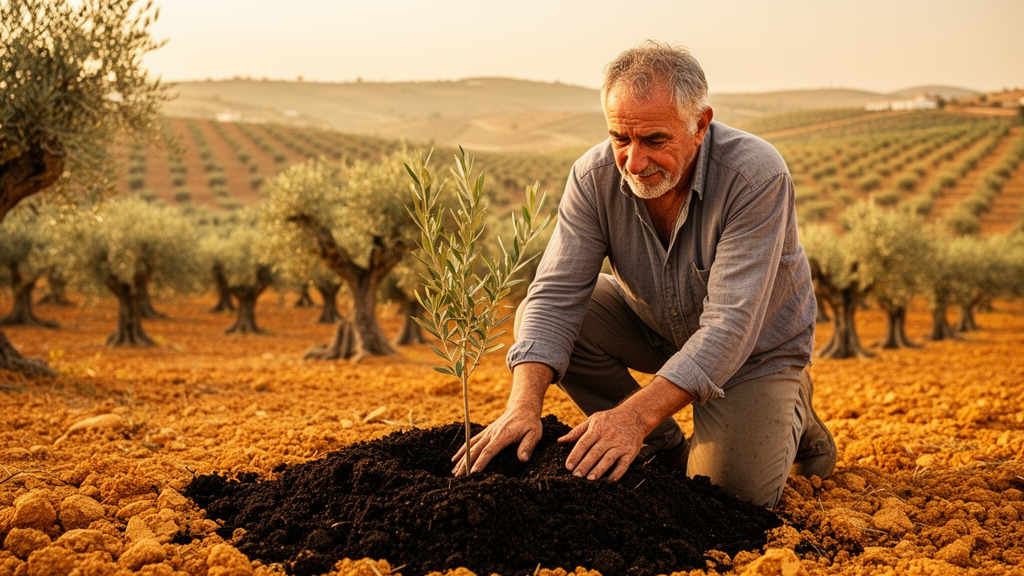
Spain is losing its soil faster than almost any other country in Europe. New research reveals that 23 percent of Spanish land suffers erosion rates above tolerable levels, with a mean soil loss of 12.3 tonnes per hectare per year—roughly four times the European average of 3.07 tonnes. Against this backdrop, a team of Spanish researchers has completed the first comprehensive 20-year audit of how public money flowed into soil conservation through the European Union’s Common Agricultural Policy, and their findings arrive at a pivotal moment: the CAP’s 2023 reform has just rewritten the rules, making soil protection compulsory for farmers who want their subsidies.
The study, published in the Spanish Journal of Soil Science, was led by Mistral Van Oudenhove of the Soil and Water Conservation Research Group at CEBAS-CSIC in Murcia, together with Pedro Pérez-Cutillas of the University of Murcia and Carolina Boix-Fayos of CEBAS-CSIC. The researchers set out to answer a deceptively simple question: was the money spent on soil conservation actually going where it was needed? To find out, they mined 54 policy documents spanning three programming periods—2000–2006, 2007–2013, and 2014–2020—covering Spain’s national Rural Development Programme plus the 17 regional programmes administered by Spain’s autonomous communities.
The CAP rests on two pillars. Pillar one covers direct agricultural payments, while pillar two funds rural development, including the agri-environmental and climate measures and forestry measures that carried most soil conservation spending. From 1992 onward, the CAP progressively decoupled subsidies from production, shifting toward environmental goals. Spain’s rural development programmes, approved by the European Commission and audited throughout their execution, became the principal vehicle for structuring these environmental policies. The researchers identified ten soil conservation measures common to all regions, mostly forestry, afforestation, and agri-environmental measures, and tracked their executed public spending through the ex-post evaluations published by the Spanish Ministry of Agriculture.
The headline numbers tell a striking story. Overall rural development budgets collapsed by 78 percent over the two decades, partly because several Spanish regions were reclassified as no longer underdeveloped relative to the EU average after the first programming period. Yet executed public spending on soil conservation measures rose by 13 percent between the first and last periods, peaking during 2014–2020 with an 18 percent increase in commitment. Soil conservation measures grew steadily heavier within shrinking rural development budgets, signaling a rising environmental perspective even as the overall rural development pot dwindled—a trend that continues under the 2023 reform, which plans 1.76 billion euros per year for rural development, of which 48.7 percent targets environmental measures.
Execution rates were generally high, with most measures close to 100 percent of programmed spending, which the authors read as evidence that farmers were willing to adopt soil conservation when measures were available and adequately funded. But the audit also exposed glaring regional failures. During 2000–2006, the Balearic Islands reported zero execution on a measure for protecting and regenerating the natural environment after initially programming over 3 million euros, and spent only 37.64 percent of programmed forestry funds. Eleven regions failed to adopt afforestation of non-agricultural lands during 2007–2013, making it the most unsuccessful measure of that period. In some cases regions skipped a measure entirely during one programming period only to program it with high execution rates in the other two, without clear justification—effectively denying their farmers access to those funds.
To test whether spending followed need, the team built a 24-variable matrix combining spending data with land use, soil condition, socio-economic, and political indicators. They applied canonical correlation analysis, a multivariate technique that finds linear combinations of variables maximizing correlations between two subsets, after checking normality with Shapiro-Wilk tests, homoscedasticity with Breusch-Pagan tests, and removing redundant variables with variance inflation factors above 5. The results showed executed public spending was moderately correlated with land use—driven mainly by irrigated utilized agricultural area and meadows—and weakly but significantly correlated with soil condition, where severe erosion and overall weighted average soil loss carried the strongest coefficients. No significant correlations emerged with socio-economic variables.
The correlations strengthened over time in an instructive pattern. The association between spending and land use peaked during 2007–2013 before easing in the last period, while the link between spending and soil condition remained stable through the first two periods and then jumped to a strong significant correlation during 2014–2020. The authors attribute this shift to the availability of national soil condition cartography, published mostly during the second programming period, including the National Soil Erosion Inventory and the Map of Land Condition in Spain. Once regions could see the data, they adapted and strengthened their spending associations—a finding the authors say underscores the importance of soil health monitoring. The problem is that much of this information is now obsolete: some regions have not had an erosion inventory update since 2002, and the desertification risk cartography relies on an aridity index calculated from 1989–2000 data.
Political influence, by contrast, proved minimal. The researchers tested days in power for the Spanish Socialist Workers’ Party, the People’s Party, and regionalist parties using Spearman’s correlation, since the exclusionary nature of governance made canonical correlation unsuitable. Neither major party showed any statistically significant correlation with soil conservation spending, suggesting the CAP’s main environmental goals remain mostly apolitical. Regionalist governments, present in only six regions, showed a positive correlation with forestry measures during the first period but negative correlations with soil conservation effort in the second and third periods—partly explainable because most regionalist-governed regions sit in northern Spain where soil conditions are better.
The 2023 CAP reform, aligned with the European Green Deal and its Farm to Fork, Biodiversity, and Soil Strategies, has folded all rural development actions into national CAP strategic plans and moved soil conservation largely into pillar one. Enhanced conditionality now makes certain practices compulsory for receiving payments, including the Good Agricultural Environmental Conditions on maintenance of permanent grassland, protection of wetlands and peat bogs, and non-productive features. Voluntary eco-schemes and agri-environmental measures remain mandatory for member states to offer but optional for farmers. In Spain’s strategic plan, only four regions—Aragon, the Canary Islands, Castile and Leon, and Navarra—have implemented the intervention on soil improvement and erosion control, while nearly half the regions have ignored reforestation and agroforestry investments. The compulsory approach has sparked conflicts in many regions, as small and medium-sized farms that are largely uncompetitive without CAP subsidies feel obliged to comply out of fear of going out of business, and the cost of adopting new techniques is identified as a major barrier to sustainable soil management.
The lessons from two decades of voluntary pillar-two spending are clear, the authors argue: when comprehensive environmental spending was made available through voluntary schemes, uptake was generally positive. They recommend that conditionality be flexible enough to adapt to regional conditions, which can be very restrictive in Spain’s semi-arid areas, and that soil conservation eco-schemes be promoted, made available, and properly funded in regions with higher soil degradation. Above all, they stress that updated soil condition databases are essential—the most recent national data is over ten years old, and some datasets rest on figures more than two decades old. Without monitoring, the information that helped regions align spending with need will quickly become useless, and the challenge of harmonizing the European Green Deal with agricultural reality will only grow harder.
Subject of Research: Soil conservation policy in Spain under the Common Agricultural Policy
Article Title: Legislating for Soil Conservation: A 20-Year Review and the New Approach of the CAP in Spain
Article References: Van Oudenhove, M., Pérez-Cutillas, P., & Boix-Fayos, C. (2025). Legislating for Soil Conservation: A 20-Year Review and the New Approach of the CAP in Spain. Spanish Journal of Soil Science, 15, Article 14733. https://doi.org/10.3389/sjss.2025.14733
Image Credits: AI Generated
Keywords: soil conservation, Common Agricultural Policy, Spain, soil erosion, European Green Deal, rural development, agriculture policy, Legislating, Soil, Conservation, Year, Review
Cite Scienmag News
Alan Morgan. (October 17, 2026). Spain Spent Two Decades Paying Farmers to Save Its Soil—Now the Rules Have Changed. Scienmag. https://scienmag.com/spain-spent-two-decades-paying-farmers-to-save-its-soil-now-the-rules-have-changed/
Alan Morgan. "Spain Spent Two Decades Paying Farmers to Save Its Soil—Now the Rules Have Changed." Scienmag, 17 October 2026, https://scienmag.com/spain-spent-two-decades-paying-farmers-to-save-its-soil-now-the-rules-have-changed/. Accessed 17 October 2026.
Alan Morgan. "Spain Spent Two Decades Paying Farmers to Save Its Soil—Now the Rules Have Changed." Scienmag. October 17, 2026. https://scienmag.com/spain-spent-two-decades-paying-farmers-to-save-its-soil-now-the-rules-have-changed/


