


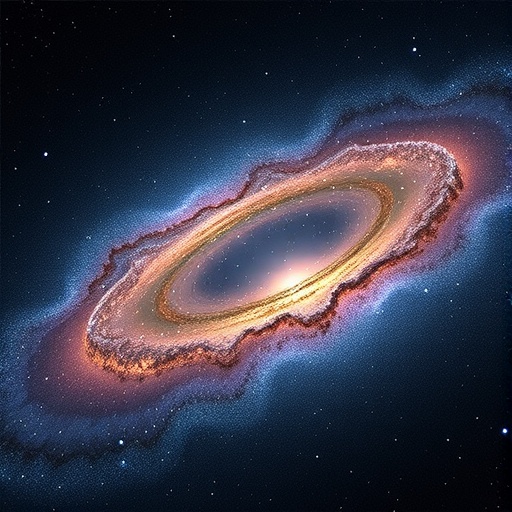
The Milky Way galaxy, once thought to be a relatively stable and placid entity, has revealed a dynamic and visually striking characteristic that has captivated astronomers and astrophysicists. Recent findings from the European Space Agency’s Gaia space telescope have unveiled the existence of a massive wave rippling outward from the galaxy’s center, challenging previous notions of galactic stability. This discovery not only enriches our understanding of our cosmic environment but also raises compelling questions about the underlying processes that govern such grand-scale phenomena.
For decades, scientists have observed the rotational patterns of our galaxy, noting that stars orbit around a central point. Since the mid-20th century, it has been acknowledged that the Milky Way’s disc exhibits a warping distortion. However, the revelation of this galactic wave has introduced a significant new dimension to our understanding of stellar motion and the structure of our galaxy. The wave’s manifestation paints a complex picture of a galaxy in constant motion, resembling the rippling surface of a pond disturbed by a stone.
The implications of this newly found wave are substantial. It stretches over tens of thousands of light-years from the solar system and influences the positioning and movement of stars, representing a considerable area of the Milky Way’s outer disc. This extraordinary wave is depicted in a series of images generated by Gaia, with red and blue markings suggesting the vertical placements of stars in relation to the warped structure of the galactic disc. Red areas indicate stars positioned above this structure, while blue demarcates those below, providing an eye-catching representation of the galactic dynamics at play.
A comparative analysis of the galaxy’s structure reveals a stark dichotomy between its upper and lower regions. From a top-down perspective, the disk of the Milky Way takes on an appearance reminiscent of waves in the ocean, with the new findings highlighting the significant upward curving of the left side, contrasted with a downward slant on the right. Such asymmetries not only bear visual impact but also carry implications for our understanding of galactic evolution and motion.
The origin of these galactic waves remains uncertain, invoking much enthusiasm and curiosity within the scientific community. While there are hypotheses suggesting that past interactions with dwarf galaxies could contribute to this whirling behavior, further elucidation is required to substantiate these claims. This scenario prompts queries surrounding the interplay of gravitational influences and cosmic events that may incite such large-scale waves.
The Gaia space telescope, with its exceptional capability to chart three-dimensional positions and velocities of celestial objects, has been pivotal in delineating the structures within our galaxy. The precise mapping of bright stars, particularly young giants and variable stars like Cepheids, has been crucial in tracking the effects of the wave. These methodologies facilitate not only observational advancements but also offer insights into stellar life cycles and the forces that mold the galaxy’s morphology.
In exploring the distinctive behavior of the Milky Way’s stellar motions, it becomes apparent that this wave acts akin to a wave propagated in a crowded stadium. The visualization of galaxies and stars traveling in synchronized motions reflects a profound analogy with human dynamics, where individual actions contribute to a greater collective movement. By observing such phenomena, we recognize that the stars in the galaxy are not merely passive objects but active participants shaped by the underlying cosmic ebb and flow.
Eloisa Poggio, an astronomer from the Istituto Nazionale di Astrofisica in Italy, emphasizes that understanding the wave structure is only part of the equation. The study of stellar movements alongside their vertical placements offers the potential for richer interpretations of cosmic variance and stability. The observed star patterns and their velocity variations elucidate a deeper, underlying order than previously recognized, with implications for models of galactic formation.
Moreover, the scientific intrigue extends to the relationship between the newly discovered great wave and known smaller-scale ripples, such as the Radcliffe Wave. Understanding the affiliations, if any, between these phenomena creates a comprehensive framework through which scientists can explore the dynamics of stellar distributions and galactic structural integrity. This burgeoning field of study promises new geological and astronomical insights.
With the forthcoming fourth data release from Gaia, expectations rise for additional revelations. Enhancements in data quality regarding stellar positions and movements could dramatically refine our understanding not just of the Milky Way, but of galactic mechanics at large. The future of galactic research is thick with possibility as the expanding database holds the secrets to ongoing cosmic phenomena.
As we continue to interrogate the structure and behavior of the Milky Way, we are reminded of the vastness of our universe and the multitude of unknowns that still remain. The great wave exemplifies both the complexity of galactic interaction and the sophisticated capabilities of modern observational astronomy. With each new discovery, we inch closer to demystifying the grandeur and the animated intricacies of our galactic home.
The universe has woven an intricate tapestry of cosmic events, and the study of waves within galaxies like the Milky Way is an exciting frontier. As scientists like Poggio and her team lead the charge into uncharted territories of knowledge, the potential for revolutionary insights into the nature of our galaxy and beyond beckons enticingly.
Through rigorous research and advanced technology like the Gaia telescope, we stand at the precipice of significant strides in our exploration of the cosmos. The more we understand about galactic structures and behaviors, the more we realize the wonders that lay hidden in their depths. Our quest for knowledge about the Milky Way is a reminder that even the familiar can often harbor surprises, igniting a passion for discovery that will chart the course of astronomy in the years to come.
This exploration into the Milky Way’s grand wave serves as a testament to humankind’s insatiable curiosity about the universe. It is this relentless pursuit of understanding that propels us forward, urging us to unveil the mysteries woven throughout the cosmos, nurturing both knowledge and inspiration for generations yet to come.
Keywords
Galaxies, Milky Way, Astronomy, Cosmic Waves, ESA, Gaia, Astrophysics, Stellar Motion, Galactic Structure, Space Telescope, Cosmic Events.
Cite Scienmag News
Grant Pearson. (September 30, 2025). ESA’s Gaia Telescope Unveils the Milky Way’s Majestic Cosmic Wave. Scienmag. https://scienmag.com/esas-gaia-telescope-unveils-the-milky-ways-majestic-cosmic-wave/
Grant Pearson. "ESA’s Gaia Telescope Unveils the Milky Way’s Majestic Cosmic Wave." Scienmag, 30 September 2025, https://scienmag.com/esas-gaia-telescope-unveils-the-milky-ways-majestic-cosmic-wave/. Accessed 3 September 2026.
Grant Pearson. "ESA’s Gaia Telescope Unveils the Milky Way’s Majestic Cosmic Wave." Scienmag. September 30, 2025. https://scienmag.com/esas-gaia-telescope-unveils-the-milky-ways-majestic-cosmic-wave/


