


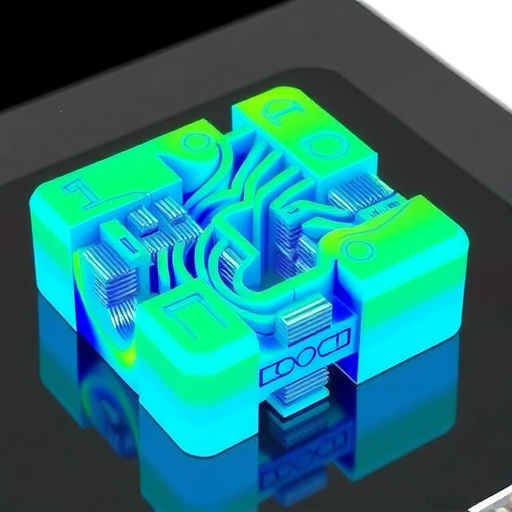
In the rapidly advancing field of additive manufacturing, a team of researchers led by Wu, X., Zhu, Y., and Gotawala, N. has unveiled a pioneering approach that promises to revolutionize the precision and understanding of thermal and material dynamics during additive friction stir deposition (AFSD). Their study, soon to be published in npj Advanced Manufacturing, introduces a sophisticated computational framework rooted in sequential Bayesian learning to predict thermal and material flow fields with remarkable accuracy. This breakthrough addresses one of the most critical challenges in the additive manufacturing domain: the complex and transient nature of heat transfer and material deformation during the build process.
Additive friction stir deposition represents an innovative solid-state manufacturing technique where materials are deposited layer by layer through the stirring and plastic deformation induced by a rotating tool. Unlike traditional additive manufacturing techniques, AFSD avoids melting the feedstock material, resulting in minimal thermal degradation and improved mechanical properties of the final product. However, the process involves intricate interactions between thermal gradients and material flow, which are notoriously difficult to monitor and predict in real-time. This complexity has historically impeded reliable control and optimization of AFSD, limiting its broader industrial application.
The research team’s novel contribution lies in harnessing the power of sequential Bayesian learning, a statistical inference method that enhances prediction accuracy by continuously updating probabilities as new data becomes available. By integrating real-time sensor data with advanced computational physics models, the researchers developed an adaptive prediction system capable of dynamically capturing the evolving thermal fields and material flow characteristics throughout the deposition process. This approach contrasts starkly with traditional deterministic simulations that often rely on fixed parameters and cannot effectively account for uncertainties or process variability.
At the heart of their methodology is a sophisticated probabilistic framework that fuses physics-based models with experimental measurements. This fusion allows for an iterative learning process where the system’s predictions are constantly refined using observed data from in-situ thermal sensors and material deformation measurements. Such a dynamic updating mechanism not only improves predictive accuracy but also provides robust uncertainty quantification, a critical factor for deploying AFSD in highly controlled manufacturing environments where precision is paramount.
Through extensive computational experiments and validation against empirical data, the team demonstrated that their sequential Bayesian learning-enabled model significantly outperforms conventional prediction methods. The model accurately forecasts temperature distributions and material flow patterns with a temporal resolution that matches the rapid dynamics of the AFSD process. This high-fidelity prediction capability is vital for optimizing process parameters, reducing defects, and ultimately enhancing the mechanical performance and surface quality of manufactured parts.
One of the remarkable advantages of this approach is its adaptability to different materials and process conditions. AFSD can be applied to a variety of metal alloys and composite materials, each exhibiting unique thermal and flow behaviors. The Bayesian framework’s ability to incorporate prior knowledge and update predictions with new observations means it can be calibrated to new material systems with minimal human intervention, thereby accelerating the development and deployment of AFSD technologies across diverse industrial sectors.
Furthermore, this research paves the way for integrating machine learning techniques with traditional manufacturing process controls, signaling a shift towards smarter, more autonomous systems in advanced manufacturing. By providing a predictive tool that can anticipate process fluctuations and material responses in real time, manufacturers can implement proactive control strategies to mitigate defects before they occur. This proactive approach is a significant step toward achieving zero-defect manufacturing, a long-sought goal that promises to reduce waste, lower costs, and improve the sustainability of production processes.
Delving into the thermal aspects, understanding and controlling the heat distribution during AFSD is crucial because local temperature variations directly influence material microstructure evolution and residual stress formation. The sequential Bayesian model captures these thermal gradients with high precision, enabling deeper insights into how heat drives microstructural transformations during the deposition. This understanding can inform post-processing heat treatments and mechanical property optimization, leading to parts with tailored performance characteristics.
Material flow dynamics in AFSD are equally complex, involving plastic deformation, material mixing, and consolidation as the rotating tool traverses along the build path. The team’s model successfully simulates these flow fields by assimilating sensor data that track strain and displacement within the material. Such detailed flow field predictions assist in preventing defects related to improper consolidation, such as voids or weak interlayer bonding, which are common challenges in friction stir-based additive processes.
The implications of this research extend beyond AFSD itself. The conceptual framework for combining sequential Bayesian learning with in-situ monitoring and physics-informed models could be adapted to other additive and subtractive manufacturing processes where process variability and uncertainty complicate control strategies. Fields like laser powder bed fusion, directed energy deposition, and even traditional welding could benefit from similar predictive analytics to optimize quality and performance.
In an industrial context, this technology is poised to enhance the manufacturing of critical components in aerospace, automotive, biomedical implants, and energy sectors, where additive friction stir deposition is gaining traction due to its superior material properties and environmental advantages. By embedding predictive intelligence into the manufacturing workflow, companies can accelerate innovation cycles, improve part reliability, and reduce costly trial-and-error experimentation.
Despite the promising results, the research team acknowledges the challenges ahead. Implementing such a complex modeling approach in real-time industrial settings requires robust sensor networks, high-performance computing resources, and seamless integration with existing manufacturing execution systems. Additionally, further studies are required to extend the model’s applicability to more intricate geometries, multi-material systems, and varying environmental conditions that impact AFSD processes.
Nevertheless, the introduction of sequential Bayesian learning into the predictive modeling of additive friction stir deposition marks a significant milestone. It exemplifies the convergence of materials science, manufacturing engineering, and artificial intelligence to solve deeply challenging problems in modern fabrication technologies. This work not only advances the theoretical understanding of AFSD but also offers pragmatic tools for manufacturers seeking to harness the full potential of this emerging process.
As additive manufacturing continues its trajectory toward widespread industrialization, innovations like this will be key in bridging the gap between experimental research and practical application. The ability to foresee and control thermal and material flow phenomena accurately will empower manufacturers to deliver high-quality, tailor-made components faster and more economically than ever before, driving the industry toward new horizons of precision and efficiency.
In conclusion, the study by Wu, Zhu, and Gotawala et al. heralds a new era in additive friction stir deposition by integrating sequential Bayesian learning for predictive modeling. This work exemplifies cutting-edge interdisciplinary research poised to transform additive manufacturing from an art to a precise science. The broader adoption of such intelligent models will be instrumental in unlocking the next generation of manufacturing capabilities, shaping the future of design, production, and innovation in high-performance material systems.
Cite Scienmag News
Denise Maddox. (May 22, 2026). Bayesian Learning Advances Thermal, Flow Prediction in Additive Deposition. Scienmag. https://scienmag.com/bayesian-learning-advances-thermal-flow-prediction-in-additive-deposition/
Denise Maddox. "Bayesian Learning Advances Thermal, Flow Prediction in Additive Deposition." Scienmag, 22 May 2026, https://scienmag.com/bayesian-learning-advances-thermal-flow-prediction-in-additive-deposition/. Accessed 4 September 2026.
Denise Maddox. "Bayesian Learning Advances Thermal, Flow Prediction in Additive Deposition." Scienmag. May 22, 2026. https://scienmag.com/bayesian-learning-advances-thermal-flow-prediction-in-additive-deposition/


