


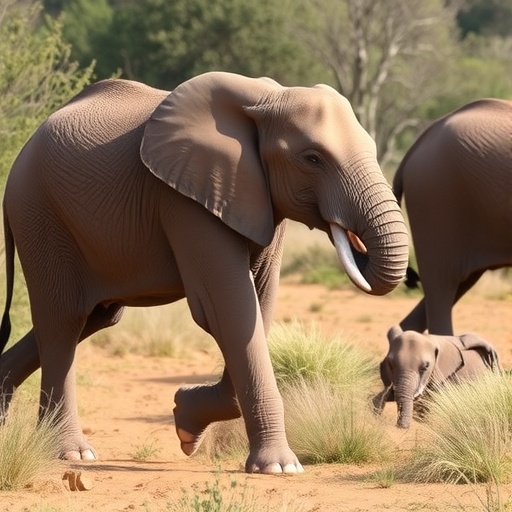
In an unprecedented achievement in wildlife genomics, an international consortium of scientists has completed the largest comprehensive genomic survey ever conducted on Africa’s elephants, encompassing 232 whole genomes sampled from both savanna and forest elephant populations across 17 African nations. This monumental dataset marks a significant advance in our understanding of elephant evolutionary history, population genetics, and the impacts of anthropogenic pressures on their genetic diversity and connectivity. The study, recently published in Nature Communications, provides unparalleled insights into the genomic fabric that underpins these iconic species, revealing how their capacity for extensive migration and gene flow has historically shaped their genetic robustness—and how increasing habitat fragmentation is now undermining this vital biological network.
For millions of years, African elephants have traversed vast landscapes, maintaining gene flow across expansive ranges that span different ecological zones. The study’s results highlight this deep evolutionary connectivity, showing how widespread movement has fostered genetic diversity, which is crucial for resilience against environmental change and disease. This genomic resilience is now being compromised as human activities—such as settlement expansion, farming, and infrastructural development—severely disrupt elephant corridors, resulting in fragmented habitats and isolated populations.
Notably, populations residing in remote northeastern Africa, specifically in Eritrea and Ethiopia, exhibit stark genetic signatures characterized by elevated levels of inbreeding, diminished nucleotide diversity, and a build-up of mildly deleterious mutations. Such genetic deterioration reflects the profound isolation of these populations, which are geographically separated from other herds by over 400 kilometers and are ensnared by expanding human settlements and agricultural zones. This genetic bottleneck places these elephants in heightened jeopardy, as reduced variability decreases their adaptive potential and resistance to pathogenic threats.
Intriguingly, the genomic analysis also challenges previous assumptions about hybridization dynamics between the two African elephant species—the savanna elephant (Loxodonta africana) and the forest elephant (Loxodonta cyclotis). Although hybridization was traditionally believed to occur only in a narrow overlap zone where these species’ ranges intersect, the study detects vestigial traces of forest elephant genetic material in savanna elephant populations well beyond this region. This finding suggests either historical shifts in hybridization zones or the possibility that forest elephant alleles have disseminated far across the continent through extensive elephant migrations, underscoring the complex evolutionary interplay between these two species over millennia.
Despite this gene flow, the genomic distinctions between savanna and forest elephants remain profound, with evolutionary divergence deepened over the past four million years. The research cautions conservationists about the potential risks of artificially mixing populations for translocation or rewilding efforts. Senior author Professor Alfred Roca emphasizes that while gene flow within species has been historically advantageous, interspecies gene transfer may not confer benefits, advocating for a nuanced approach that respects genetic boundaries when managing elephant populations.
The study spotlights southern Africa as a regional exemplar where relatively intact and continuous landscapes enable sustained connectivity among elephant populations. Within the Kavango–Zambezi Transfrontier Conservation Area (KAZA)—the largest contiguous conservation zone spanning five countries—the elephants display rich genetic variation facilitated by ongoing gene exchange. This contrasts sharply with the genetic isolation seen elsewhere on the continent and demonstrates the critical importance of protected ecological corridors in preserving genomic health.
The genetic vitality witnessed in the KAZA region highlights how conservation efforts must extend beyond protecting animals as isolated entities; they must also prioritize safeguarding migratory pathways and contiguous habitats. Elephants’ innate intelligence and behavioral adaptability enable them to coexist near human settlements, but their long-term survival hinges on sustained landscape connectivity enabling gene flow. As corridors vanish and populations become increasingly insular, the risk of genetic erosion and population decline escalates alarmingly.
Moreover, the research underscores an urgent conservation message: genomic tools are indispensable for effective monitoring of elephant populations and combating illegal wildlife trade. The study’s authors, in partnership with wildlife organizations like Save the Elephants and San Diego Zoo Wildlife Alliance, are developing DNA-based on-site diagnostic techniques to identify and trace the origins of confiscated ivory. This approach promises to strengthen anti-poaching efforts by providing forensic evidence to deter ivory trafficking and inform targeted conservation actions.
Co-authors Charles Masembe and Vincent Muwanika, both affiliated with Makerere University in Uganda, emphasize the broader implications of integrating genomics into conservation strategies. They suggest that genomic insights can refine habitat management, identify conservation units, tailor translocation policies, and facilitate education initiatives that ultimately safeguard elephant populations continent-wide against the accelerating impacts of climate change and human encroachment.
Among other key findings, the analysis reveals a striking contrast in genetic health between forest and savanna elephants. Forest elephants maintain higher genetic variation and harbor fewer harmful mutations, indicating a relatively better prognosis despite significant population declines. Conversely, many savanna elephant populations, particularly those isolated by human activity and historical hunting pressures, show signs of genetic vulnerability, necessitating immediate conservation interventions to restore connectivity.
This genomic atlas sets a new standard for wildlife genetics, combining decades-worth of biobanked samples with advanced sequencing technologies sponsored by Illumina’s iConserve program. The publicly available data serve as an operational tool for wildlife managers and across-the-board conservation stakeholders dedicated to reversing elephant population decline and conserving the evolutionary legacy of Africa’s largest terrestrial mammals.
In sum, the study advances a compelling narrative: elephant conservation must be increasingly informed by genomics, integrated across national boundaries and land-use frameworks, and cognizant of the critical role that landscape connectivity plays in maintaining genetic health. Fostering transboundary conservation areas, protecting movement corridors, and applying genomics-driven forensics all represent vital components of a multi-layered strategy to ensure that these majestic creatures continue to thrive in Africa’s rapidly evolving environments.
News Publication Date: 16-Apr-2026
Web References: DOI link
Keywords
African elephants, genomics, population connectivity, genetic diversity, inbreeding, hybridization, conservation genetics, habitat fragmentation, gene flow, savanna elephants, forest elephants, transboundary conservation, wildlife forensics, iConserve, landscape connectivity
Cite Scienmag News
Juliet Wilcox. (April 16, 2026). Elephant Genomes Uncover Ancient Continental Links and Signal a Future of Growing Isolation. Scienmag. https://scienmag.com/elephant-genomes-uncover-ancient-continental-links-and-signal-a-future-of-growing-isolation/
Juliet Wilcox. "Elephant Genomes Uncover Ancient Continental Links and Signal a Future of Growing Isolation." Scienmag, 16 April 2026, https://scienmag.com/elephant-genomes-uncover-ancient-continental-links-and-signal-a-future-of-growing-isolation/. Accessed 3 September 2026.
Juliet Wilcox. "Elephant Genomes Uncover Ancient Continental Links and Signal a Future of Growing Isolation." Scienmag. April 16, 2026. https://scienmag.com/elephant-genomes-uncover-ancient-continental-links-and-signal-a-future-of-growing-isolation/


