


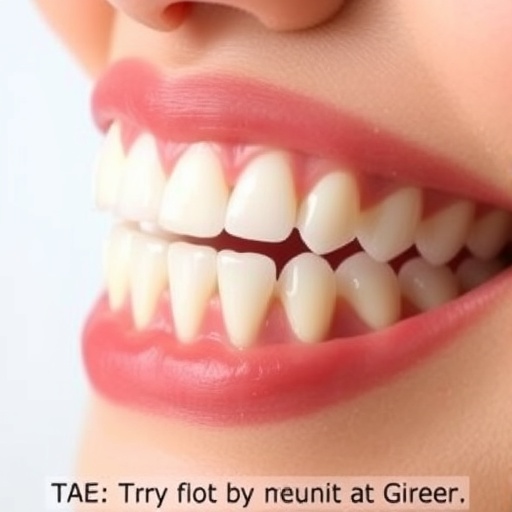
The restoration of severely damaged anterior teeth that have undergone root canal treatment presents one of the most formidable challenges in restorative dentistry. Traditionally, the go-to technique has involved placing a post within the root canal to reinforce the tooth’s structure, followed by building a core and fabricating a full-coverage crown. While effective, this method often necessitates the removal of additional tooth material, potentially compromising the already weakened tooth and heightening the risk of catastrophic root fractures that are difficult or impossible to repair. However, a promising alternative, known as the endocrown, offers a less invasive solution by eliminating the need for a post and instead relying on adhesive bonding within the pulp chamber to provide retention. This single-piece ceramic restoration encapsulates the tooth, combining esthetics with preservation of the natural tooth structure.
Researchers at Tishreen University in Latakia, Syria, undertook a rigorous biomechanical investigation to directly compare these two restorative approaches when applied to severely compromised upper central incisors that had undergone root canal therapy. The study involved twenty freshly extracted teeth, standardized in their damage level, divided evenly into two groups: one restored using the traditional post-and-core technique with quartz fiber posts, and the other using endocrowns fabricated entirely from a ceramic material. This innovative study design aimed to simulate real-life clinical conditions by subjecting the restored teeth to mechanical stress at an angle resembling normal biting forces encountered on front teeth.
Each tooth was mounted at a 45-degree inclination, which approximately replicates the occlusal forces during function on maxillary central incisors. A precise and steadily increasing load was applied until structural failure occurred. Failure modes were meticulously documented and classified as either “favorable,” indicating damage potentially amenable to repair or retreatment, or “unfavorable,” implying irreparable destruction leading to tooth loss. This clear differentiation between types of failure is crucial as it not only assesses the immediate strength of the restoration but also predicts the long-term prognosis and salvageability of the treated teeth.
The findings revealed no statistically significant differences in overall fracture resistance or failure patterns between endocrowns and posts-and-cores. Interestingly, fractures in the endocrown group exhibited a greater variety of sites but tended to be more favorable, with 80% of failures categorized as repairable. Conversely, the post-and-core group showed predominantly failures localized within the restorative materials themselves, with 60% deemed favorable. The use of quartz fiber posts, which possess elasticity closely matching that of natural dentin, was an influential factor; their flexibility allows for the dissipation and redirection of stress away from the root, thereby mitigating the likelihood of catastrophic root fractures.
This biomechanical assessment challenges the long-held clinical assumption that posts are indispensable for retaining severely damaged anterior teeth. Endocrowns stand out as a less invasive, biologically conservative alternative that minimizes tooth structure removal. The elimination of posts reduces the complexity of the procedure, shortens chair-side time, and importantly preserves the integrity of the root, which is often the weakest link post-endodontic treatment. Additionally, should retreatment or revision become necessary, teeth restored with endocrowns may be more straightforward to manage, given the preservation of natural structures and absence of intra-radicular components.
Despite the encouraging outcomes, the authors duly note that these results stem from controlled laboratory conditions not fully replicating the intraoral environment. Variables such as thermal cycling, long-term fatigue from masticatory forces, and exposure to salivary enzymes and fluctuations in pH are difficult to reproduce ex vivo but play a pivotal role in restoration longevity. Moreover, the sample size of twenty teeth, although methodologically justified for an in vitro study, limits the generalizability of the findings. Larger-scale clinical trials with extended follow-up will be necessary to confirm these preliminary conclusions and translate them into evidence-based guidelines.
This study holds significant implications for both dentists and patients, particularly in advancing minimally invasive dentistry. The ability to restore front teeth with endocrowns without sacrificing further dentin could revolutionize treatment planning, emphasizing preservation over aggressive preparation. Patients may benefit from shorter treatment sessions, less postoperative sensitivity, and potentially higher long-term survival rates of restorations. From a biomaterial standpoint, the advancements in ceramic technology underpinning endocrowns provide excellent esthetic results that conform to modern patient expectations for natural-looking restorations in highly visible areas.
The adoption of endocrowns for anterior teeth restoration may also impact educational protocols, necessitating updates to curriculum and continuing education to familiarize practitioners with adhesive protocols, ceramic material handling, and preparation designs unique to this technique. Furthermore, the cost-effectiveness of endocrowns compared to post-and-core restorations, considering chair time and material expenses, could influence practice management decisions and insurance coverage paradigms.
Future research directions should aim at investigating the long-term clinical performance of endocrowns in diverse patient populations with varying occlusal schemes and parafunctional habits. Additionally, exploring the performance of different ceramic materials, resin cements, and bonding strategies in endocrown restorations could optimize protocols for maximum durability and esthetics. Advances in digital dentistry, such as CAD/CAM technology, stand to enhance the precision and reproducibility of endocrown fabrication, potentially increasing their widespread acceptance.
The groundbreaking work from Dr. Abed Alhade Kheder and his team has thus opened new avenues in the restoration of endodontically treated anterior teeth, emphasizing a paradigm shift towards more conservative treatment options without compromising functional outcomes. Publishing their full findings in The Open Dentistry Journal makes this knowledge accessible to the global dental community, encouraging replication, discourse, and clinical adoption. As dental science continues to strive for the dual goals of preservation and patient-centered care, innovations like the endocrown represent a promising frontier in restorative dentistry.
Cite Scienmag News
Grant Pearson. (May 22, 2026). Simpler Way to Restore Root-Treated Front Teeth? New Study Compares Two Methods. Scienmag. https://scienmag.com/simpler-way-to-restore-root-treated-front-teeth-new-study-compares-two-methods/
Grant Pearson. "Simpler Way to Restore Root-Treated Front Teeth? New Study Compares Two Methods." Scienmag, 22 May 2026, https://scienmag.com/simpler-way-to-restore-root-treated-front-teeth-new-study-compares-two-methods/. Accessed 4 September 2026.
Grant Pearson. "Simpler Way to Restore Root-Treated Front Teeth? New Study Compares Two Methods." Scienmag. May 22, 2026. https://scienmag.com/simpler-way-to-restore-root-treated-front-teeth-new-study-compares-two-methods/


