


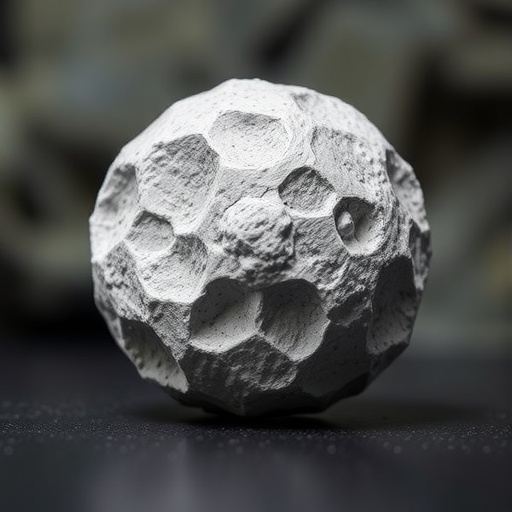
The Moon’s surface, long regarded as a static and unchanging landscape, is in fact a dynamic environment continuously sculpted by an invisible barrage of microscopic impacts and the persistent flow of charged particles from the Sun. This process, termed space weathering, subtly but inexorably transforms the lunar regolith over time, altering its physical and chemical properties. Recently, researchers from Georgia Tech have pushed the boundaries of our understanding by replicating one of the primary agents of lunar weathering—solar wind—in a controlled laboratory setting. Their groundbreaking work sheds new light on the microstructural evolution of the Moon’s surface and offers valuable clues about the ongoing interactions between the lunar environment and the space weather.
For decades, scientists have noticed that the Moon’s surface is coated with a distinctive layer of fine dust and soil that behaves differently from Earth’s geological materials when probed by remote sensing instruments. A key driver of these differences is the formation of nanophase iron particles, tiny metallic iron inclusions that develop within lunar soil grains due to repeated bombardment by cosmic dust and solar wind ions. Although nanophase iron has been recognized as a hallmark of space weathering, its precise origin and the relative contributions of different space weathering mechanisms have remained somewhat ambiguous.
In a pioneering experiment led by physics doctoral candidate Roshan Trivedi and recent graduate Advik Vira at Georgia Tech, ilmenite—a titanium-iron oxide mineral abundant on the Moon and Earth—was used as a proxy to understand these processes. Employing a sophisticated vacuum chamber capable of simulating the solar wind’s composition and energy, the team bombarded ilmenite samples with a synthetic ion stream that mimics the flux of protons and other particles emitted by the Sun. This procedure resulted in the formation of nanophase iron particles within the ilmenite, mirroring the transformations observed on actual lunar samples collected during past missions.
The significance of this laboratory achievement lies in the ability to create lunar-like rims and features under precisely defined experimental conditions. Prior studies have largely relied on indirect sensing data from spacecraft or terrestrial analyses of lunar soil, which, while informative, lacked the ability to isolate and control the role of solar wind. The Georgia Tech experiments demonstrate conclusively that solar wind exposure alone can generate the characteristic nanophase iron, underscoring its dominant role in reshaping the Moon’s surface at microscopic scales.
These findings were detailed in the article “Creation of Lunar-Like Rims in Ilmenite Using Synthetic Solar Wind,” published in The Planetary Science Journal in June. This work emerged from the Georgia Tech Center for Lunar Environment and Volatile Exploration Research (CLEVER), a multidisciplinary initiative under NASA’s Solar System Exploration Research Virtual Institute (SSERVI). Under the guidance of Regents’ Professor Thom Orlando, the collaborative effort merges physics, chemistry, and materials science expertise to unravel the complexities of lunar surface processes, particularly within the context of NASA’s Artemis missions aimed at renewed lunar exploration.
Understanding the microevolution of lunar soil is critical for interpreting the remote sensing datasets collected by orbiters and landers. As space agencies worldwide gear up for extended lunar missions, deciphering the precise weathering timeline and mechanisms will refine the geological context and resource distribution models on the Moon. This research thus serves as a vital foundation for correctly reading signs embedded in the regolith’s spectral and physical properties, enhancing mission planning and in-situ utilization strategies.
Beyond surface evolution, the study has profound implications for the persistent mystery of how water is formed and sustained on the Moon. Water ice deposits at polar shadowed regions have been observed, but the provenance of lunar water remains a subject of intense scientific debate. Co-author Phillip First, a professor in the School of Physics, highlights the importance of solar wind as a potential source of hydrogen. Protons traveling with the solar wind can interact with exposed oxygen within lunar minerals, possibly synthesizing water molecules in situ—a hypothesis now supported by laboratory recreation of these interactions.
The team utilized high-resolution electron microscopy to examine the irradiated ilmenite samples, revealing not only nanophase iron particles but also the formation of nanoscale voids and defects. These voids in the crystal lattice may serve as molecular traps where hydrogen and oxygen atoms bond, providing discrete sites for water molecule formation. Reproducing these features in a controlled setting allows researchers to simulate thousands of years’ worth of solar wind weathering within mere laboratory hours, revolutionizing our capacity to model lunar surface chemistry.
Lead author Roshan Trivedi emphasizes the novelty of the detailed characterization made possible through advanced microscopy techniques. Although laboratory simulations of space radiation have been performed previously, this represents one of the first times that the resulting mineralogical changes have been so meticulously examined. The precise replication of lunar-like rims and iron nanoparticle inclusions paves the way for more nuanced studies of mineral weathering and volatile generation on airless bodies.
Co-lead author Advik Vira remarks on the transformative nature of these findings, noting that the ability to closely mimic lunar weathering processes heralds a new era of laboratory-based lunar science. The experimental results strongly corroborate observations made from Apollo-era samples and contemporary remote sensing data, closing a long-standing gap between theory and empirical evidence. This work further provides a versatile platform for probing how varying exposure durations and solar wind intensities influence lunar soil properties.
The broader scientific community stands to benefit from the CLEVER team’s innovations, particularly as missions like Artemis aim not only to revisit the Moon but to establish sustained human presence. Accurately modeling space weathering processes helps predict surface conditions that affect astronaut safety, rover durability, and resource extraction efficacy. Moreover, insights gleaned into water formation processes can contribute to developing in situ resource utilization (ISRU) technologies critical for deep space exploration.
Overall, the successful laboratory simulation of solar wind-induced space weathering marks a pivotal advance in planetary science, bridging the divide between microscopic surface alterations and macroscopic lunar phenomena. By harnessing cutting-edge analytical tools and experimental platforms, the Georgia Tech researchers have unveiled a richer understanding of the dynamic forces sculpting the Moon’s face—a celestial landscape ever-evolving under the Sun’s persistent influence.
Cite Scienmag News
Grant Pearson. (June 10, 2026). Georgia Tech Scientists Successfully Synthesize Moon Rock in the Laboratory. Scienmag. https://scienmag.com/georgia-tech-scientists-successfully-synthesize-moon-rock-in-the-laboratory/
Grant Pearson. "Georgia Tech Scientists Successfully Synthesize Moon Rock in the Laboratory." Scienmag, 10 June 2026, https://scienmag.com/georgia-tech-scientists-successfully-synthesize-moon-rock-in-the-laboratory/. Accessed 3 September 2026.
Grant Pearson. "Georgia Tech Scientists Successfully Synthesize Moon Rock in the Laboratory." Scienmag. June 10, 2026. https://scienmag.com/georgia-tech-scientists-successfully-synthesize-moon-rock-in-the-laboratory/


