


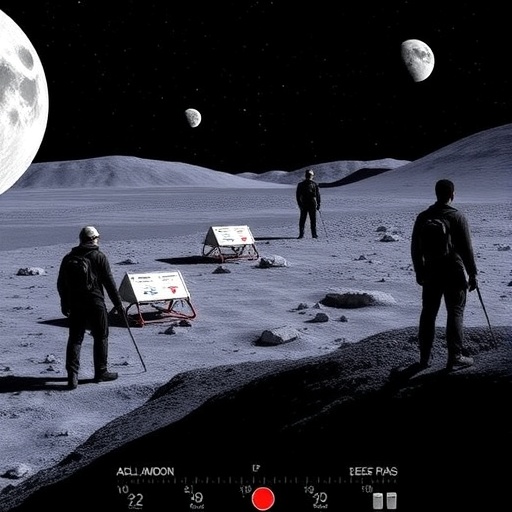
In a groundbreaking step toward humanity’s sustainable presence beyond Earth, researchers at George Mason University have unveiled an innovative agent-based model designed to simulate the intricate social and environmental dynamics of future lunar base missions. This pioneering work, recently published in the open-access journal PLOS One, offers unprecedented insights into how astronauts might interact and adapt while living and working on the Moon, potentially steering mission protocols toward greater success and crew well-being.
Central to NASA’s ambitious Artemis program is the construction of a permanent lunar base intended to support prolonged human operations on the Moon’s surface. Such a venture necessitates an acute understanding not just of the engineering challenges, but also of the psychological and social complexities inherent to isolated, confined, and extreme environments. The team led by Raymond Vera recognized this critical gap, developing a multifaceted simulation that integrates cognitive, social, emotional, and environmental variables—factors that heavily influence astronaut efficacy and resilience.
The core of this agent-based model involves virtual “astronaut agents,” each endowed with distinct professional skills, personalities, physical health statuses, and psychological traits. These agents are programmed to evolve over time, improving their mastery of routine and emergency tasks, and adapting to an array of unanticipated challenges such as equipment failure, lunar seismic activity, and hazardous radiation bursts. By introducing these stochastic external stressors, the model realistically mirrors the unpredictability and complexity of lunar missions.
Moreover, the simulation accounts for the interdependence between astronauts and robotic lunar rovers—an emerging aspect of extraterrestrial teamwork. This relationship is critical given the increasing reliance on robotic assistance for exploration and maintenance tasks. The dynamic interplay between human agents and autonomous machines introduces additional layers of operational complexity, crucial for assessing mission planning and resource allocation.
One of the pivotal findings from tens of thousands of simulation runs is the beneficial impact of larger crew sizes. An increase in the number of astronauts correlates not only with improved professional skill advancement but also with enhanced compatibility among personality types, fostering cooperative team dynamics. This discovery underscores the importance of carefully composing astronaut crews to balance diversity and compatibility, optimizing both individual and collective functioning in high-stress domains.
Conversely, the simulations reveal that extended mission durations and the absence of crew rotation impose significant psychological strain, which in turn diminishes overall task performance. These insights accentuate the need for carefully calibrated mission lengths and strategic astronaut replacements, ensuring crew mental health and operational sustainability are preserved over time during deep space expeditions.
By quantitatively modeling these subtle yet influential human factors, Vera and colleagues’ work moves beyond traditional engineering-centric mission simulations. Their approach recognizes that the success of lunar operations hinges upon nuanced human behaviors and interactions as much as technical reliability, calling for integrated social-behavioral models in mission design.
Future iterations of this model are anticipated to incorporate additional physiological parameters, such as bone density loss, muscle atrophy, and circadian rhythm disruptions—known complications of extended exposure to microgravity and lunar gravity environments. Furthermore, simulating communication delays between lunar crews and Earth-based mission control will add layers of realism, reflecting the inherent temporal disconnects in extraterrestrial undertakings.
The model’s capacity to produce key performance metrics—including NASA Task Load Index (TLX) scores, measures of coping capacity, interpersonal tension levels, and task completion rates—provides mission planners with valuable quantitative feedback. These indicators open avenues for optimizing training regimens, team selection, and support systems tailored to the unique challenges of long-duration lunar habitation.
This research not only innovates simulation science but also informs strategic decision-making for future lunar missions. By integrating psychological and social dynamics with environmental hazards, it lays a foundation for designing more resilient crews equipped to thrive in the extraordinary conditions of off-world colonization.
As humanity stands on the cusp of becoming a multi-planetary species, understanding the human dimension of space exploration becomes imperative. Vera et al.’s agent-based modeling approach serves as a vital tool to anticipate and mitigate risks associated with crew interactions and psychological health, ultimately enhancing the prospects for sustained human presence on the Moon and beyond.
This work represents a crucial step in closing the gap between engineering feasibility and human compatibility in space missions, providing a benchmark for future explorations that blend advanced computational techniques with profound insights into human behavior under extreme circumstances.
The study exemplifies how cutting-edge simulation technologies can extend the frontiers of space mission planning, making intangible aspects of human experience tangible and manageable through robust computational frameworks. Such integration of social sciences with aerospace engineering heralds a new era in astronautic research and operational foresight.
In summary, the innovative agent-based model by Vera and colleagues pioneers the simulation of crewed lunar missions with exceptional detail, offering a predictive lens through which mission architects can better prepare for complex interdependencies that define life and work on the Moon. As these simulations evolve, they promise to significantly enhance the safety, efficiency, and psychological resilience of future space explorers.
Keywords
Agent-based modeling, lunar base, crewed space missions, astronaut psychology, team dynamics, Artemis program, Moon exploration, computational simulation, space mission planning, astronaut interactions, lunar environment, space mission stressors
Cite Scienmag News
Grant Pearson. (May 27, 2026). Simulations Reveal How Astronaut Team Dynamics May Shape Future Moon Base Missions. Scienmag. https://scienmag.com/simulations-reveal-how-astronaut-team-dynamics-may-shape-future-moon-base-missions/
Grant Pearson. "Simulations Reveal How Astronaut Team Dynamics May Shape Future Moon Base Missions." Scienmag, 27 May 2026, https://scienmag.com/simulations-reveal-how-astronaut-team-dynamics-may-shape-future-moon-base-missions/. Accessed 4 September 2026.
Grant Pearson. "Simulations Reveal How Astronaut Team Dynamics May Shape Future Moon Base Missions." Scienmag. May 27, 2026. https://scienmag.com/simulations-reveal-how-astronaut-team-dynamics-may-shape-future-moon-base-missions/


