


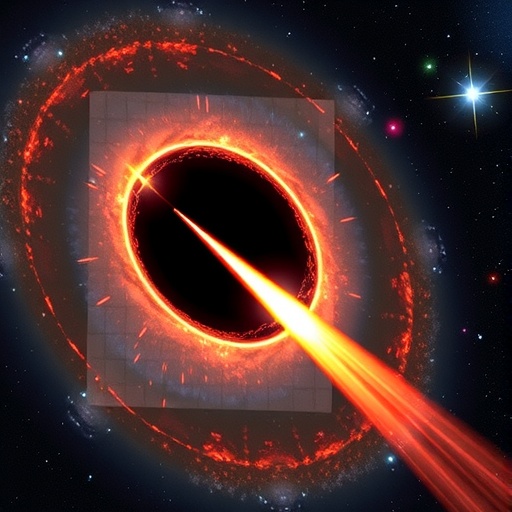
Astronomers have identified a population of faint, rapidly fading radio galaxies that may represent one of the most elusive stages in the life cycle of supermassive black holes. The discovery offers a rare view of what happens after the powerful jets launched by an active galactic nucleus abruptly shut down, leaving behind vast lobes of magnetised plasma that continue to glow across intergalactic space. Using some of the most sensitive radio observations available, researchers have confirmed that many of these “remnant” galaxies are surprisingly young and may disappear from view far sooner than previously expected. The results suggest that radio surveys have been missing a large, short-lived population of dying galaxies and provide new clues about how black holes regulate the evolution of their host galaxies.
The study examined 14 candidate remnant radio galaxies located in the XMM–Newton Large-Scale Structure field, a well-studied region of sky covering several square degrees. The research was led by scientists at the University of Cape Town and the Inter-University Institute for Data Intensive Astronomy. Remnant radio galaxies are the final stage of a cycle that begins when a supermassive black hole accretes gas at the centre of a galaxy. As material spirals into the black hole, some of it can be redirected into narrow, oppositely moving jets travelling at close to the speed of light. These jets inflate enormous radio-emitting lobes far beyond the visible boundaries of the galaxy. When the central engine stops feeding the jets, the lobes are cut off from their supply of fresh, high-energy particles and begin to fade.
To identify and study these fading systems, the researchers combined observations from several radio facilities operating at different frequencies. The data included the MeerKAT MIGHTEE survey and the uGMRT superMIGHTEE survey, supplemented by observations from LOFAR, the Giant Metrewave Radio Telescope and the Karl G. Jansky Very Large Array. Together, the instruments covered frequencies from 144 megahertz to 1.5 gigahertz, allowing the team to trace the changing radio spectrum of each source. This broad frequency range was critical because the electrons inside radio lobes do not radiate uniformly as they age. High-energy electrons lose energy first, causing the radio spectrum to steepen and shift toward lower frequencies. The spectral shape therefore acts as a kind of clock, recording how long ago the jets stopped operating.
Detailed modelling confirmed that 12 of the 14 candidates were genuine remnant radio galaxies, while the remaining two were still active and continued to receive energy from their central jets. The result illustrates why a single radio image or a narrow frequency range can produce misleading classifications. An active galaxy may appear weak if its jets are oriented unfavourably or if only part of its emission is detected, while a remnant can retain faint structures that resemble an active source. By comparing the intensity and shape of the radio emission across multiple frequencies, the researchers were able to distinguish between ongoing jet activity and the fading afterglow of a dead central engine. The high confirmation rate also demonstrates the scientific value of deep, multifrequency surveys.
The ages of the confirmed remnants were among the study’s most striking findings. Their total spectral ages ranged from approximately 8 million to 42 million years, with a median of about 12 million years. In cosmic terms, these are brief intervals. Earlier samples of remnant radio galaxies often included much older systems, leading astronomers to suspect that fading lobes might remain detectable for tens or even hundreds of millions of years. The new results point to a different possibility: many remnants may fade below the detection limits of existing surveys within only a few million years of jet activity ending. If so, the remnants that astronomers have historically found could be the survivors of a much larger population that is normally too faint to see.
The sources also displayed a remarkable range of evolutionary histories. The remnant phase accounted for between roughly 4 and 83 per cent of the total lifetime inferred for the galaxies. Some objects appear to have entered the remnant stage only recently, with their lobes still relatively bright and structurally coherent. Others have spent most of their observable radio lives fading without a renewed supply of energetic particles. This variation provides a direct view of the changing balance between particle acceleration, radiative losses and the surrounding environment. As electrons travel through the lobes, they lose energy through synchrotron radiation in magnetic fields and through inverse-Compton scattering, in which they transfer energy to photons from the cosmic microwave background. These processes gradually reduce the radio brightness and alter the spectrum.
Distance appears to play an important role in how quickly a remnant becomes invisible. The study found a significant negative relationship between redshift and spectral age, meaning that the more distant, higher-redshift remnants in the sample tended to have younger measured ages. Redshift is a measure of how much the expansion of the universe has stretched the light from a source and is also a proxy for cosmic distance. At earlier epochs, the cosmic microwave background was more intense because the universe was denser and hotter. Relativistic electrons in distant radio lobes therefore lose energy more efficiently through inverse-Compton scattering against this background radiation. The effect can accelerate the decline of radio emission, particularly at higher frequencies, shortening the period during which a remnant remains detectable. This may help explain why distant dying radio galaxies are so difficult to find.
The researchers also created spatially resolved spectral-age maps, revealing that the lobes do not age as simple, uniform clouds. In extended remnants, the maps showed systematic gradients consistent with the movement of plasma away from the former jet termination regions. Such patterns can preserve information about how the jets transported energy and how the lobes expanded into their surroundings. More compact sources displayed irregular age distributions, suggesting that local conditions may strongly influence their evolution. Turbulence, changes in magnetic-field strength, interactions with hot gas and the uneven mixing of particles can all disturb the simple ageing pattern expected from an isolated, steadily expanding lobe. These maps transform a faint radio image into a record of the physical history of the galaxy.
The discovery has implications well beyond the 12 confirmed objects. Radio galaxies are thought to undergo repeated cycles in which their central black holes switch on, launch jets, shut down and later reactivate. These episodes can inject enormous amounts of energy into the gas surrounding the host galaxy and even into the larger-scale environment of galaxy groups and clusters. That energy can regulate the supply of cold gas available for star formation, influencing how galaxies grow over cosmic time. Yet the duration of each phase and the time between outbursts remain poorly understood. A larger census of young remnants could reveal how frequently black holes switch off, how rapidly their jets fade and whether the remnant stage depends on the mass of the black hole or the density of its environment.
The study also previews what future radio observatories may uncover. The Square Kilometre Array and its precursor surveys are expected to detect vast numbers of faint, distant radio sources, including remnants that are currently below the sensitivity limits of most instruments. With broad frequency coverage, high angular resolution and advanced spectral modelling, astronomers will be able to follow the final stages of jet activity across different cosmic environments and epochs. The newly confirmed population in the XMM–LSS field suggests that the radio sky may be filled with quiet, rapidly fading remnants that have escaped previous searches. By finding these objects before their last electrons lose the ability to radiate detectable radio waves, researchers may finally reconstruct the complete life cycle of some of the universe’s most powerful black-hole engines.
News Publication Date: 14-Jul-2026
Web References: https://doi.org/10.1093/mnras/stag1328
References: Monthly Notices of the Royal Astronomical Society, Volume 550 (2026)
Keywords
remnant radio galaxies, supermassive black holes, active galactic nuclei, radio jets, MeerKAT, uGMRT, spectral ageing, synchrotron radiation, cosmic microwave background, SKA
Cite Scienmag News
Grant Pearson. (August 18, 2026). Fading Radio Galaxies Reveal Black Hole Jets Have Shorter, More Dynamic Afterlives. Scienmag. https://scienmag.com/fading-radio-galaxies-reveal-black-hole-jets-have-shorter-more-dynamic-afterlives/
Grant Pearson. "Fading Radio Galaxies Reveal Black Hole Jets Have Shorter, More Dynamic Afterlives." Scienmag, 18 August 2026, https://scienmag.com/fading-radio-galaxies-reveal-black-hole-jets-have-shorter-more-dynamic-afterlives/. Accessed 3 September 2026.
Grant Pearson. "Fading Radio Galaxies Reveal Black Hole Jets Have Shorter, More Dynamic Afterlives." Scienmag. August 18, 2026. https://scienmag.com/fading-radio-galaxies-reveal-black-hole-jets-have-shorter-more-dynamic-afterlives/


