


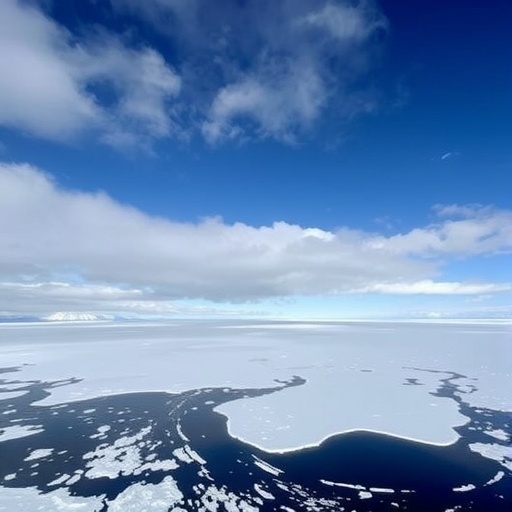
In March 2022, an unprecedented heatwave swept across Antarctica, pushing temperatures to levels that were once considered unfathomable for the icy continent. Recent research published in Communications Earth & Environment has now shed light on the underlying drivers of this alarming phenomenon. By meticulously attributing the cause of this event to complex atmospheric interactions, the study reveals that cloud feedback mechanisms played a crucial role in amplifying the heatwave’s intensity, resulting in increased meltwater production and signaling ominous implications for Antarctica’s future climate stability and global sea level rise.
Antarctica has long been perceived as a bastion of frigid cold, with its vast ice sheets serving as critical regulators of the Earth’s climate system. However, the March 2022 heatwave disrupted this long-standing balance, causing surface temperatures to soar well beyond seasonal norms. Unlike typical warming events driven by straightforward increases in greenhouse gases, the researchers found that cloud feedbacks created a positive loop that intensified the heatwave’s impact more than would have been expected otherwise. These cloud interactions modulated radiation and heat exchange in the atmosphere, effectively trapping warmth at the surface to an unprecedented degree.
Utilizing advanced climate attribution techniques, the research team led by González-Herrero et al. dissected the intertwined contributions of natural variability and anthropogenic forcing. Their results pointed to anthropogenic climate change as the principal catalyst, with cloud behavior acting as a multiplier. Clouds, often thought of as a climatic wildcard due to their transient and multifaceted nature, emerged here as key amplifiers—altering both shortwave and longwave radiation budgets. This finding challenges existing models that often underestimate cloud feedback strength, especially in polar regions where cloud dynamics remain poorly represented.
A critical insight from the study stems from the enhanced meltwater production observed during and after the heatwave. Meltwater generation on Antarctica’s ice sheets is a dangerous precursor to ice shelf destabilization and accelerated glacial flow. The team quantified increases in surface melt and linked them directly to the thermal anomalies induced by cloud feedbacks. This raises pressing concerns about the stability of Antarctica’s ice mass, as enhanced surface melting can lead to fracturing and calving events that contribute to global sea level rise, with cascading effects on coastal communities worldwide.
To reach these conclusions, the authors employed an integrated approach combining satellite remote sensing, in situ meteorological data, and state-of-the-art climate models configured to isolate cloud interactions. By running multiple simulations with and without cloud feedbacks, the scientists demonstrated a distinct amplification effect during the heatwave window. The cloud feedback mechanisms involved both low-level stratiform clouds that trap infrared radiation and high-altitude cirrus clouds that modulate solar radiation, together driving the reinforcement of surface temperatures beyond typical thresholds.
Further exploration into the atmospheric dynamics revealed that the persistent cloud cover also affected Antarctic atmospheric circulation patterns. This redistribution of heat and moisture contributed to maintaining the heatwave conditions for a protracted period, a phenomenon previously not well understood in polar meteorology. The study’s findings highlight the need for improved parameterizations of cloud processes in global climate models, which often struggle to capture the subtleties of polar cloud physics. Such improvements are critical for accurate projections of future Antarctic climate behavior.
Intriguingly, the research points to a troubling feedback loop. As temperatures rise and meltwater accumulates, changes in albedo—the reflectivity of the ice surface—further exacerbate warming. This sequence accelerates localized melting and could lead to more frequent and severe heatwave events in Antarctica, transforming it from a relatively stable ice repository to a highly dynamic and vulnerable system. The interplay between clouds, radiation, and ice surface conditions thus emerges as a central factor in shaping the continent’s future under warming scenarios.
The implications of these findings extend beyond the scientific community. Policymakers and coastal planners must consider the increased likelihood of accelerated Antarctic melting as part of global climate risk assessments. Rising sea levels threaten densely populated coastal regions, and understanding the mechanisms driving Antarctic heatwaves helps refine predictions crucial for future infrastructure adaptation and disaster preparedness. The study serves as a call to action for enhanced monitoring and mitigation efforts targeting atmospheric composition and cloud feedback processes.
Moreover, the study challenges the conventional narratives that primarily attribute polar heatwaves to large-scale atmospheric circulation anomalies alone. It shows that microphysical factors at the cloud level interplay significantly with macroclimatic forces to produce extreme surface temperature events. In this context, fine-scale observations and targeted experimentation to understand cloud microphysics become indispensable to advancing climate science. Satellite missions and polar observatories may need to adjust measurement priorities to capture these delicate but impactful processes more effectively.
In addition to climate modeling, the research invited multidisciplinary collaboration, integrating insights from glaciology, atmospheric science, and oceanography. The Antarctic heatwave’s impacts on oceanic circulation, ice shelf integrity, and regional ecosystems underscore the interconnectedness of Earth’s systems. For example, meltwater influx into surrounding seas affects thermohaline circulation patterns, potentially disrupting global climate regulation. Understanding the Antarctic heatwave thus illuminates a broader narrative of pervasive climate change impacts across the planet’s coupled systems.
Public awareness of these findings could catalyze support for international climate initiatives focused on greenhouse gas reductions and polar preservation. The study’s revelations about heightened cloud feedback sensitivity suggest that mitigating anthropogenic emissions is even more urgent than previously thought. As clouds can significantly modulate planetary energy balance, minor changes in their properties triggered by warming could have outsized effects, triggering tipping points in the Earth system that are difficult to reverse.
Looking ahead, the research team calls for enhanced modeling frameworks that better incorporate cloud-radiation-ice interactions. Next-generation climate models must resolve cloud processes at higher spatial and temporal resolutions to capture feedback loops accurately. Field campaigns in Antarctica, employing aircraft and ground-based instrumentation, could provide vital observational constraints to validate these models. This integrated scientific strategy is essential for producing reliable forecasts that inform global climate policy and response strategies.
In summary, the March 2022 Antarctic heatwave represents a significant milestone in understanding polar climate extremes. The research conducted by González-Herrero, Deb, Li, and colleagues elaborates a nuanced physical mechanism where cloud feedbacks amplify the effects of anthropogenic warming, promoting elevated surface temperatures and increased meltwater. This complex interplay underscores the urgency of refining climate models and boosting observational capabilities in polar regions to anticipate and manage the consequences of a warming world.
As we grapple with escalating climate crises, Antarctica’s evolving response emerges as both a warning and an opportunity for the scientific community. The revelation that cloud feedbacks exacerbate heatwave impacts challenges us to rethink polar climate dynamics comprehensively. It also emphasizes how previously subtle atmospheric processes can cascade into significant environmental transformations with global ramifications. Strikingly, this new knowledge crystallizes the interconnected stakes of atmospheric science, cryosphere research, and environmental stewardship in the Anthropocene epoch.
Ultimately, addressing the vulnerabilities revealed by this Antarctic heatwave demands sustained international cooperation in climate research, policy innovation, and emission reductions. The future of Antarctic ice retention, global sea levels, and planetary climate stability hinges on our ability to assimilate such scientific advancements and translate them into actionable solutions. As this study vividly demonstrates, the clouds above Antarctica may hold keys to understanding—and mitigating—some of the most pressing challenges of our time.
Cite Scienmag News
Violet Maxwell. (April 16, 2026). March 2022 Antarctic Heatwave Amplified by Clouds. Scienmag. https://scienmag.com/march-2022-antarctic-heatwave-amplified-by-clouds/
Violet Maxwell. "March 2022 Antarctic Heatwave Amplified by Clouds." Scienmag, 16 April 2026, https://scienmag.com/march-2022-antarctic-heatwave-amplified-by-clouds/. Accessed 4 September 2026.
Violet Maxwell. "March 2022 Antarctic Heatwave Amplified by Clouds." Scienmag. April 16, 2026. https://scienmag.com/march-2022-antarctic-heatwave-amplified-by-clouds/


