


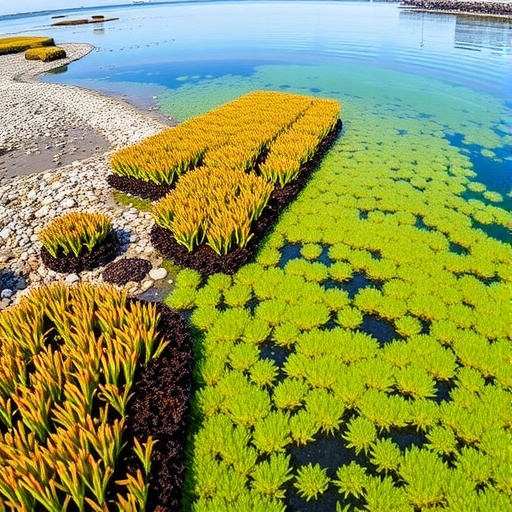
In a groundbreaking study emerging from coastal regions of Japan, researchers have unveiled significant variability in the production of recalcitrant dissolved organic carbon (RDOC) by different species of macroalgae and seagrasses. This discovery sheds new light on the complex roles these coastal plants play in carbon cycling, with profound implications for our understanding of carbon sequestration mechanisms in marine ecosystems. The research, led by Watanabe, Hori, Kubo, and their colleagues, demonstrates not only the varying capacity of these species to generate RDOC but also highlights the crucial influence they may exert on global carbon budgets.
Dissolved organic carbon (DOC) exists ubiquitously throughout the world’s oceans and plays a pivotal role in carbon cycling by contributing to the marine carbon reservoir. Within this pool, recalcitrant dissolved organic carbon represents a fraction that resists rapid microbial degradation, thereby contributing to long-term carbon storage in aquatic environments. Understanding the sources and dynamics of RDOC is essential for building accurate models of carbon flux and assessing the ocean’s potential as a carbon sink amid accelerating climate change. The new findings from Japan’s coastal waters provide a nuanced picture of biological contributions to RDOC pools.
The investigators conducted extensive field sampling in diverse habitats along Japan’s coastlines, analyzing DOC released by a variety of macroalgae and seagrass species under controlled conditions. They employed advanced spectroscopic and chromatographic techniques to characterize the molecular composition of the DOC exudates and to quantify the fraction of RDOC within these complex mixtures. The innovative methodological approach allowed for unprecedented resolution in tracing how specific species contribute to the persistent organic carbon pool in coastal waters.
One of the study’s key revelations is the species-specific nature of RDOC production. While all studied macroalgae and seagrasses release dissolved organic carbon, their efficiency in generating recalcitrant fractions varies significantly. For instance, certain brown macroalgae species were found to produce higher amounts of RDOC compared to their green or red counterparts, possibly due to differences in their biochemical compositions, such as complex polysaccharides or phenolic compounds that are inherently harder to degrade. Seagrasses, despite their relatively lower biomass in coastal zones, also contribute uniquely proportionate amounts of RDOC.
These findings challenge previously held assumptions that the terrestrial detritus contribution dominated the marine recalcitrant organic matter pool. Instead, the researchers elucidate the vital role that living coastal vegetation plays in supplying RDOC, which can persist in seawater for centuries. This long residence time suggests that coastal macroalgae and seagrass beds are undervalued hotspots for carbon sequestration, potentially buffering the effects of anthropogenic CO2 emissions by stabilizing carbon in a biologically derived, yet resistant, form.
The implications for ecosystem management and climate mitigation strategies are manifold. Protecting and restoring coastal vegetation becomes imperative not only for biodiversity and habitat services but also for carbon capture potentials locked within the organic carbon continuum. Given the variability observed among species, conservation priorities may need refinement to focus on ecosystems harboring species with particularly high RDOC output. Enhanced protection may ultimately enhance the resilience of coastal carbon sinks under changing environmental conditions.
The molecular composition analyses further revealed intriguing insights. The recalcitrant DOC compounds identified included a spectrum of high molecular weight polysaccharides and complex aromatics, which offer resistance to microbial oxidation and photodegradation. These compounds likely contribute to the stability and longevity of the RDOC pool once released into the marine environment. Such detailed chemical characterization is vital for improving biogeochemical models that traditionally lump DOC pools into simplified categories without accounting for molecular diversity.
Moreover, the dynamics of RDOC release exhibited seasonal patterns linked to plant metabolic cycles and environmental factors such as temperature and light availability. Higher productivity periods corresponded with increased exudation rates of DOC, thereby suggesting that climate change-driven shifts in seasonality and productivity could alter the ocean’s recalcitrant carbon stocks. This adds yet another layer of feedback between coastal ecosystems and the global climate system, underscoring the need for comprehensive multidisciplinary monitoring approaches.
One of the profound aspects of this study is its contribution to resolving the so-called “marine carbon paradox”—the discrepancy between known terrestrial carbon inputs and the unexpectedly large and stable DOC reservoir in the oceans. By teasing apart biological sources from different vegetation types, the researchers provide a pathway toward quantifying biological “carbon pumps” operating at finer ecological scales in coastal zones. This knowledge refines our conceptual frameworks and facilitates predictive capabilities critical for Earth system science.
The study also emphasizes the variability introduced by local environmental conditions, including nutrient availability, salinity, and hydrodynamics, which modulate DOC production rates and composition. Such spatial heterogeneity points to the complexity embedded in marine carbon cycling processes and highlights the necessity for geographically diverse datasets. Field investigations at multiple coastal sites across Japan contributed valuable comparative insights, suggesting that regional oceanographic features can influence carbon sequestration efficiencies.
Looking forward, the research team advocates for integrating molecular-level DOC data into broader ecosystem models. Such integration could enable more robust forecasting of coastal carbon dynamics under future environmental scenarios. Additionally, they call for extended temporal datasets and expanded species coverage to capture the variability and drivers of RDOC production fully. The intersection of observational, experimental, and modeling efforts will be critical for translating this newfound understanding into practical policies for climate mitigation.
This pioneering work also opens promising avenues for exploring biotechnological applications by harnessing natural processes of RDOC stabilization. Recognizing which plant-derived compounds confer long-term carbon persistence could inspire innovative strategies in carbon storage or materials science. Furthermore, the study revitalizes interest in coastal marine plants not only as ecological components but also as instrumental contributors to Earth’s carbon regulatory systems.
In conclusion, the research conducted along Japan’s coastal marine environments represents a significant advance in our grasp of how macroalgae and seagrasses influence the sequestration of recalcitrant dissolved organic carbon. By unraveling species-specific contributions and molecular intricacies, Watanabe and colleagues pave the way for more accurate models of oceanic carbon storage and highlight the critical need to conserve and restore coastal vegetation. As climate change poses escalating challenges, such knowledge becomes indispensable for devising effective carbon management strategies, reinforcing the ocean’s vital role in sustaining planetary health.
Cite Scienmag News
Violet Maxwell. (May 27, 2026). Macroalgae, Seagrass Produce Variable Coastal DOC Japan. Scienmag. https://scienmag.com/macroalgae-seagrass-produce-variable-coastal-doc-japan/
Violet Maxwell. "Macroalgae, Seagrass Produce Variable Coastal DOC Japan." Scienmag, 27 May 2026, https://scienmag.com/macroalgae-seagrass-produce-variable-coastal-doc-japan/. Accessed 3 September 2026.
Violet Maxwell. "Macroalgae, Seagrass Produce Variable Coastal DOC Japan." Scienmag. May 27, 2026. https://scienmag.com/macroalgae-seagrass-produce-variable-coastal-doc-japan/


