


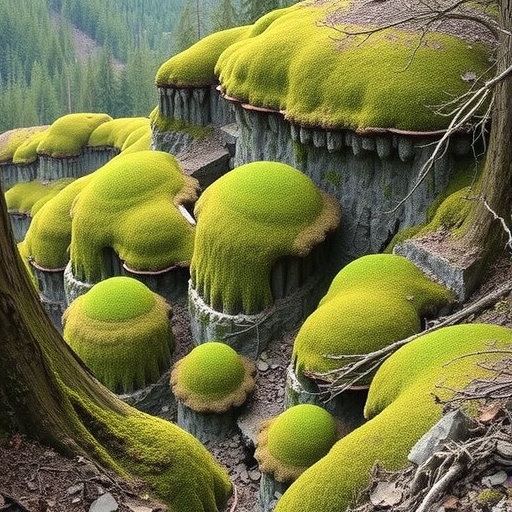
Southwest China’s dramatic greening may be facing an invisible limit beneath the surface. A regional analysis of karst forests and shrublands has found that soil thickness—not climate or the concentration of nutrients in the soil—was the strongest predictor of woody vegetation volume. The result points to a fundamental problem in carbonate landscapes: plants may appear to benefit from restoration and increased vegetation cover, yet their long-term growth can remain constrained by the amount of soil available to store water, nutrients and roots.
The study, published in Science China Earth Sciences, examined vegetation and environmental data from across Yunnan, Guangxi, Guizhou, Chongqing and Hubei. These provinces contain extensive karst terrain, where soluble carbonate rocks have been shaped by erosion, underground drainage and the formation of fractured slopes, depressions and rocky outcrops. Such landscapes can support forests and shrublands, but their soils are often discontinuous and shallow. Rainwater may move rapidly through cracks and cavities in the bedrock, while exposed surfaces are vulnerable to erosion and the loss of fine soil particles.
To investigate which environmental factors most strongly influence vegetation, the researchers assembled 525 records from 35 previous studies covering 41 forest and shrubland sites. The dataset included vegetation-cover and vegetation-height measurements collected in different karst landforms and climatic settings. For a more focused analysis, the team identified 56 valid records of woody vegetation volume, an index calculated by multiplying canopy cover by canopy height. Although this measure does not equal the actual biomass of a forest, it provides a standardized way to compare the amount of woody vegetation across sites. Soil thickness, measured by excavating soil profiles, was used as an indicator of soil volume available to plants.
The researchers then compared the effects of soil thickness with climate variables and soil nutrient concentrations using several statistical approaches. Univariate regression first examined the relationship between individual environmental factors and woody vegetation volume. An eXtreme Gradient Boosting, or XGBoost, model was subsequently used to evaluate the relative importance of multiple predictors. XGBoost is a machine-learning method that builds a sequence of decision trees, with each new tree improving the model’s errors from the previous ones. This makes it useful for identifying nonlinear relationships and ranking the contribution of interacting environmental variables.
Across the analyses, soil thickness consistently emerged as the dominant factor. In the univariate model, it accounted for 69.78 percent of the spatial variation in woody vegetation volume. Its importance score in the XGBoost model exceeded 0.8, substantially higher than the scores of most climate and nutrient variables. The result does not mean that temperature, rainfall or nutrients are irrelevant. Instead, it suggests that their effects may be strongly moderated by the physical capacity of the soil system. Where soil is too shallow, even favorable climate conditions or relatively high nutrient concentrations may not translate into sustained woody growth.
The analysis identified a sharp change in the soil–vegetation relationship at approximately 57.5 centimeters. Above this breakpoint, additional soil thickness was associated with a comparatively weaker increase in woody vegetation volume. Below it, however, small reductions in soil thickness corresponded to much larger changes in vegetation. This threshold suggests that shallow-soil ecosystems may operate close to a physical limit. Once soil volume falls below a critical level, the loss of even a few centimeters can remove a substantial fraction of the water-storage and rooting environment available to trees and shrubs.
Network analysis provided further evidence that the dominant ecological constraint shifts across this threshold. In areas with greater soil volume, woody vegetation was more closely associated with soil nutrient concentrations. Under those conditions, plants may have enough physical space and moisture storage for nutrient availability to become a more visible control on growth. In low-soil-volume environments, by contrast, most nutrient-concentration variables became weakly connected to vegetation volume, while soil thickness became the strongest correlate. Temperature and precipitation also showed stronger links with vegetation in these shallow-soil settings, indicating that reduced soil storage may amplify the influence of short-term weather fluctuations and long-term climate variability.
The mechanism proposed by the researchers involves total resource storage rather than concentration alone. A thin soil layer can contain a high concentration of nitrogen, phosphorus or other nutrients while holding only a small total stock because there is little soil mass. The same principle applies to water. Shallow soil has limited capacity to absorb and retain rainfall, and the fractured structure of karst bedrock can accelerate drainage beyond the reach of plant roots. Weathered rock may provide some moisture, but it generally does not buffer drought and temperature swings as effectively as a deeper, fine-textured soil profile. As a result, plants growing in thin soils may experience rapid transitions between water availability and water stress, even when local annual rainfall appears sufficient.
Phosphorus remained a secondary but persistent limitation in the study, reinforcing the idea that nutrients still matter in karst ecosystems. However, nutrient concentration measurements alone may give an incomplete picture of plant resources. Restoration assessments that focus only on chemical fertility could overestimate the ability of a site to support trees and shrubs if they do not also measure soil depth, erosion status and total water and nutrient stocks. The findings therefore place soil conservation at the center of questions about the durability of Southwest China’s greening. Preventing erosion and rocky desertification may be as important as selecting species or adding nutrients, particularly in locations already close to the 57.5-centimeter threshold.
The study does not directly test a specific restoration technique, plantation design or erosion-control intervention, and its regional statistical relationships should not be treated as a universal planting prescription. Even so, it offers a warning for landscapes where rising vegetation cover may conceal declining soil resources. Karst vegetation can recover while the foundation supporting that recovery continues to erode. By showing that the principal limitation shifts from nutrients to soil volume under shallow conditions, the research provides a framework for identifying vulnerable sites and for testing how forest management, soil conservation and climate variability will influence the future of greening across Southwest China.
Web References: https://doi.org/10.1007/s11430-025-1973-1
References: Pan W, Li X, Li Z, Gui Z, Liu H. 2026. “Karst greening is challenged by reduced soil volume in Southwest China.” Science China Earth Sciences 69(8): 3102–3109.
Cite Scienmag News
Violet Maxwell. (August 17, 2026). Karst Greening Hits a Hidden Limit: Insufficient Soil. Scienmag. https://scienmag.com/karst-greening-hits-a-hidden-limit-insufficient-soil/
Violet Maxwell. "Karst Greening Hits a Hidden Limit: Insufficient Soil." Scienmag, 17 August 2026, https://scienmag.com/karst-greening-hits-a-hidden-limit-insufficient-soil/. Accessed 6 September 2026.
Violet Maxwell. "Karst Greening Hits a Hidden Limit: Insufficient Soil." Scienmag. August 17, 2026. https://scienmag.com/karst-greening-hits-a-hidden-limit-insufficient-soil/


