


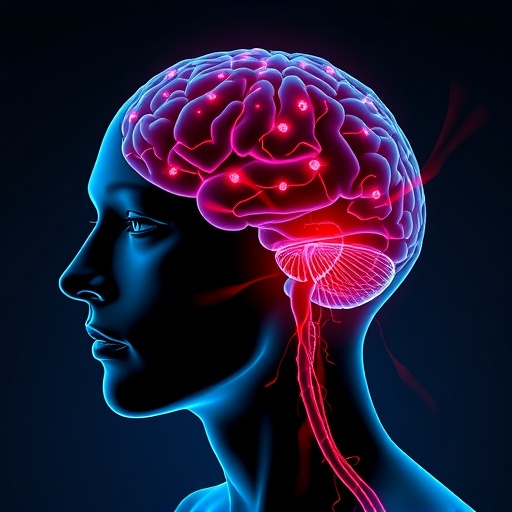
At the base of the brain, a small but powerful cluster of nerve cells may hold the key to developing more precise treatments for chronic pain. Researchers at Washington University School of Medicine in St. Louis have identified a population of receptors in the locus coeruleus—a brain region best known for controlling alertness, attention and stress—that can suppress the neural activity driving persistent pain after nerve injury. Their findings, obtained in mice and published in Current Biology, suggest that the brain’s natural opioid system does more than provide general pain relief: it can act locally as a molecular brake on a chronic pain circuit.
Neuropathic pain develops when nerves are damaged or malfunctioning. Instead of transmitting accurate information about an injury, damaged nerve fibers can send continuous or distorted electrical signals toward the spinal cord and brain. The resulting sensations may include burning, stabbing, shooting or hypersensitivity to normally harmless stimuli such as light touch or mild heat. Neuropathic pain can arise from diabetes, viral infections, nerve compression and physical trauma, and it is often difficult to treat because the abnormal signaling persists long after the original injury has healed.
The Washington University team focused on the locus coeruleus because previous research has shown that this compact region influences how the nervous system processes pain. Located in the brainstem, the locus coeruleus contains neurons that release noradrenaline, a chemical messenger involved in arousal, vigilance, stress responses and communication between the brain and spinal cord. Under normal conditions, activity in this region can engage descending pathways that reduce incoming pain signals. Following nerve injury, however, the same system can become abnormally active and act as what the researchers describe as a “pain generator,” intensifying the perception of pain rather than suppressing it.
To test the region’s role, the researchers used mice with experimentally induced neuropathic pain and temporarily silenced neurons in the locus coeruleus. The animals became less sensitive to touch and heat than untreated mice with nerve injury, indicating that activity in the region was contributing to their pain-related behavior. This result supported the idea that the locus coeruleus does not simply participate in pain regulation in an abstract way; under chronic pain conditions, its neurons can become a functional source of heightened sensitivity.
The scientists then examined mu opioid receptors, proteins embedded in the surface of nerve cells that respond to naturally produced opioid peptides as well as opioid drugs such as morphine and fentanyl. When activated, mu opioid receptors can reduce neuronal excitability by altering ion channels and suppressing the release of neurotransmitters. These receptors are distributed throughout the brain and spinal cord, which helps explain the broad pain-relieving effects of opioids but also contributes to sedation, respiratory depression, tolerance and addiction risk. Because the locus coeruleus contains a particularly high concentration of mu opioid receptors, the researchers asked whether these receptors might control pain specifically within this brain region.
Using molecular techniques, the team removed mu opioid receptors from locus coeruleus neurons in mice experiencing neuropathic pain. Without the receptors, the animals showed greater sensitivity to both touch and heat than mice whose receptors remained intact. The result indicated that mu opioid receptors normally restrain the activity of these neurons, preventing the locus coeruleus from amplifying pain signals. The finding also provided evidence that the receptors are not merely passive targets for opioid drugs but active components of the brain’s own pain-control system.
The researchers next restored mu opioid receptors to the same locus coeruleus neurons. This intervention reversed the animals’ hypersensitivity, effectively switching off the pain-related behavior. The experiment was important because it linked the receptor directly to the observed effect: removing the receptor worsened sensitivity, while putting it back reduced sensitivity. According to the researchers, the results suggest that nerve injury may impair the ability of mu opioid receptors to control the locus coeruleus, allowing the region’s neurons to remain excessively active and sustain chronic pain.
The study may help explain why conventional opioid medications can relieve pain while also producing serious complications. Drugs that circulate throughout the nervous system activate mu opioid receptors in many locations, including regions involved in reward, breathing and arousal. A treatment designed to act preferentially on receptors in the locus coeruleus could, in principle, suppress a chronic pain circuit without producing the same degree of widespread opioid activity. Such an approach remains theoretical, however. The present experiments were performed in mice, and the researchers must still determine whether the same receptor mechanisms operate in humans and whether they can be targeted safely without disturbing the locus coeruleus’s other functions.
The team is now investigating ways to manipulate mu opioid receptors and locus coeruleus circuits with greater precision. Future therapies might use drugs engineered to reach specific receptor populations, molecular delivery systems, or other interventions capable of changing activity in a defined part of the brain. The goal would be to preserve the pain-relieving effects of opioid signaling while limiting exposure of the rest of the nervous system. Although considerable work is required before such strategies could be tested clinically, the discovery identifies a localized biological checkpoint that may be central to the transition from acute pain to persistent neuropathic pain.
Chronic neuropathic pain affects millions of adults and remains one of the most challenging conditions in medicine. The Washington University findings do not yet represent a treatment for patients, but they offer a clearer map of how the brain can both suppress and generate pain. By showing that mu opioid receptors in the locus coeruleus can gate the activity of a chronic pain circuit, the study points toward therapies that are more selective than traditional opioids. It also reinforces a growing view in neuroscience: effective pain relief may depend not on broadly shutting down the nervous system, but on precisely controlling the small groups of cells that decide whether pain signals are amplified or silenced.
News Publication Date: 17-Aug-2026
Web References: https://clinicalpharmacology.wustl.edu/people/jordan-mccall-phd/ ; https://mccall-lab.wustl.edu/people/chao-cheng-kuo-phd/
References: Kuo CC, Norris MR, Dunn SS, Becker LJ, Kim JR, Vazquez CR, Borges G, Thang LV, O’Brien JT, Parker KE, McCall JG. “Mu opioid receptors gate the locus coeruleus pain generator.” Current Biology, 17 August 2026.
Cite Scienmag News
Cassandra Pierce. (August 17, 2026). Scientists discover brain mechanism that switches off chronic pain. Scienmag. https://scienmag.com/scientists-discover-brain-mechanism-that-switches-off-chronic-pain/
Cassandra Pierce. "Scientists discover brain mechanism that switches off chronic pain." Scienmag, 17 August 2026, https://scienmag.com/scientists-discover-brain-mechanism-that-switches-off-chronic-pain/. Accessed 3 September 2026.
Cassandra Pierce. "Scientists discover brain mechanism that switches off chronic pain." Scienmag. August 17, 2026. https://scienmag.com/scientists-discover-brain-mechanism-that-switches-off-chronic-pain/


