


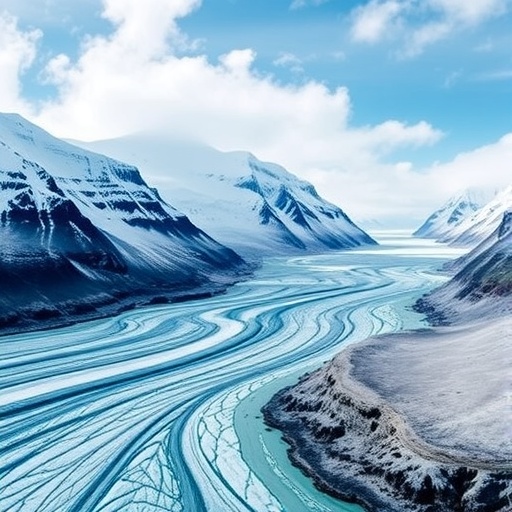
A quiet scientific crisis is unfolding high in the world’s mountains. As glaciers retreat, they are not only shrinking as frozen reservoirs of freshwater; they are also losing the natural archives that record how climate and water cycles have changed over centuries and millennia. A new study by Yana Vystavna, Maxime Vital, Andrew Watson and colleagues warns that glacier-fed basins worldwide are rapidly surrendering this environmental memory. The consequences could reach far beyond mountain valleys, affecting climate research, water management and the ability of societies to anticipate future hydrological change.
Glaciers are often described as reservoirs because they store precipitation as ice and release it gradually through melting. But they are also archives. Snowfall, dust, volcanic ash, atmospheric pollutants and chemical compounds become trapped in successive layers of ice. By extracting and analysing ice cores, scientists can reconstruct past temperatures, precipitation patterns, atmospheric circulation and pollution histories. Sediments accumulating in proglacial lakes and streams preserve a second record, containing minerals, organic matter and chemical signatures transported from the glacier and surrounding landscape. Together, these materials form a detailed history of a basin’s hydroclimate—the interaction between atmospheric conditions, water availability, runoff and land processes.
That archive is now being erased from the top down. Human-driven warming is accelerating glacier mass loss across nearly every mountain region, including the Himalayas, Andes, Alps, Rockies and high-latitude ranges. When ice thins, melts and fragments, the layered structure that makes it scientifically valuable can be disrupted or destroyed. Old ice may disappear before researchers have an opportunity to recover it. At the same time, changes in meltwater discharge can disturb lake sediments and river deposits, mixing older material with newly transported sediment and blurring the chronological sequence. The result is not simply less ice, but less reliable evidence about the past.
The study, published in Communications Earth & Environment, focuses on glacier-fed basins as interconnected systems rather than isolated ice bodies. A glacier’s retreat changes the entire chain through which environmental information is stored and transported. As the ice surface lowers, previously buried layers may become exposed to melting and erosion. Newly formed lakes can trap sediment, while expanding meltwater channels can reroute material away from established depositional environments. Permafrost thaw, rockfall and the expansion of unvegetated terrain can add further sediment to rivers and lakes, making it increasingly difficult to distinguish climate signals from landscape disturbance.
This distinction is technically crucial. Researchers reconstruct past climate by identifying signals that change in a predictable relationship with environmental conditions. For example, the ratio of stable oxygen isotopes in ice or sediment can provide clues about the origin and temperature of precipitation. Grain size, mineral composition and sediment accumulation rates can reveal changes in runoff, erosion and glacier extent. Organic molecules and trace elements can indicate vegetation shifts or atmospheric contamination. But these proxies only work when their position in time is preserved. If layers are melted, overturned, chemically altered or redeposited, the archive may retain material without retaining a dependable chronology.
The researchers’ central warning is that the loss is irreversible. A glacier can sometimes be monitored after retreat, and new measurements can document present-day change, but a vanished ice layer cannot be recreated. Modern instruments may provide exceptionally detailed observations of temperature, precipitation and streamflow, yet these records generally extend back only a few decades. Natural archives offer a much longer perspective, allowing scientists to compare today’s rapid warming with earlier fluctuations and to test climate models against real environmental responses. Without them, many mountain regions could enter a future in which their most valuable baseline information has disappeared.
The disappearance of these archives also threatens water planning. Glacier-fed rivers supply water to hundreds of millions of people, particularly during warm and dry seasons when snow and ice melt sustain downstream flows. Understanding how a basin responded to earlier periods of warming, drought or intense precipitation can help authorities estimate future water availability and flood risk. If the historical record is lost, projections must rely more heavily on models operating with fewer local constraints. That uncertainty matters for hydropower, irrigation, drinking-water systems and ecosystems that depend on seasonal meltwater.
There is a further danger: the very processes that destroy the archives can increase short-term hazards. Glacier retreat often creates unstable slopes, rapidly expanding lakes and changing river channels. Sudden drainage from glacier lakes can produce destructive outburst floods, while enhanced erosion can overload rivers with sediment and damage infrastructure. In this sense, the loss of hydroclimate archives is occurring alongside a transformation of the hazards they might have helped explain. Scientists are being asked to reconstruct a changing system at the same time that the physical evidence needed for reconstruction is being dismantled.
The authors’ message is therefore urgent but practical: remaining archives must be identified, prioritised and sampled before they vanish. That effort requires more than drilling ice cores. Researchers need coordinated surveys of glacier ice, proglacial lakes, river sediments, soils and biological indicators, combined with satellite observations, automatic weather stations, hydrological measurements and geochemical dating. Samples should be documented with precise information about their location, elevation, depth and environmental setting so they can be compared across regions. Digital mapping and remote sensing can help identify rapidly changing basins, but field campaigns remain essential for collecting material that satellites cannot see beneath ice or sediment.
The study turns glacier retreat into a race against time for climate science. Every metre of thinning ice and every newly disturbed sediment layer may remove part of a record that cannot be recovered by technology later. Protecting mountain communities still requires emissions reductions, adaptation and improved hazard monitoring, but it also requires preserving the evidence that tells researchers how these environments work. The world’s glaciers are melting into rivers, lakes and oceans—and, with them, a library of Earth’s hydroclimate history is disappearing before its final pages can be read.
Cite Scienmag News
Violet Maxwell. (August 17, 2026). Glacier-Fed Basins Worldwide Are Losing Critical Hydroclimate Records. Scienmag. https://scienmag.com/glacier-fed-basins-worldwide-are-losing-critical-hydroclimate-records/
Violet Maxwell. "Glacier-Fed Basins Worldwide Are Losing Critical Hydroclimate Records." Scienmag, 17 August 2026, https://scienmag.com/glacier-fed-basins-worldwide-are-losing-critical-hydroclimate-records/. Accessed 5 September 2026.
Violet Maxwell. "Glacier-Fed Basins Worldwide Are Losing Critical Hydroclimate Records." Scienmag. August 17, 2026. https://scienmag.com/glacier-fed-basins-worldwide-are-losing-critical-hydroclimate-records/


