

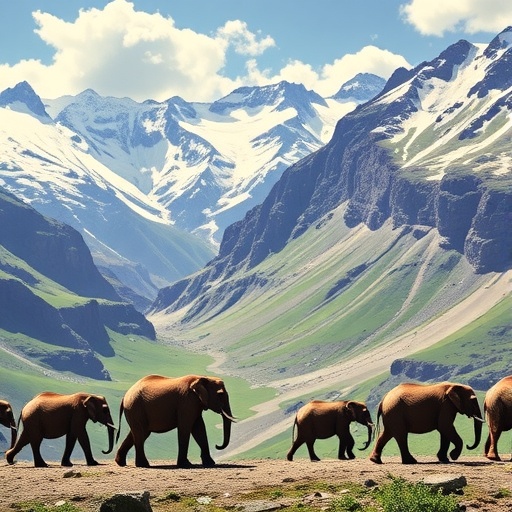
For more than two millennia, the exact route Hannibal took to march his army—including 37 war elephants—over the Alps into Italy has been one of ancient history’s most tantalizing puzzles. Now, a study that treats the Carthaginian general’s legendary crossing as a problem in bioenergetics has placed a heavy thumb on the scale in favor of a narrow, high‑altitude pass called the Col de la Traversette. Rather than sifting through cryptic ancient texts, researchers built a physics‑based model of how much metabolic energy men, horses, and especially elephants would have expended on each candidate path, turning the debate into a calculation of joules and body fat.
The work, published in the Proceedings of the National Academy of Sciences, was led by scientists from the University of Oxford and the German Centre for Integrative Biodiversity Research at Friedrich Schiller University Jena. They evaluated four Alpine passes long considered plausible: the Col de la Traversette, Col du Clapier, Col de Montgenèvre, and Col du Mont Cenis. The Col du Clapier had previously been the leading hypothesis, but the new numbers tell a different story. The team’s energy‑budget analysis shows that the Traversette would have been the least costly, requiring about 5.42 terajoules (10¹² joules) for the entire army to cross, while the Clapier demanded 6.28 terajoules—a 16 percent penalty.
To build their model, the researchers tapped into a rich dataset on modern African elephants, the closest living analogues to the now‑extinct North African forest elephants Hannibal likely used. Previous work had established how energy expenditure scales with body mass and terrain gradient in these animals; the new study imported those equations into a digital elevation model of the Alps. Every rise and fall along each route was converted into a cumulative energy bill, integrating the muscle‑level physics of locomotion. This bioenergetic approach sidesteps the ambiguities of ancient narratives by focusing on a constraint Hannibal’s officers would have felt viscerally: if the animals ran out of reserves, the campaign collapsed before it began.
The energy gaps between routes were substantial. Compared with the Traversette, the route through Montgenèvre would have cost 11 percent more energy, Clapier 16 percent more, and Mont Cenis 19 percent more. In absolute terms, the differences run into hundreds of billions of additional joules, which on steep, icy terrain translate directly into exhaustion, slower progress, and higher mortality. The model also captured the grim human arithmetic of Alpine warfare: the men, who started with much slimmer fat stores, would have lost roughly 19 percent of their body fat during the Traversette crossing alone, a depletion extreme enough to explain the high death toll recorded in historical accounts.
Paradoxically, the elephants appear to have been physiologically well‑buffered against the ordeal. Despite their immense size, the simulations predict they shed only about 4 percent of their energy reserves on the Traversette route. This resilience stems from the peculiar energetics of large mammals: a tonne of elephant burns far less energy per kilogram than a human on the same slope, and their prodigious fat deposits—often exceeding 100 kilograms in a healthy adult—act as living batteries that would have sustained them even after their human companions began to starve. The finding adds a quantitative layer to classical reports that most of the elephants not only survived the crossing but went on to fight in Italy.
Professor Fritz Vollrath of Oxford’s Department of Biology, who has spent years studying elephant locomotion in Kenya, noted that the study demonstrates how ecological field data can illuminate ancient events in surprising ways. “Applying insights gained from studying the energetics of African elephants is bringing a novel dimension to the longstanding debate over Hannibal’s Alpine crossing,” he said. The work underscores a growing trend in which movement ecology tools—originally developed to track migrations and energy budgets of living species—are being retrofitted onto historical and archaeological questions.
Dr. Emilio Berti from iDiv and Friedrich Schiller University Jena, a co‑author, acknowledged that no single analysis can settle the debate definitively, given the fragmentary nature of the sources. However, he stressed that the energetic perspective strongly shifts the burden of proof toward the Traversette. “The new analysis does not eliminate all ambiguity,” he said, “but it does strengthen the case for the Traversette route by demonstrating that it would better accommodate the demands of moving a large army that included elephants through extremely difficult alpine terrain.” The selection of an alpine pass, in this light, becomes not merely a question of topography but of the metabolic ledger that determined life or death for thousands of organisms uphill.
Why Hannibal chose to bring elephants at all remains an open historical question. The animals may have been intended as tactical shock weapons to terrify Roman legionaries in the first Punic War engagements on Italian soil, or perhaps as awe‑inspiring recruitment tools to win over the Celtic tribes of the Po Valley. Whatever their strategic purpose, the new research clarifies the biological feasibility of moving them through one of the most forbidding mountain ranges on earth. It also exemplifies how cross‑disciplinary work—melding bioenergetic theory, elephant physiology, and classical archaeology—can transform an ancient riddle into a testable scientific hypothesis, offering fresh answers while leaving a few mysteries still standing on the Alpine snow.
Subject of Research: Bioenergetic evaluation of Hannibal’s Alpine crossing route using movement ecology models based on elephant energetics
Article Title: Energy costs of Hannibal’s alpine crossing
News Publication Date: 6-Jul-2026
Web References: https://www.pnas.org/doi/10.1073/pnas.2612764123
References: 10.1073/pnas.2612764123
Keywords: Hannibal, Alps, elephant energetics, bioenergetics, movement ecology, Col de la Traversette, historical archaeology, energy expenditure


