


In a groundbreaking advancement that promises to reshape our approach to prehistoric archaeology, scientists have, for the first time, successfully retrieved ancient human DNA directly from cave walls, illuminating an unseen dimension of human history preserved within stone. This extraordinary achievement, the product of the First Art project, conducted collaboratively by researchers from Spain, Portugal, the Max Planck Institute for Evolutionary Anthropology in Germany, the UK, and China, demonstrates that these seemingly inert surfaces harbor genetic remnants of our ancestors, some dating back at least two millennia.
The discovery shifts the paradigm of archaeogenetics, where DNA studies traditionally focused on bones, sediments, and artifacts. By harnessing cutting-edge extraction and sequencing technologies, researchers ventured beyond established confines to probe both pigmented and unpigmented sections of cave walls, expanding the molecular window into Paleolithic human activity. This new frontier promises unprecedented insights not only into the creators of ancient cave art but also into the broader behaviors, movements, and identities of prehistoric populations who inhabited these subterranean environments.
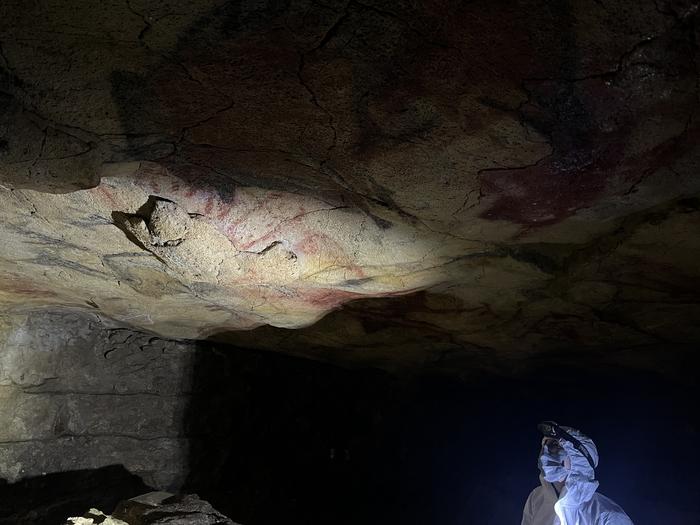
Central to the study were 24 rock art panels from eleven caves spanning Spain and Portugal, encompassing a variety of prehistoric markings—from simple etchings and hand stencils to complex figurative paintings. Among these, fragments of pigment and mineral crusts were meticulously sampled, including material from the iconic Cave of Altamira, home to some of the most celebrated Paleolithic artworks. Alongside cave walls, sediments, bones, and even a prehistoric bird bone “airbrush” tool used for pigment application were analyzed, reflecting the multidisciplinary reach of the research.
The team’s analyses yielded mitochondrial and nuclear human DNA from both visibly pigmented calcite crusts and unpigmented cave wall surfaces. Notably, they uncovered authentic ancient human DNA in a pigmented calcite crust beneath Panel 11 at Escoural Cave in Portugal, suggesting direct human contact likely introduced via saliva or bodily fluids during pigment application. Equally compelling was the detection of ancient human DNA in non-pigmented cave wall samples from Escoural and Covarón Caves, initially sampled as negative controls, hinting that DNA traces can endure in the cave matrix beyond pigment presence.
A significant aspect of the discovery is the rare absence of faunal DNA in certain samples that contained robust human genetic signatures. This dissociation strongly supports the hypothesis of direct DNA deposition by humans, as opposed to passive contamination from environmental sources like sediments or waterborne transfer, which typically introduce a mixture of animal and human DNA. This finding elevates the potential for cave walls to function as biological archives reflecting human presence and activity in exquisite fidelity.
Despite the remarkable promise, the DNA preservation was patchy and evidently fragile. Out of 54 total samples, only five yielded authentic ancient human mitochondrial DNA, underscoring that DNA retention on rock surfaces is highly variable and influenced by complex environmental and geological factors. Intriguingly, attempts to recover human DNA from an ancient bird bone airbrush tool, anticipated to bear saliva-derived genetic material, failed due to pervasive modern contamination and the limited sampling fraction—highlighting methodological challenges inherent in ancient DNA studies involving heavily handled artifacts.
The genetic profiles inferred from the samples reveal a tapestry of human diversity. DNA signatures indicate a predominance of female ancestry in three samples, male lineage in one, and an undetermined origin in another. Nuclear DNA analyses from the Covarón cave wall fragments situate these individuals within the framework of Western hunter-gatherer populations, aligning with broader patterns observed in ancient Iberian genomic studies. These insights set the stage for more refined paleo-population reconstructions sourced directly from cave substrates.
This pioneering work fundamentally alters existing conceptions regarding the locales where ancient DNA can be retrieved and analyzed. The revelation that cave walls—even those devoid of visible pigment or cultural markings—can preserve genomic evidence of prehistoric inhabitants invites archaeologists to reconsider strategies for probing human interactions within deep cave environments. Questions that were once speculative, such as inquiring about the sex or population affinity of cave visitors, now acquire tangible investigative potential.
Moreover, beyond the alluring prospect of characterizing the makers of Paleolithic art, this discovery offers a non-destructive avenue to elucidate patterns of cave usage, seasonal occupation, and social behavior. The minimally invasive nature of DNA sampling from mineral surfaces may reduce reliance on skeletal remains and sediment excavations, preserving sensitive archaeological contexts while unlocking information previously out of reach.
Although this is an inaugural step, the rarity of DNA detection across sampled panels signals the necessity for enhanced methodological refinement. Factors such as mineral crust protection, cave microclimate stability, and biochemical interactions likely play determinants roles in DNA preservation, warranting intensive research into optimal sampling conditions and molecular recovery techniques. As extraction technologies evolve, so too will the capacity to retrieve richer, more complete genomic data sets from cave environments.
Future investigations envision systematic surveys across varying cave types, geographic regions, and art styles, including hand stencils and large-scale figurative paintings. These endeavors aspire to converge molecular biology, geochemistry, and archaeology into a transformative discipline that reconstructs the biological and cultural identities of prehistoric humans left inscribed in stone. Through such integrative approaches, it may become feasible to attribute genetic identities—and perhaps individual stories—to the enigmatic artists whose works have fascinated humanity for millennia.
In an era when the secrets of ancient human existence increasingly emerge from the most unexpected quarters, the discovery of ancient DNA within cave walls stands as a monumental beacon. It invites us to imagine the silent whispers embedded in rock, extending an invitation across ages to decipher the genetic echoes of our Palaeolithic forebears—ushering in a novel chapter in the pursuit of our shared origins.
News Publication Date: 23 June 2026
Web References:
http://dx.doi.org/10.1038/s41467-026-74234-2
Cite Scienmag News
Courtney Benton. (June 24, 2026). Ancient DNA Discovered on Cave Walls Reveals New Insights. Scienmag. https://scienmag.com/ancient-dna-discovered-on-cave-walls-reveals-new-insights/
Courtney Benton. "Ancient DNA Discovered on Cave Walls Reveals New Insights." Scienmag, 24 June 2026, https://scienmag.com/ancient-dna-discovered-on-cave-walls-reveals-new-insights/. Accessed 3 September 2026.
Courtney Benton. "Ancient DNA Discovered on Cave Walls Reveals New Insights." Scienmag. June 24, 2026. https://scienmag.com/ancient-dna-discovered-on-cave-walls-reveals-new-insights/


