

Wednesday, July 29, 2026
Science
No Result
View All Result
  • Login
  • HOME
  • SCIENCE NEWS
  • CONTACT US
  • HOME
  • SCIENCE NEWS
  • CONTACT US
No Result
View All Result
Scienmag
No Result
View All Result
Home Science News Archaeology

Sheep Teeth Reveal Life in Medieval Kazakhstan Through Dental Evidence

July 29, 2026
in Archaeology
Reading Time: 2 mins read
0
Sheep Teeth Reveal Life in Medieval Kazakhstan Through Dental Evidence
65
SHARES
587
VIEWS
Share on FacebookShare on Twitter
ADVERTISEMENT

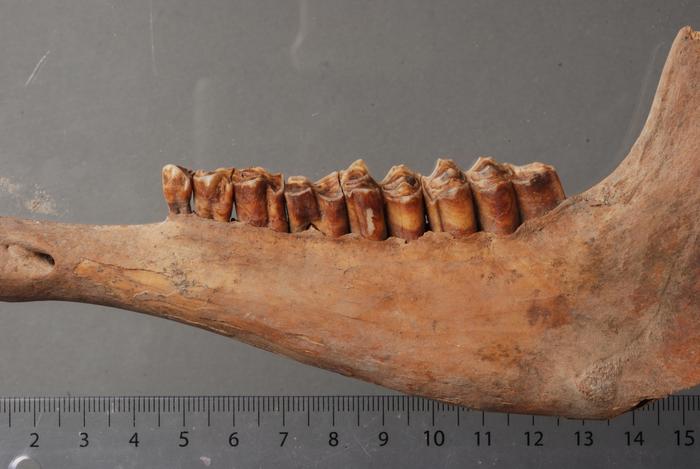
Archaeology is often narrated through artifacts, but a new study shows that livestock teeth can also preserve the logic of past survival strategies. In medieval southern Kazakhstan, sheep mandibles reveal how herders managed risk in an arid landscape where winter cold, summer heat, and limited rainfall forced constant adaptation.

Led by researchers at the University of Michigan, an international team used isotope geochemistry to reconstruct herd provisioning at the Silk Road city of Dzhankent during the 9th and 10th centuries. Their focus was on enamel chemistry—minute variations that become time-stamped chemical records as animals grow.

The method relies on isotopes embedded in what sheep eat and drink. Carbon isotope ratios helped track shifts in forage sources, distinguishing grass intake typical of drier or warmer periods from vegetation patterns associated with wetter seasons. Oxygen isotope ratios reflected seasonal water variability, with values rising in summer and falling in winter.

To extract these signals, the team examined sequential measurements across the second molars from 16 sheep. The enamel preserved a series of carbon–oxygen combinations, which were then grouped to infer when animals were likely pastured, foddered, and culled. These data provided a seasonal “map” of husbandry rather than a single snapshot.

The results point to year-round breeding, with most births occurring in spring. Spreading reproduction across the calendar appears to have stabilized milk availability for winter consumption. In a setting where pasture quality likely collapsed during colder months, reproduction timing functioned as a nutritional hedge.

Herd management also looks deliberately diversified. The study indicates that dried grass formed part of feeding regimes and that some animals were obtained from outside the local region. Such sourcing would broaden food options when local forage failed.

Taken together, the isotope patterns suggest flexible planning aimed at sustaining milk products throughout the year. The researchers argue that practices such as using preserved dairy inputs—comparable to modern qurt—would have supported communities during lean periods.

By combining seasonal isotope dynamics with zooarchaeological sampling, the study reframes “urban resilience” as an outcome of husbandry engineering. Dzhankent did not rely on a single strategy; it adjusted timing, feeding, and animal sourcing to keep flocks productive in a hostile climate.

Subject of Research: Herd management strategies using isotope analysis of sheep molars at the medieval Silk Road city of Dzhankent, Kazakhstan.

Article Title: Provisioning a Silk Road City: Herd Management Strategies at the Urban Site of Dzhankent, Kazakhstan

News Publication Date: 28-Jul-2026

Web References: http://dx.doi.org/10.1111/arcm.70199

References: 10.1111/arcm.70199

Image Credits: Alicia Ventresca-Miller, University of Michigan

Keywords: isotope geochemistry; archaeometry; oxygen isotopes; carbon isotopes; enamel; herd management; sheep domestication; Silk Road; medieval Kazakhstan; resilience

Tags: ancient seasonal herding practicesarchaeological dental evidencearchaeological insights into medieval pastoralismarid landscape adaptation in medieval Central Asiaenamel chemistry in archaeologyisotope geochemistry in archaeologylivestock culling patterns in historymedieval Kazakhstan livestock managementreconstructing past survival strategiesseasonal variation in ancient water and forage sourcesSheep teeth isotope analysisSilk Road trade and agriculture
Share26Tweet16
Previous Post

Warm Agulhas Current Powers Western Cape’s Deadliest Flood-Producing Storms

Next Post

AI Tool Acts Like a Molecular Shrink Ray, Redesigns Proteins Reliably

Related Posts

New Assyrian King List Insights Reveal Three Newly Identified Kings
Archaeology

New Assyrian King List Insights Reveal Three Newly Identified Kings

July 28, 2026
Mesolithic Hunter-Gatherers Lived on Malta, New Evidence Suggests
Archaeology

Mesolithic Hunter-Gatherers Lived on Malta, New Evidence Suggests

July 28, 2026
Chicxulub impact dust ignited the fires that ended the dinosaurs’ world
Archaeology

Chicxulub impact dust ignited the fires that ended the dinosaurs’ world

July 28, 2026
Fossil Footprints Reveal Body Size and Group Behavior of 1.4-Million-Year-Old
Archaeology

Fossil Footprints Reveal Body Size and Group Behavior of 1.4-Million-Year-Old Human Relative

July 27, 2026
Australian Cave Finds Evidence of 25,000-Year Grass Burning for Rituals
Archaeology

Australian Cave Finds Evidence of 25,000-Year Grass Burning for Rituals

July 27, 2026
Mapping Project Helps Shield Coastal World Heritage Sites From Climate
Archaeology

Mapping Project Helps Shield Coastal World Heritage Sites From Climate Risks

July 27, 2026
Next Post
AI Tool Acts Like a Molecular Shrink Ray, Redesigns Proteins Reliably

AI Tool Acts Like a Molecular Shrink Ray, Redesigns Proteins Reliably

  • Mothers who receive childcare support from maternal grandparents show more

    Mothers who receive childcare support from maternal grandparents show more parental warmth, finds NTU Singapore study

    27656 shares
    Share 11059 Tweet 6912
  • University of Seville Breaks 120-Year-Old Mystery, Revises a Key Einstein Concept

    1061 shares
    Share 424 Tweet 265
  • Bee body mass, pathogens and local climate influence heat tolerance

    682 shares
    Share 273 Tweet 171
  • Researchers record first-ever images and data of a shark experiencing a boat strike

    546 shares
    Share 218 Tweet 137
  • Groundbreaking Clinical Trial Reveals Lubiprostone Enhances Kidney Function

    531 shares
    Share 212 Tweet 133
Science

Embark on a thrilling journey of discovery with Scienmag.com—your ultimate source for cutting-edge breakthroughs. Immerse yourself in a world where curiosity knows no limits and tomorrow’s possibilities become today’s reality!

RECENT NEWS

  • Comment on: ‘Modelled impact of a multi-cancer early detection screening programme on cancer treatment in England
  • Black hole “blast” reaches 300,000 light years
  • Taufer Leads NSF-Funded $9 Million Team to Accelerate AI-Driven Discovery
  • Massey researchers uncover pathway that could transform glioblastoma treatment options

Categories

  • Agriculture
  • Anthropology
  • Archaeology
  • Athmospheric
  • Biology
  • Biotechnology
  • Blog
  • Bussines
  • Cancer
  • Chemistry
  • Climate
  • Earth Science
  • Editorial Policy
  • Marine
  • Mathematics
  • Medicine
  • Pediatry
  • Policy
  • Psychology & Psychiatry
  • Science Education
  • Social Science
  • Space
  • Technology and Engineering

Subscribe to Blog via Email

Enter your email address to subscribe to this blog and receive notifications of new posts by email.

Join 5,147 other subscribers

© 2025 Scienmag - Science Magazine

Welcome Back!

Login to your account below

Forgotten Password?

Retrieve your password

Please enter your username or email address to reset your password.

Log In
No Result
View All Result
  • HOME
  • SCIENCE NEWS
  • CONTACT US

© 2025 Scienmag - Science Magazine

Discover more from Science

Subscribe now to keep reading and get access to the full archive.

Continue reading
