


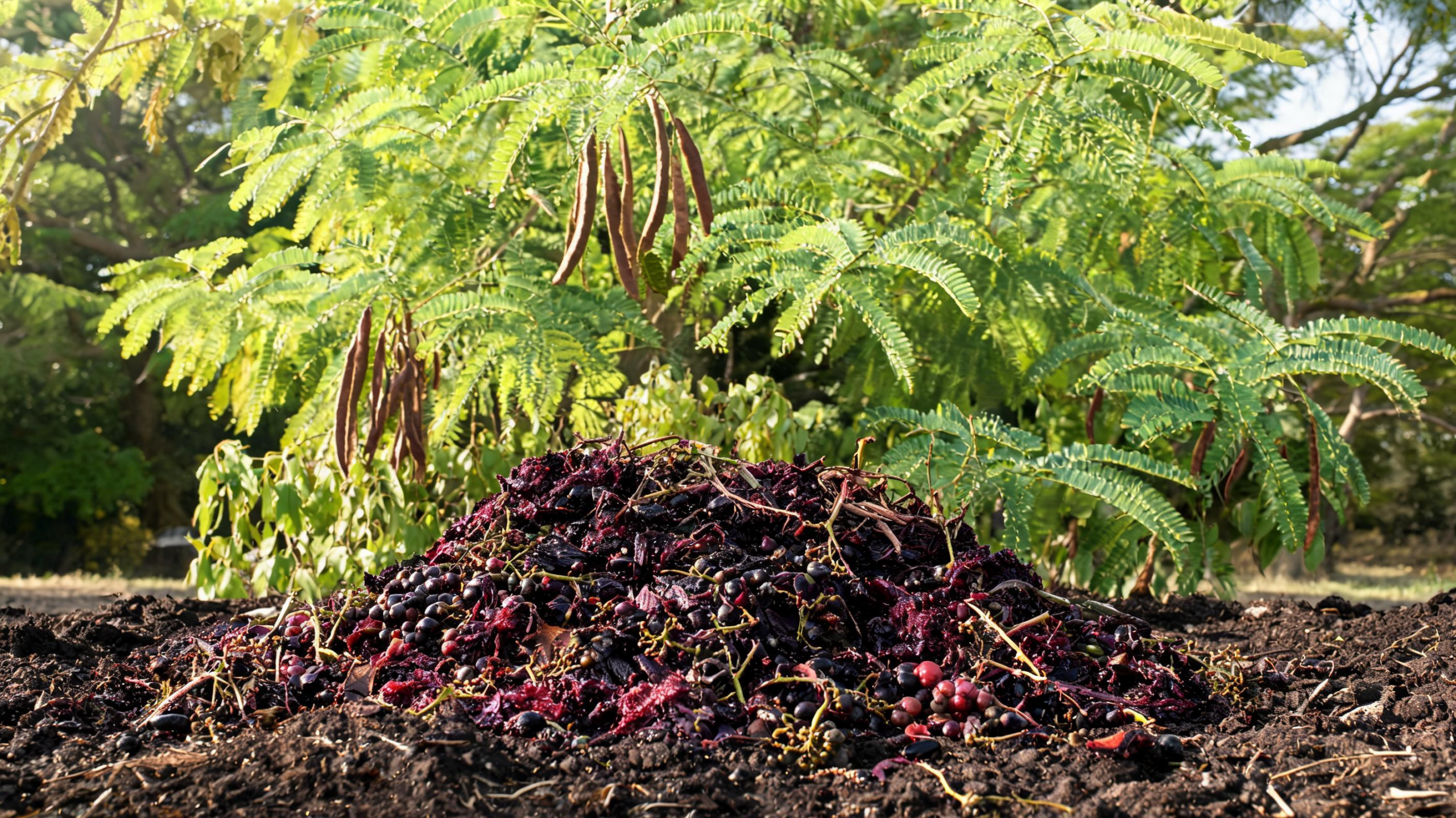
A common residue of winemaking, grape pomace is usually destined for compost heaps or animal feed. Now, a team of Brazilian researchers reports that a simple aqueous extract of this agro-industrial by-product can significantly impair the germination and early seedling development of Leucaena leucocephala, one of the most aggressive invasive tree species in tropical regions worldwide. The study, published in Plant Biosystems, suggests that a waste stream generated in enormous quantities by the global wine and juice industries could be repurposed as an environmentally friendly tool for managing biological invasions, potentially reducing reliance on synthetic herbicides in sensitive ecosystems.
Leucaena leucocephala, a fast-growing leguminous tree in the family Fabaceae, was originally spread across the tropics for use as fodder, fuelwood, and soil improvement, but it has since escaped cultivation and established self-sustaining populations on every inhabited continent. Its dense stands shade out native vegetation, alter soil chemistry, and resist conventional control measures. Previous work has shown that the species itself is a formidable allelopathic agent, releasing chemical compounds through its leaves and roots that suppress competitors, a trait that contributes to its dominance. The new study flips that logic, asking whether a locally available plant-derived extract could be turned against the invader during its most vulnerable life stage: germination.
The research team, led by Rosivaldo Machado da Silva Junior and colleagues at the State University of Goiás in Ipameri, Brazil, prepared aqueous extracts from grape pomace using two distinct extraction methods, one at ambient temperature, described as cold extraction, and one involving heat. These preparations were then tested at six concentrations, 0, 20, 40, 60, 80, and 100 percent, in a completely randomized experimental design arranged as a two-by-six factorial combination. Each treatment was replicated four times, with 50 seeds of L. leucocephala per replicate, providing a statistically controlled framework for evaluating the effects on germination and early growth.
The results revealed a pronounced inhibitory effect that depended strongly on both extraction temperature and concentration. Seeds treated with the cold-extracted pomace preparation germinated at a rate of only 39.4 percent, a substantial decline from the 52.5 percent observed in the untreated control group. Surprisingly, the hot-extracted extract produced a germination rate of 64.8 percent, actually above the control level, indicating that heat treatment altered the chemical profile of the extract in ways that weakened, and in some respects reversed, its allelopathic impact. This contrast points to the sensitivity of the bioactive compounds in grape pomace to thermal processing, a phenomenon consistent with the broader literature on polyphenol degradation during heated extraction.
Beyond germination percentages, the researchers measured seed vigor, the proportion of abnormal seedlings, seedling elongation, and dry matter accumulation, all standard indices in seed testing protocols. As extract concentration increased, seed vigor declined steadily, and the fractions of abnormal and ungerminated seeds rose sharply. At the highest concentration of 100 percent, the proportion of abnormal seedlings reached 37.96 percent, while ungerminated seeds climbed to 29.61 percent. These figures indicate that the extract does not merely delay germination but actively disrupts normal seedling morphogenesis, producing seedlings with deformities that would almost certainly prevent establishment under field conditions.
Seedling growth showed a more nuanced, dose-dependent response. At intermediate concentrations, the hot extract slightly stimulated seedling growth, echoing a pattern recognized in allelopathy research known as hormesis, in which low doses of a potentially toxic compound elicit a mild positive response while high doses become inhibitory. However, once concentrations reached 80 and 100 percent, the extracts suppressed shoot, root, and total seedling length, with the cold-extracted preparation again exerting the stronger effect. Root elongation is typically the most sensitive indicator of allelochemical stress because roots are the first tissues to contact dissolved compounds, and the observed suppression of both shoot and root growth suggests that the phenolic constituents of pomace interfere with fundamental processes such as cell division, elongation, and possibly oxidative balance in young seedlings.
The dry mass data added a final layer of complexity. Shoot dry mass declined at the highest concentration under both extraction methods, confirming that the extract compromised above-ground biomass accumulation. Yet total dry mass increased as extract concentration rose, an apparently contradictory result that may reflect the accumulation of abnormal seedling tissues or shifts in biomass partitioning under stress. The authors interpret the overall pattern as evidence that aqueous grape pomace extract, particularly when obtained by cold extraction, holds genuine potential as a sustainable allelopathic tool for integrated weed management, while noting that the precise dosage and application method will require further optimization before field deployment.
The chemical basis for these effects likely lies in the rich phenolic content of grape pomace, which includes anthocyanins, tannins, flavonoids, and phenolic acids known for their biological activity. Phenolic compounds can interfere with seed metabolism by inhibiting enzyme activity, disrupting membrane integrity, and generating oxidative stress in germinating tissues. Because pomace is produced in vast quantities by wineries and juice processors and often constitutes a disposal problem, the prospect of converting this residue into a bioherbicide or seed-suppression treatment carries an appealing double dividend: it valorizes an agricultural waste stream while addressing an ecological problem. The finding also aligns with a growing body of research exploring plant-derived allelochemicals, from wild plant leaf extracts to cereal-derived preparations, as candidates for low-impact weed suppression.
The implications extend beyond invasive species management. Synthetic herbicides face increasing scrutiny for their environmental persistence, effects on non-target organisms, and the evolution of resistant weed populations, driving interest in integrated approaches that combine mechanical, ecological, and biochemical strategies. A water-based extract requires no organic solvents, can be prepared with simple equipment, and leaves a relatively benign residue profile compared to many synthetic compounds. The Brazilian team emphasizes that the approach contributes to the valorization of agro-industrial residues and the development of environmentally friendly strategies for invasive plant control, and the work was supported by CAPES and the State University of Goiás.
Significant questions remain before grape pomace extracts can move from petri dishes to restoration sites. Laboratory germination assays cannot fully capture the complexities of soil chemistry, microbial degradation of phenolics, rainfall dilution, and interactions with co-occurring native species, any of which could diminish efficacy in the field. Researchers will also need to identify the specific allelochemicals responsible, determine whether extracts affect desirable native plants at the same concentrations, and assess the practical economics of collection, extraction, and application at scale. Nonetheless, the study offers a compelling proof of concept that the solution to one of the tropics’ most persistent plant invasions may be sitting in the waste bins of the world’s wineries, awaiting extraction.
Allelopathy, the chemical interference between plants, has long been recognized as a powerful force shaping plant communities, and the mechanisms underlying it have been increasingly characterized at the cellular level. Phenolic allelochemicals can trigger oxidative stress in receiving tissues, alter enzyme systems, and in severe cases initiate programmed cell death in root cells. The interference observed in this study is consistent with these broader findings, in which susceptible seedlings exposed to dissolved secondary metabolites show disrupted mitotic activity in root meristems and compromised membrane stability. The stronger effect of the cold extract suggests that heat-labile compounds, potentially including specific phenolic acids or tannins, may be the principal active agents.
The choice of extraction method matters considerably for the practical utility of such preparations. Heat can promote hydrolysis, polymerization, or oxidative transformation of polyphenols, changing both the identity and the concentration of dissolved allelochemicals. Studies of bioactive recovery from food industry by-products have repeatedly shown that extraction temperature and duration strongly influence phenolic yield and composition, and the divergent results between the cold and hot treatments here mirror that pattern. For a future bioherbicide, this means the preparation protocol itself becomes part of the formulation, and standardization would be essential to guarantee consistent field performance.
Grape pomace is among the most abundant lignocellulosic residues in viticulture, generated annually in quantities that pose real disposal and environmental challenges for producers. Its documented richness in phenolic compounds has already attracted attention for applications in food packaging, antioxidants, and animal nutrition, and the present study adds invasive plant suppression to that repertoire. The possibility of extracting value from a residue twice over, first for bioactive compounds and then for the depleted material as compost, would further strengthen the circular economy argument that motivates much of this line of research.
The use of L. leucocephala as a test species is also notable. Because it is itself a well-documented allelopathic plant that suppresses neighboring vegetation through its own chemical defenses, the finding that its seedlings are vulnerable to externally applied allelochemicals illustrates a reciprocal vulnerability. Self-inhibition and interspecific interference are common in allelopathy, and such susceptibility to another species’ chemical arsenal could inform integrated control strategies that combine cut-stump or mechanical removal with a follow-up extract treatment targeting the seed bank and regenerating seedlings.
Standardized seed testing methods, such as those used in the experiment for scoring germination, vigor, and abnormal seedlings, provide a transparent baseline that allows future studies to compare results across species and extract types. The factorial design with multiple concentrations permits detection of the hormetic stimulation seen at intermediate doses, a phenomenon now widely reported in allelopathy literature and one that any applied use must account for, since sublethal applications could conceivably enhance rather than suppress target growth.
Overall, the study situates grape pomace within a growing international effort to harness plant secondary metabolites for ecologically grounded weed and invasion management, while its extraction-dependent results underline the importance of careful chemical characterization before any deployment beyond the laboratory.
Subject of Research: Allelopathic suppression of the invasive plant Leucaena leucocephala using aqueous grape pomace extract
Article Title: Aqueous grape pomace extract suppresses seed germination and seedling responses of the invasive plant Leucaena leucocephala (Fabaceae)
Article References: da Silva Junior, R. M., Dionizio, L. M., De Jesus, F. F., Guimarães Silva, V., Coutinho, M. E., De Assis, V. C. S. S., Santiago Silva Benett, K., & Félix, F. C. (2026). Aqueous grape pomace extract suppresses seed germination and seedling responses of the invasive plant Leucaena leucocephala (Fabaceae). Plant Biosystems, 160(5), Article 259. https://doi.org/10.1007/s44473-026-00256-9
Image Credits: AI Generated
DOI: 10.1007/s44473-026-00256-9
Keywords: Leucaena leucocephala, grape pomace, allelopathy, invasive species, seed germination, phenolic compounds, bioherbicide, weed management, agro-industrial waste, sustainable agriculture, Plant Biosystems, seedling growth
Cite Scienmag News
Alan Morgan. (September 3, 2026). Grape Waste Emerges as Natural Weapon Against Invasive Leucaena Tree. Scienmag. https://scienmag.com/grape-waste-emerges-as-natural-weapon-against-invasive-leucaena-tree/
Alan Morgan. "Grape Waste Emerges as Natural Weapon Against Invasive Leucaena Tree." Scienmag, 3 September 2026, https://scienmag.com/grape-waste-emerges-as-natural-weapon-against-invasive-leucaena-tree/. Accessed 5 October 2026.
Alan Morgan. "Grape Waste Emerges as Natural Weapon Against Invasive Leucaena Tree." Scienmag. September 3, 2026. https://scienmag.com/grape-waste-emerges-as-natural-weapon-against-invasive-leucaena-tree/


