


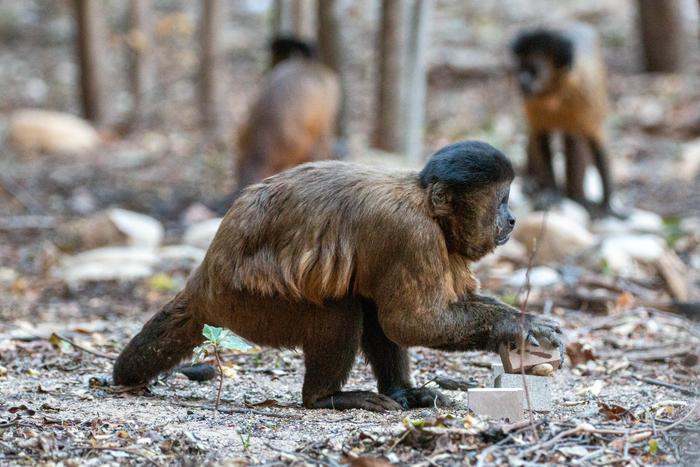
Wild bearded capuchin monkeys appear to judge stone tools not only by what the stones are made of, but also by what those stones reveal about their past. A new study of two wild populations in Brazil finds that the monkeys match stone hardness to specific mechanical tasks when tools are unused, yet may abandon that strategy when a stone carries visible evidence of successful nut cracking. Signs of previous use—including battered surfaces, impact damage and nearby nutshell debris—can become powerful sources of information, sometimes outweighing the physical properties that make a stone technically suitable for the job.
The findings, published in Proceedings of the Royal Society B: Biological Sciences, offer a detailed look at how nonhuman primates select and reuse tools. Bearded capuchins (Sapajus libidinosus) crack hard-shelled fruits and nuts by placing them on an anvil stone and striking them with a hammerstone. The task requires coordinating two tools with different functions. An anvil must provide a stable surface that absorbs and distributes impact, while a hammerstone must withstand repeated blows and transfer sufficient force to fracture the shell.
Researchers from the Max Planck Institute for Evolutionary Anthropology and the University of São Paulo presented the monkeys with standardised stones in a series of experiments. The stones differed in hardness and in whether they were raw or visibly modified by earlier use. By separating these characteristics, the researchers could test whether the animals responded primarily to material properties, to signs of previous success, or to a combination of both.
When the stones were unused and provided no visual evidence of earlier activity, the monkeys showed a consistent functional pattern. They tended to select softer stones as anvils and harder stones as hammerstones. This distinction is mechanically plausible. A relatively soft anvil can help grip or stabilise a nut and may be less likely to cause the nut to slip, while a hard hammerstone is better suited to delivering repeated impacts without breaking or deforming quickly. The choices suggest that the capuchins are sensitive to the relationship between a stone’s physical properties and the demands of the task.
“What surprised us was how consistently the monkeys distinguished between stone types based purely on hardness, with no prior visible use,” says Johanna Henke-von der Malsburg, the study’s first author, formerly a postdoctoral researcher at the Max Planck Institute for Evolutionary Anthropology and now a postdoctoral researcher at the Research Institute for Farm Animal Biology. According to the researchers, the result indicates that tool choice is not simply a rigid habit or an incidental consequence of stones being available in particular places. Instead, the monkeys appear capable of evaluating material differences in relation to mechanical function.
The pattern changed when the researchers introduced environmental evidence that a site had already been productive. In one experiment, the monkeys could choose between an unused nut-cracking location and a site containing battered stones and broken nutshells. They strongly preferred the previously used site. Once there, they continued to show some functional preferences, including a tendency to use softer stones as anvils and harder stones as hammerstones. They also favoured stones with visible wear, suggesting that the physical traces of earlier activity made the location and its tools more attractive.
A third experiment tested the influence of use-wear more directly by placing raw and used stones side by side. In this situation, visible evidence of previous use altered the monkeys’ decisions. For anvils, the animals preferred used stones even when those stones were not made of the mechanically ideal material. The preference for hardness also weakened or disappeared for hammerstones once signs of earlier use were present. In other words, a stone’s history could become more informative than its composition.
“This is a striking case where social information appears to override an individual’s assessment of physical properties,” says Lydia Lunz, the study’s senior author and a research group leader at the Max Planck Institute for Evolutionary Anthropology. The monkeys did not need to observe another animal cracking a nut. Damage patterns on the stones and discarded shell fragments acted as indirect evidence that the site had previously supported successful tool use. Such information may guide decisions without direct teaching, imitation or visual access to the original event.
The study therefore expands the meaning of social learning in wild primates. Social information is often associated with watching another animal perform a behaviour, but the capuchins’ choices show that the environment itself can preserve and transmit behavioural information. A battered anvil may function as a record of repeated success, while a concentration of broken shells can identify a productive processing site. These traces could help maintain tool-use traditions across generations by attracting individuals to locations where useful materials and effective techniques are already embedded in the landscape.
The results also raise questions about how archaeologists interpret ancient concentrations of worked stone. At early hominin sites, accumulations of damaged or modified rocks are commonly explained by raw-material availability, convenient locations or the practical requirements of food processing. The capuchin findings suggest another possibility: visibly used tools may have drawn later visitors back to the same places. If early humans responded to similar environmental cues, discarded tools and impact-marked stones may have served as a form of external memory, preserving evidence of past activity and influencing where tool traditions were repeated. The study does not show that early hominins behaved identically to capuchins, but it demonstrates how physical traces can shape tool decisions even when no demonstrator is present.
News Publication Date: 5-Aug-2026
Web References: https://doi.org/10.1098/rspb.2026.0416; https://www.eurekalert.org/multimedia/1145108
References: Proceedings of the Royal Society B: Biological Sciences, DOI: 10.1098/rspb.2026.0416
Cite Scienmag News
Courtney Benton. (August 5, 2026). Wild capuchins favor time-tested stones for cracking nuts. Scienmag. https://scienmag.com/wild-capuchins-favor-time-tested-stones-for-cracking-nuts/
Courtney Benton. "Wild capuchins favor time-tested stones for cracking nuts." Scienmag, 5 August 2026, https://scienmag.com/wild-capuchins-favor-time-tested-stones-for-cracking-nuts/. Accessed 3 September 2026.
Courtney Benton. "Wild capuchins favor time-tested stones for cracking nuts." Scienmag. August 5, 2026. https://scienmag.com/wild-capuchins-favor-time-tested-stones-for-cracking-nuts/


