

Tuesday, July 28, 2026
Science
No Result
View All Result
  • Login
  • HOME
  • SCIENCE NEWS
  • CONTACT US
  • HOME
  • SCIENCE NEWS
  • CONTACT US
No Result
View All Result
Scienmag
No Result
View All Result
Home Science News Archaeology

Chicxulub impact dust ignited the fires that ended the dinosaurs’ world

July 28, 2026
in Archaeology
Reading Time: 2 mins read
0
Chicxulub impact dust ignited the fires that ended the dinosaurs’ world

Chicxulub impact dust ignited the fires that ended the dinosaurs’ world

65
SHARES
587
VIEWS
Share on FacebookShare on Twitter
ADVERTISEMENT

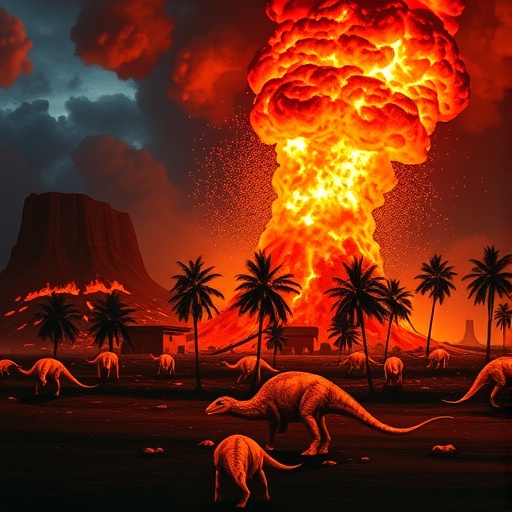
Sixty-six million years ago, an asteroid the size of a mountain slammed into Earth near Mexico’s Yucatán Peninsula, triggering the K–Pg mass extinction and ending the reign of non-avian dinosaurs. A new study now argues that the impact’s immediate aftermath was even more lethal than previously thought—because a hidden ingredient in the impact debris could trap heat close to the surface and ignite widespread burning.

When Chicxulub struck, intense energy vaporized rock, injecting a mix of dust and rock vapor high into the atmosphere. Some of that material cooled into tiny spherical droplets—spherules—that rained back down. As these fast-falling particles interacted with the air, friction produced a sharp, planet-wide pulse of heat.

Earlier models suggested this heat acted like a “broiler”: scorching animals that lacked protection, but not necessarily delivering enough energy to turn vegetation into flammable fuel. However, researchers revisited the fossil record of the catastrophe and re-focused on what happened to the leftover vapor that didn’t condense into spherules.

Evidence from the extinction horizon in North America includes a layer of extremely fine post-impact dust. Building on impact simulations and geological observations of this dust, the researchers estimated how much of it entered the atmosphere—and how effectively it would retain and re-emit heat.

Their calculations indicate that a thick global dust blanket would have made surface heating about 3.5 times stronger than spherules alone. In the first hour or two, the model implies lethal conditions for terrestrial animals, along with spontaneous wildfires occurring across large regions.

The same heat-and-fire mechanism could also support a second, longer-term extinction pathway. After the spherules finished falling and fires burned out, dust lingering in the sky could block sunlight for years to decades, driving a prolonged post-impact cooling consistent with a “winter” scenario.

While the fiery aftermath is supported best by wildfire evidence from North America, the researchers caution that patterns may have varied with distance from the Chicxulub site. More complete records will be needed to determine whether truly global wildfires occurred.

Understanding whether animals perished instantly in flames or later through starvation and ecosystem collapse matters for interpreting how complex life recovers after planet-scale disruptions. The new work refocuses the debate on what the impact itself delivered—on the ground, in real time.

The study appears in Journal of Geophysical Research: Biogeosciences.

Subject of Research: K–Pg mass extinction mechanisms; impact-driven heating, dust formation, and wildfires

Article Title: Heat and wildfires during the K-Pg mass extinction enhanced by fine dust

News Publication Date: 28-Jul-2026

Web References: https://agupubs.onlinelibrary.wiley.com/doi/10.1029/2026JG009837

References: 10.1029/2026JG009837

Image Credits:

Tags: Chicxulub asteroid impactCretaceous-Paleogene extinctioneffects of asteroid impact on Earth's biosphereformation of impact spherulesfossil record of dinosaur extinctiongeological evidence of mass extinctionglobal wildfire ignition after asteroid impactimpact debris and atmospheric heatingimpact-induced atmospheric vapor and heat retentionlong-term environmental effects of Chicxulub impactmodeling asteroid impact consequencesrole of dust in climate change
Share26Tweet16
Previous Post

Asteroid Impact Created Dust Cloud Insulating Earth, Frying Cretaceous Dinosaurs

Next Post

Vitamin B3 therapy may reduce severity of rare genetic disease

Related Posts

Fossil Footprints Reveal Body Size and Group Behavior of 1.4-Million-Year-Old
Archaeology

Fossil Footprints Reveal Body Size and Group Behavior of 1.4-Million-Year-Old Human Relative

July 27, 2026
Australian Cave Finds Evidence of 25,000-Year Grass Burning for Rituals
Archaeology

Australian Cave Finds Evidence of 25,000-Year Grass Burning for Rituals

July 27, 2026
Mapping Project Helps Shield Coastal World Heritage Sites From Climate
Archaeology

Mapping Project Helps Shield Coastal World Heritage Sites From Climate Risks

July 27, 2026
Genetically distinct Nicaraguan avocados reveal South American transport thousands of
Archaeology

Genetically distinct Nicaraguan avocados reveal South American transport thousands of years ago

July 26, 2026
Ceramic Vessels Show Social Inequality Was Baked into 19th-Century Brazil
Archaeology

Ceramic Vessels Show Social Inequality Was Baked into 19th-Century Brazil

July 26, 2026
Study Quantifies Damage to Historic Sites Across Syria
Archaeology

Study Quantifies Damage to Historic Sites Across Syria

July 26, 2026
Next Post
Vitamin B3 therapy may reduce severity of rare genetic disease

Vitamin B3 therapy may reduce severity of rare genetic disease

  • Mothers who receive childcare support from maternal grandparents show more

    Mothers who receive childcare support from maternal grandparents show more parental warmth, finds NTU Singapore study

    27656 shares
    Share 11059 Tweet 6912
  • University of Seville Breaks 120-Year-Old Mystery, Revises a Key Einstein Concept

    1061 shares
    Share 424 Tweet 265
  • Bee body mass, pathogens and local climate influence heat tolerance

    682 shares
    Share 273 Tweet 171
  • Researchers record first-ever images and data of a shark experiencing a boat strike

    546 shares
    Share 218 Tweet 137
  • Groundbreaking Clinical Trial Reveals Lubiprostone Enhances Kidney Function

    531 shares
    Share 212 Tweet 133
Science

Embark on a thrilling journey of discovery with Scienmag.com—your ultimate source for cutting-edge breakthroughs. Immerse yourself in a world where curiosity knows no limits and tomorrow’s possibilities become today’s reality!

RECENT NEWS

  • Biguanide derivative 4C boosts talazoparib by triggering ferroptosis in bladder cancer
  • Heterointerface Engineering in Bimetallic Sulfides Cuts Polarization Loss for Better Microwave Absorption
  • Sanford Underground Facility Welcomes NEMESIS for Cutting-Edge Physics Research
  • Vitamin B3 therapy may reduce severity of rare genetic disease

Categories

  • Agriculture
  • Anthropology
  • Archaeology
  • Athmospheric
  • Biology
  • Biotechnology
  • Blog
  • Bussines
  • Cancer
  • Chemistry
  • Climate
  • Earth Science
  • Editorial Policy
  • Marine
  • Mathematics
  • Medicine
  • Pediatry
  • Policy
  • Psychology & Psychiatry
  • Science Education
  • Social Science
  • Space
  • Technology and Engineering

Subscribe to Blog via Email

Enter your email address to subscribe to this blog and receive notifications of new posts by email.

Join 5,146 other subscribers

© 2025 Scienmag - Science Magazine

Welcome Back!

Login to your account below

Forgotten Password?

Retrieve your password

Please enter your username or email address to reset your password.

Log In
No Result
View All Result
  • HOME
  • SCIENCE NEWS
  • CONTACT US

© 2025 Scienmag - Science Magazine

Discover more from Science

Subscribe now to keep reading and get access to the full archive.

Continue reading
