


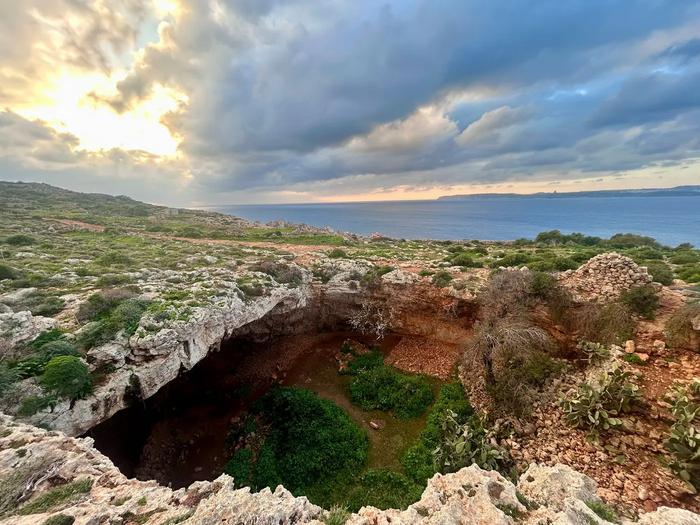
Humans reached Malta—tiny, resource-limited and far from the mainland—during the Mesolithic, a timeline that has long puzzled researchers. Archaeology suggests foragers occupied the Maltese islands between 8,500 and 7,500 years ago, likely arriving by sea. The new work asks a straightforward question with a complicated answer: how could small communities survive there for centuries when food and freshwater options were constrained?
To tackle this, James Blinkhorn and colleagues built demographic and subsistence models comparing Malta with Sicily during the terminal Pleistocene to Holocene transition. Their approach integrates changing sea levels, island geometry, and fluctuations in vegetation productivity to estimate how many people the landscape could plausibly support.
The modeling accounts for a key geographic turning point: Malta and Sicily split into separate islands around 14,200 years ago. As time passed, both islands shrank, with Malta eventually shrinking to its modern area of about 252 square kilometers. These environmental shifts matter because they directly affect carrying capacity—how many people an ecosystem can sustain without collapsing.
Distance also proved decisive. After separation, the minimum sea-crossing distance between Malta and Sicily fell to roughly 80 km within about a millennium. That number is not just a travel detail; it defines whether repeated movement could realistically occur in routine lifeways.
Predicted maximum population sizes for Malta, after disconnection, start at around 419 individuals and decline to about 170 by 9,000 years ago. This projected upper range is below thresholds required for long-term viability in small, isolated populations.
So, the authors argue that continued habitation required frequent, long-distance sea crossings rather than steady in-island growth. Malta may have functioned as a seasonal destination, or as a place where groups visited repeatedly while maintaining a connection—direct or indirect—to broader networks.
Beyond solving a local survival problem, the results reshape a bigger narrative. They suggest that seafaring hunter-gatherers operated with demographic flexibility across the pre-farming Mediterranean, potentially influencing how population histories and genetic ancestry formed from North Africa into Europe.
Cite Scienmag News
Courtney Benton. (July 28, 2026). Mesolithic Hunter-Gatherers Lived on Malta, New Evidence Suggests. Scienmag. https://scienmag.com/mesolithic-hunter-gatherers-lived-on-malta-new-evidence-suggests/
Courtney Benton. "Mesolithic Hunter-Gatherers Lived on Malta, New Evidence Suggests." Scienmag, 28 July 2026, https://scienmag.com/mesolithic-hunter-gatherers-lived-on-malta-new-evidence-suggests/. Accessed 5 September 2026.
Courtney Benton. "Mesolithic Hunter-Gatherers Lived on Malta, New Evidence Suggests." Scienmag. July 28, 2026. https://scienmag.com/mesolithic-hunter-gatherers-lived-on-malta-new-evidence-suggests/


