


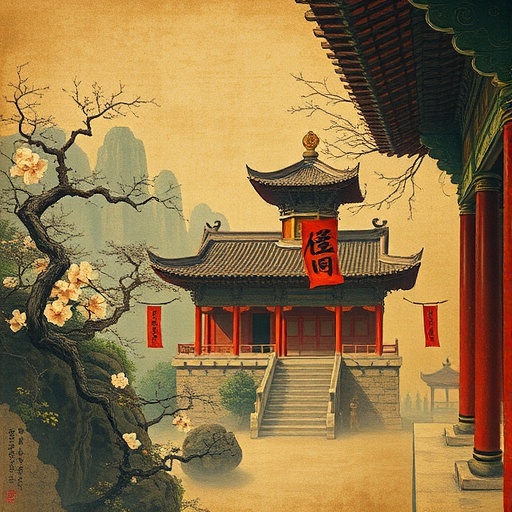
Deep beneath the eaves of a nearly thousand-year-old timber temple in China’s Shanxi Province, scientists have uncovered molecular evidence that its decorative paintings are not the work of a single moment in history, but a layered archive of painters working across at least two different dynasties. A new study of Yuanrong Temple, one of the few well-preserved wooden structures surviving from the Song–Jin period (AD 960–1234), has combined microscopy, spectroscopy and gas chromatography to reconstruct the materials and techniques used in its architectural paintings — and in doing so has revealed a hidden sequence of repainting and repair that spans centuries.
The research, led by Weihan Zou of Northwestern Polytechnical University and Sok Yee Yeo of Tongji University, together with colleagues at Xi’an Jiaotong University and Shanxi Ancient Architecture Engineering Supervision Co., was carried out ahead of conservation work on the temple. Because scientific studies of Song–Jin architectural paintings remain strikingly scarce, the team treated the surviving painted surfaces as a rare opportunity to document how early Chinese craftsmen decorated monumental timber buildings, and how later generations altered that decoration.
Architectural paintings occupy a distinctive place in Chinese building tradition. Unlike murals applied to walls, these are decorative schemes painted directly onto the structural members themselves — architraves, beams and brackets — following conventions recorded in imperial building manuals. Their polychrome patterns served both aesthetic and symbolic purposes, and their materials can reveal the technical knowledge, economic circumstances and workshop traditions of the period in which they were applied. But centuries of exposure, repair and renewal mean that what survives on a temple’s timbers today is rarely what was painted first.
To disentangle that history, the researchers collected twelve micro-samples from the architrave and beam paintings of the temple. From fragments often smaller than a fingernail, they extracted an extraordinary amount of information using a multi-analytical strategy in which each technique interrogates a different aspect of the material. Optical microscopy and cross-sectional analysis revealed the stratigraphy — the sequence of paint and ground layers stacked on top of one another. Scanning electron microscopy coupled with energy-dispersive spectroscopy (SEM–EDS) mapped the elemental composition of each layer, identifying characteristic elements such as iron, copper, calcium and silicon. Raman spectroscopy and Fourier-transform infrared spectroscopy (FTIR) provided molecular fingerprints of pigments and organic binders, while X-ray diffraction confirmed crystalline phases. Finally, pyrolysis gas chromatography–mass spectrometry (Py–GC/MS) identified the organic binding media, the most elusive component of ancient paints.
The cross-sections told the first and most consequential story. The architrave paintings displayed a clear preparatory ground layer beneath the pigment layers, composed of gypsum (calcium sulfate), quartz and plant fibers — a deliberate recipe designed to create a smooth, pale surface on rough timber. Above this ground, multiple distinct pigment layers were visible, confirming that the architraves had been repainted on several occasions across different historical periods. The beam paintings, by contrast, lacked any preparatory ground at all; the pigments were applied directly to the wood. This fundamental difference in preparation suggests the two sets of paintings were not produced in the same campaign, by the same workshop, or even within the same century.
The pigment palette identified across the samples included iron(III) oxide — the familiar earthy red of hematite-based pigments — hydrated iron oxide, corresponding to yellow ochre-like materials, gypsum, amorphous carbon black, and malachite, a basic copper carbonate that supplied vivid green. SEM–EDS and Raman spectroscopy converged on these identifications: iron and oxygen signals paired with the characteristic Raman bands of hematite for the reds, copper signatures and carbonate bands for the malachite, and the broad, featureless Raman response of amorphous carbon for the blacks. Such a palette is consistent with mineral pigments available to painters in medieval China, drawn from locally obtainable ores and earths.
The binding media proved equally revealing. Py–GC/MS, which gently heats a sample and identifies the molecular fragments released, detected amino N-ethylpropanamide, palmitic acid and related pyrolysis products. Together, these markers point to a proteinaceous glue used in combination with walnut oil — a mixed binder system in which animal glue would have provided adhesion and working properties while the drying oil contributed cohesion and water resistance. The detection of specific fatty acids and protein pyrolysates in the same samples is the kind of molecular evidence that can distinguish, for example, a pure glue tempera from an oil-enriched formulation, and it places the Yuanrong materials firmly within documented Chinese painting practice.
When the team compared their results with published analyses of architectural paintings from other periods, a chronological pattern emerged. The beam paintings, with their ground-less preparation, appear to preserve an earlier technical tradition rooted in Tang-period practices, and the researchers suggest they may plausibly date to the early Song dynasty. The architrave paintings, with their gypsum-quartz-fiber ground and evidence of repeated repainting, show closer affinities with techniques documented from the Ming period, and may be linked to a later phase of repair or renewal. In other words, the temple’s decoration is not a snapshot but a palimpsest — earlier paint schemes surviving alongside, and beneath, later ones.
This finding carries implications well beyond a single building. Architectural paintings on surviving timber structures are often assumed, implicitly or explicitly, to date to the construction date of the building itself. The Yuanrong evidence demonstrates that the surviving paint can reflect different painting phases and successive renewals rather than a single original campaign. For architectural historians, this means that technical features such as the presence or absence of a ground layer, the choice of pigments, and the composition of binding media can serve as relative dating tools — complementing dendrochronology of the timbers and documentary records. For conservators, it means that any intervention must reckon with multiple, historically distinct paint campaigns coexisting on the same structural member, each with its own material vulnerabilities.
The study also fills a geographic and chronological gap. Most previous analytical work on Chinese architectural polychromy has concentrated on later imperial structures — Ming and Qing dynasty buildings in Beijing’s Forbidden City, imperial altars and Taoist temples — where abundant surviving decoration and institutional interest have driven research. Song–Jin period timber structures, of which Shanxi Province holds the greatest concentration, have received far less laboratory attention. By documenting the materials of a genuine Song–Jin building, the study provides a baseline against which other early wooden structures can be compared, helping to map the evolution of Chinese architectural painting technology from the Tang through the Song, Jin, Yuan and Ming periods.
The analytical workflow itself exemplifies modern heritage science practice. Micro-sampling — taking only tiny, strategically chosen fragments — minimizes harm to the historic fabric while enabling the full battery of instrumental techniques that would be impossible to apply non-invasively at the required sensitivity. Cross-sectional stratigraphy anchors the chemical data in physical space, so that each identified compound can be assigned to a specific layer and therefore a specific painting event. The combination of inorganic characterization (SEM–EDS, Raman, XRD) with organic analysis (FTIR, Py–GC/MS) is essential because architectural paintings are composite systems: their appearance depends on pigments, but their survival and behavior depend on grounds and binders. The discovery that walnut oil was used in a medieval Chinese architectural context is particularly noteworthy, as drying oils occupy a contested place in the history of East Asian painting, and every securely identified instance refines that picture.
For Yuanrong Temple itself, the results arrived at a critical moment. Conservation of ancient timber architecture typically involves cleaning, consolidation and, in some cases, repainting or protective coatings — decisions that can irreversibly alter or destroy evidence of earlier campaigns if made without analytical knowledge. By characterizing the stratigraphy and materials before treatment, the researchers have given conservators a map of what is preserved, where the boundaries between painting phases lie, and which layers carry the oldest surviving evidence. The beam paintings, potentially the earliest technical testimony in the building, can now be treated with the caution their age demands.
More broadly, the study is a reminder that buildings are documents. Every structure that has stood for a millennium has been touched, patched, and renewed by generations of caretakers, and each of those interventions left a material record — sometimes visible, often buried beneath later paint. Decoding that record requires the tools of analytical chemistry as much as the eyes of an art historian. At Yuanrong Temple, those tools have now shown that the reds of the architraves and the unground pigments of the beams belong to different conversations across time: one rooted in Tang tradition and the early Song, the other echoing Ming workshops centuries later. Together, they transform the temple from a single datable monument into a continuous, physical archive of Chinese painting practice, one microscopic layer at a time.
Cite Scienmag News
Courtney Benton. (September 4, 2026). Spectroscopy reveals secrets of Song–Jin era temple paintings in Shanxi. Scienmag. https://scienmag.com/spectroscopy-reveals-secrets-of-song-jin-era-temple-paintings-in-shanxi/
Courtney Benton. "Spectroscopy reveals secrets of Song–Jin era temple paintings in Shanxi." Scienmag, 4 September 2026, https://scienmag.com/spectroscopy-reveals-secrets-of-song-jin-era-temple-paintings-in-shanxi/. Accessed 4 September 2026.
Courtney Benton. "Spectroscopy reveals secrets of Song–Jin era temple paintings in Shanxi." Scienmag. September 4, 2026. https://scienmag.com/spectroscopy-reveals-secrets-of-song-jin-era-temple-paintings-in-shanxi/


