


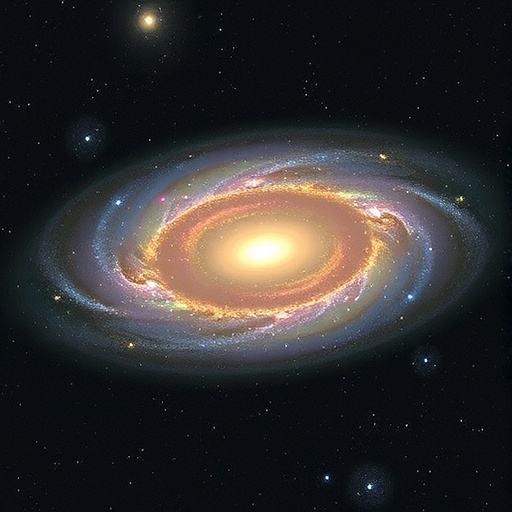
In a groundbreaking revelation, astronomers utilizing the unprecedented capabilities of the James Webb Space Telescope (JWST) have uncovered a startling characteristic of a massive galaxy formed during the universe’s infancy. The galaxy, designated XMM-VID1-2075, located more than 12 billion light-years away, defies conventional expectations by exhibiting no signs of rotational motion. This finding challenges long-held assumptions about the early dynamic evolution of galaxies and provides vital clues about the processes shaping the cosmos shortly after the Big Bang.
Galaxies are traditionally understood to acquire their spin from angular momentum instilled by the inflow of gas and the influence of gravitational forces during their formation. Typically, these rotating structures, especially at such close proximity to our cosmic era, display coherent rotational patterns. However, XMM-VID1-2075’s apparent lack of rotation aligns it with mature “slow rotator” galaxies observed in the contemporary universe—giants that have undergone complex evolutionary histories including numerous mergers, resulting in random stellar motions replacing orderly spin. Detecting this feature in a galaxy younger than two billion years unsettles orthodox timelines of galactic evolution.
According to Benjamin Forrest, a leading astrophysicist at the University of California, Davis and the study’s principal author, this discovery opens intriguing avenues for understanding the assembly of massive early galaxies. “The absence of rotational velocity in XMM-VID1-2075 marks it as an evolutionary outlier, expected only in galaxies far older and dynamically settled. Observing such characteristics at this epoch contradicts standard theories,” Forrest explains, underscoring the extraordinary nature of the observation.
The galaxy’s identification as a slow rotator has profound implications for the timeline of dynamical relaxation and merger activity in the nascent universe. Conventionally, the transition from a rotationally dominated system to a dispersion-supported system—where stars move randomly rather than in coherent orbits—results from multiple mergers and interactions over extensive cosmological timescales. Findings from the MAGAZ3NE survey, foundational to this research, have previously confirmed XMM-VID1-2075’s massive stellar population, several times that of the Milky Way, alongside the cessation of star formation. Such characteristics made it a prime candidate for JWST’s intricate follow-up observations.
The exceptional spatial resolution and sensitivity of JWST’s near-infrared instruments allowed scientists to dissect the internal kinematics of this distant system with unparalleled precision. By measuring Doppler shifts across different regions of the galaxy, the study analyzed the velocity dispersion and rotation patterns embedded within. While two other galaxies of similar age and mass in the sample exhibited expected rotational signatures or chaotic motions, XMM-VID1-2075’s lack of rotation stood out as statistically significant. This contrast demonstrates a previously underappreciated diversity in the dynamical states of early massive galaxies.
One compelling explanation proposed is that the galaxy’s slow rotation stems from the aftermath of a high-impact collision between two progenitor galaxies with opposing spins, fundamentally scrambling any coherent angular momentum. Supporting this scenario, JWST imaging unveiled an asymmetry—an excess of light—in one region of the galaxy, possibly indicative of a secondary interacting body or remnant merger structure perturbing the internal stellar motions. This insight nuances prior models that predominantly attributed slow rotation to accumulated effects of repeated minor mergers.
These observational insights offer crucial empirical data to test and refine cosmological simulations of galaxy formation and evolution. Computational models have predicted the existence of a minority population of early non-rotating galaxies but have yet to quantify their frequency accurately. By expanding samples and measurement precision, astronomers aim to resolve whether such dynamic states are anomalies or integral evolutionary pathways. The prevalence and properties of slow rotators in the early universe directly inform models of angular momentum acquisition, gas accretion, star formation quenching, and environmental effects within nascent galaxy clusters.
Moreover, understanding the mechanisms behind early formation of massive, quiescent, and dynamically hot galaxies impacts broader astrophysical contexts, including the growth of supermassive black holes and the intergalactic medium’s enrichment history. The coexistence of massive stellar populations and suppression of new star formation implies intricate feedback processes that halted cooling and collapse at an early stage. JWST’s contributions essentially bridge gaps between observational cosmology and theoretical models by furnishing unprecedented direct kinematic measurements of galaxies in epochs previously accessible only through indirect means.
The research team’s collaborative effort spans multiple international institutions, highlighting the importance of multidisciplinary approaches in contemporary astrophysics. Combining expertise in observational astronomy, spectral analysis, computational modeling, and high-redshift galaxy surveys has enabled these significant advances. The support from NASA, the Space Telescope Science Institute, and the National Science Foundation underscores the critical role of sustained funding and cutting-edge instrumentation in enabling such transformative discoveries.
As JWST continues to push technological frontiers and reveal cosmic secrets, astronomers anticipate uncovering more examples of this rare class of early slow rotators. Comprehensive surveys will elucidate how widespread these entities are and what fundamental physical processes underpin their rapid dynamical evolution. Consequently, the implications extend beyond galaxy formation to encompass the entire cosmic narrative, gradually transforming speculative theory into empirical science.
Ultimately, the discovery of a massive, evolved slow-rotating galaxy like XMM-VID1-2075 when the universe was less than two billion years old forces a re-examination of astrophysical paradigms. It spotlights unanswered questions about early galaxy mergers, angular momentum dissipation, and star formation quenching that will fuel future research. The James Webb Space Telescope stands as a monumental leap forward in humanity’s quest to understand our cosmic origins, challenging and expanding the horizons of modern astronomy.
News Publication Date: 4-May-2026
Web References: https://www.nature.com/articles/s41550-026-02855-0
References:
- Forrest, B., et al. (2026). A massive and evolved slow-rotating galaxy in the early Universe. Nature Astronomy. DOI: 10.1038/s41550-026-02855-0
Keywords
James Webb Space Telescope, galaxy evolution, slow rotator galaxy, early universe, galaxy kinematics, angular momentum, galaxy mergers, high-redshift galaxies, stellar dynamics, cosmic dawn, MAGAZ3NE survey, astrophysics
Cite Scienmag News
Grant Pearson. (May 4, 2026). Early Galaxy Defies Expectations with Lack of Rotation, Surprising Astronomers. Scienmag. https://scienmag.com/early-galaxy-defies-expectations-with-lack-of-rotation-surprising-astronomers/
Grant Pearson. "Early Galaxy Defies Expectations with Lack of Rotation, Surprising Astronomers." Scienmag, 4 May 2026, https://scienmag.com/early-galaxy-defies-expectations-with-lack-of-rotation-surprising-astronomers/. Accessed 3 September 2026.
Grant Pearson. "Early Galaxy Defies Expectations with Lack of Rotation, Surprising Astronomers." Scienmag. May 4, 2026. https://scienmag.com/early-galaxy-defies-expectations-with-lack-of-rotation-surprising-astronomers/


