


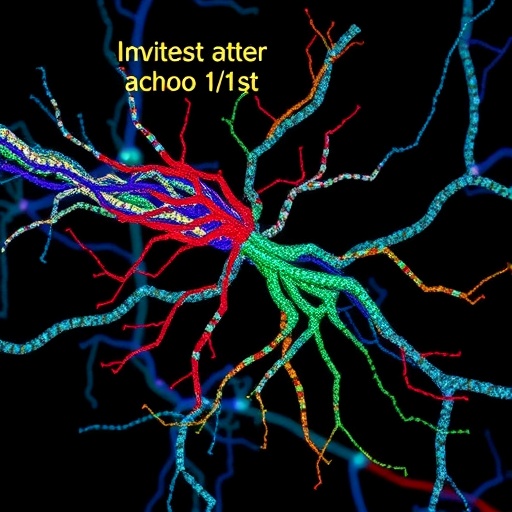
In a groundbreaking study published recently in Cell Research, scientists have unveiled the intricate structural framework underlying the neuronal M-current, a crucial electrical signal in nerve cells. This electrical current, primarily mediated by KCNQ2 and KCNQ3 potassium channels, plays a pivotal role in controlling neuronal excitability. The research, led by Cheng, Wan, Jiang, and colleagues, provides an unprecedented atomic-level view of how these channels assemble asymmetrically to generate this vital current, marking a significant milestone in neuroscience and ion channel biology.
Neurons communicate through electrical impulses, and the delicate balance of this excitability determines brain activity, cognition, and overall neural health. The M-current is a slow-activating and non-inactivating potassium current that acts as a brake on nerve cell firing, preventing overexcitation and seizures. Yet despite its fundamental importance, the precise molecular architecture that underpins the unique functional properties of the M-current has remained elusive—until now.
Using cutting-edge cryo-electron microscopy techniques, the research team resolved the structure of the heteromeric KCNQ2/3 channel complex at near-atomic resolution. Remarkably, the channels assemble asymmetrically, with two KCNQ2 and two KCNQ3 subunits forming a tetrameric configuration. This asymmetric arrangement disrupts the classical symmetry observed in many ion channels, providing fresh insights into how the channels fine-tune their voltage sensitivity and kinetic behavior.
The study demonstrates that the KCNQ2 and KCNQ3 subunits exhibit distinct conformational states within the complex, particularly in their voltage-sensing domains. This disparity significantly influences the gating mechanism by which the channel opens or closes in response to changes in membrane potential. The voltage sensor movements in KCNQ2 are more pronounced, while the KCNQ3 subunits adopt a stabilizing role, collectively shaping the unique activation profile characteristic of the M-current.
Moreover, the research illuminates key interactions at the interface between subunits that are critical for assembling the heteromeric channel. Specific amino acid residues mediate this intersubunit binding, and mutations in these regions have been implicated in a variety of neurological disorders such as benign familial neonatal epilepsy and other epileptic syndromes. By mapping these interfaces at atomic detail, the study opens avenues for targeted therapeutic interventions aiming to modulate M-current function and treat hyperexcitability disorders.
Intriguingly, the researchers also identified that the asymmetric assembly endows the channel with distinct pharmacological sensitivities. This finding has profound implications for drug development because it suggests that drugs designed to target either KCNQ2 or KCNQ3 selectively could more precisely modulate neuronal excitability with reduced side effects. Compounds currently used as antiepileptics may be refined to exploit this structural divergence for enhanced efficacy.
The structural data underscores the importance of PIP2, a membrane phospholipid, in channel function. The lipid binds at a conserved site near the interface of KCNQ subunits, stabilizing the open state of the channel. This molecular interaction explains earlier biochemical studies that emphasized PIP2 as a positive regulator of M-current amplitude and highlights how lipid-channel dynamics are integral to neuronal excitability regulation.
From a broader neuroscience perspective, these findings illustrate an elegant principle where asymmetric assembly confers functional diversity within ion channel families. This paradigm may extend to other voltage-gated channels and receptor complexes, suggesting a widespread strategy nature employs to finely modulate cellular electrical signaling through subunit composition variability.
The implications of this research are profound for understanding the pathophysiology of neurological diseases. Dysfunction in M-current regulation has been linked to epilepsy, neuropathic pain, and even psychiatric disorders like depression. Having a precise structural roadmap of KCNQ2/3 channels paves the way for rational design of modulators that restore normal electrical activity in disease states without compromising physiological functions.
Importantly, the study’s methodology sets a new benchmark for ion channel structural biology. The combination of high-resolution cryo-EM with computational modeling and electrophysiological validation bridges the gap between static structures and dynamic function. This integrative approach propels the field closer to a complete mechanistic understanding of how voltage sensors translate membrane potential changes into channel gating behaviors.
The team’s discovery also poses fascinating questions for future research. How do post-translational modifications, such as phosphorylation and ubiquitination, alter channel conformation and function? What roles do auxiliary proteins play in stabilizing the KCNQ2/3 complex or modulating its properties in different neuronal subtypes? Answering these questions will deepen our comprehension of neuronal signaling complexity and plasticity.
From a clinical standpoint, these insights validate KCNQ2/3 channels as prime drug targets. The structural blueprint can accelerate the development of novel M-channel openers or inhibitors, tailored to treat epilepsy and other neurological conditions with unprecedented precision. Fortunately, the channel’s extracellular domains also present accessible epitopes for antibody therapies or biologics, expanding therapeutic modalities beyond small molecules.
The authors emphasize that this characterization of M-current channels not only advances neuroscience but also provides a model for studying heteromeric assemblies in other multi-subunit proteins. As many critical biological processes depend on asymmetric protein arrangements, these findings herald a new era in structural and functional protein research that integrates molecular asymmetry into functional paradigms.
In conclusion, this landmark study unravels the molecular architecture of the neuronal M-current with unparalleled detail. The elucidation of the asymmetric KCNQ2/3 assembly enriches our understanding of neuronal excitability regulation and offers promising pathways for therapeutic innovation. As ion channel research continues to illuminate the brain’s electrical symphony, studies like this bring us closer to deciphering—and eventually mastering—the fundamental codes of neural function.
Cite Scienmag News
Ophelia Keating. (May 25, 2026). Neuronal M-current Unveiled by KCNQ2/3 Structure. Scienmag. https://scienmag.com/neuronal-m-current-unveiled-by-kcnq2-3-structure/
Ophelia Keating. "Neuronal M-current Unveiled by KCNQ2/3 Structure." Scienmag, 25 May 2026, https://scienmag.com/neuronal-m-current-unveiled-by-kcnq2-3-structure/. Accessed 4 September 2026.
Ophelia Keating. "Neuronal M-current Unveiled by KCNQ2/3 Structure." Scienmag. May 25, 2026. https://scienmag.com/neuronal-m-current-unveiled-by-kcnq2-3-structure/


