


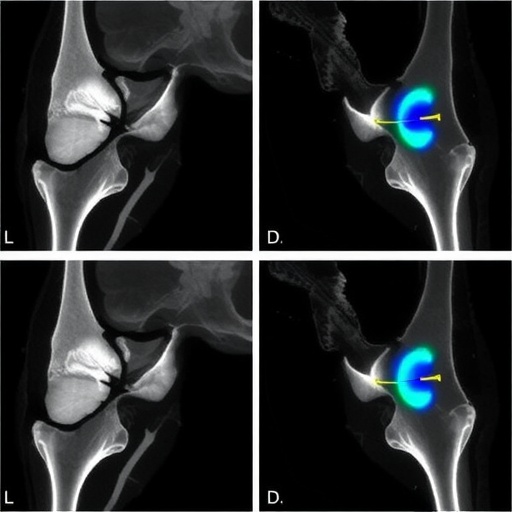
In the realm of orthopedics, understanding the complex biomechanics of the medial meniscus—particularly in the context of tears and subsequent repairs—has significant clinical implications for the treatment and management of knee injuries. Recent research led by Ma, Feng, and Lyu is stirring interest in the biomedical engineering community due to its detailed investigation into the dynamic responses of the medial meniscus. Their study employs computational dynamic analysis to model meniscal tears, therapeutic interventions, and the biomechanical implications of partial meniscectomy, offering new insights into injury management strategies.
The medial meniscus is a crescent-shaped cartilage structure located in the knee joint, crucial for joint stability, load distribution, and shock absorption. Injuries to this vital component can lead to chronic pain and increased risk of osteoarthritis. The study addresses the commonly encountered redial tear, which is characterized by its radial propagation, leading to significant functional impairment. The paper articulates that understanding the dynamic behavior of the meniscus under various loading conditions is pivotal in formulating effective reparative techniques, including surgical intervention outcomes.
Utilizing advanced computational modeling techniques, the authors meticulously recreated the anatomical and biomechanical environment of the medial meniscus. This approach allowed for a comprehensive simulation of the dynamic responses elicited during varying levels of mechanical loading. Such a method not only replicates real-life conditions but also aids in the identification of key failure modes within the meniscal tissue. Their analyses challenge conventional approaches, revealing the biomechanical nuances that occur post-injury and post-surgical treatment.
The findings underscore the intricacies of the meniscus’s response mechanisms to applied stress. For instance, the study highlights how the orientation of fibers within the meniscus interacts with tensile loads, influencing the overall strength and susceptibility to tearing. One of the critical revelations from their work is the disparity in behavior exhibited by the meniscus during its repair process compared to healthy, undamaged tissue. These insights could revolutionize surgical practices, enabling clinicians to tailor interventions based on real-time biomechanical data obtained from such simulations.
Furthermore, the team assessed the outcomes of meniscal repair versus partial meniscectomy—an operation where a portion of the meniscus is removed. Their findings suggest that repair techniques could lead to better long-term outcomes, particularly in younger patients. This conclusion stems from their analysis of the recovery periods, pain assessments, and joint stability metrics among cohorts undergoing either intervention. The potential for a more nuanced approach to the treatment of meniscal injuries holds promise for enhancing the quality of life for affected individuals.
Another pivotal aspect of the research includes a focus on the post-operative loading conditions that the meniscus endures during rehabilitation. The study’s outcomes challenge the notion of standard post-surgical protocols and call for more individualized rehabilitation programs that factor in the specific dynamism associated with each injury. Insights derived from computational models reveal which activities may place undue stress on the repaired tissue, informing more effective rehabilitation strategies.
The influence of biological factors on the healing process is also a core element of this research. Factors such as the patient’s age, activity level, and overall knee health interact with biomechanical behavior post-surgery. The authors note that a thorough understanding of these interactions can guide healthcare providers in predicting rehabilitation outcomes and tailoring post-operative care. As such, integrating biological and mechanical assessment tools could enhance surgical planning and post-operative monitoring.
The study, therefore, not only fills a crucial gap in the biomechanical understanding of medial meniscal tears but also sets the groundwork for future research endeavors. It paves the way for advancing computational models that can incorporate biological healing processes alongside mechanical analyses. By bridging the gap between engineering and clinical application, this work opens up avenues for the development of innovative treatment protocols and rehabilitation strategies tailored to individuals’ specific needs.
In conclusion, the research conducted by Ma and colleagues is a significant step forward in understanding the computational dynamic characteristics of the medial meniscus. Such insights are imperative for refining clinical practices related to meniscus injuries. The methodology utilized in this study introduces a groundbreaking way of investigating joint mechanics, potentially heralding a new era in personalized orthopedic treatment. Further studies building on their findings could yield even more pronounced improvements in both surgical outcomes and patient care.
The implications of this work extend beyond immediate clinical applications. By fostering a deeper understanding of meniscal biomechanics, future research could investigate new repair techniques that utilize tissue engineering and regenerative medicine, ultimately aiming to restore the natural function of the meniscus. As the field of orthopedic science continues to evolve, innovative approaches inspired by studies like this one will likely become integral to successful treatment and prevention strategies for knee injuries.
By employing state-of-the-art technologies in computational modeling, this research emphasizes the necessity of interdisciplinary collaboration between engineers and medical professionals. The pursuit of knowledge in both fields will undoubtedly contribute to improved patient outcomes and advancements in surgical techniques. The cascading benefits of this research are not merely theoretical; rather, they have the potential to translate into meaningful changes in clinical practice, impacting countless lives worldwide.
As we navigate the complexities of knee joint injuries, studies such as that of Ma, Feng, and Lyu offer a glimpse into the future of orthopedic care. With ongoing advancements in computational analysis, the medical community stands on the brink of a transformative era, one where treatment is informed by nuanced biomechanical understanding akin to that detailed in this enlightening study.
Ma, X., Feng, L., Lyu, Y. et al. Computational Dynamic Analysis of Medial Meniscus with Redial Tear, Repair, and Meniscectomy.
Ann Biomed Eng (2025). https://doi.org/10.1007/s10439-025-03803-1
Cite Scienmag News
Ophelia Keating. (August 30, 2025). Dynamic Analysis of Medial Meniscus Tear and Repair. Scienmag. https://scienmag.com/dynamic-analysis-of-medial-meniscus-tear-and-repair/
Ophelia Keating. "Dynamic Analysis of Medial Meniscus Tear and Repair." Scienmag, 30 August 2025, https://scienmag.com/dynamic-analysis-of-medial-meniscus-tear-and-repair/. Accessed 3 September 2026.
Ophelia Keating. "Dynamic Analysis of Medial Meniscus Tear and Repair." Scienmag. August 30, 2025. https://scienmag.com/dynamic-analysis-of-medial-meniscus-tear-and-repair/


