


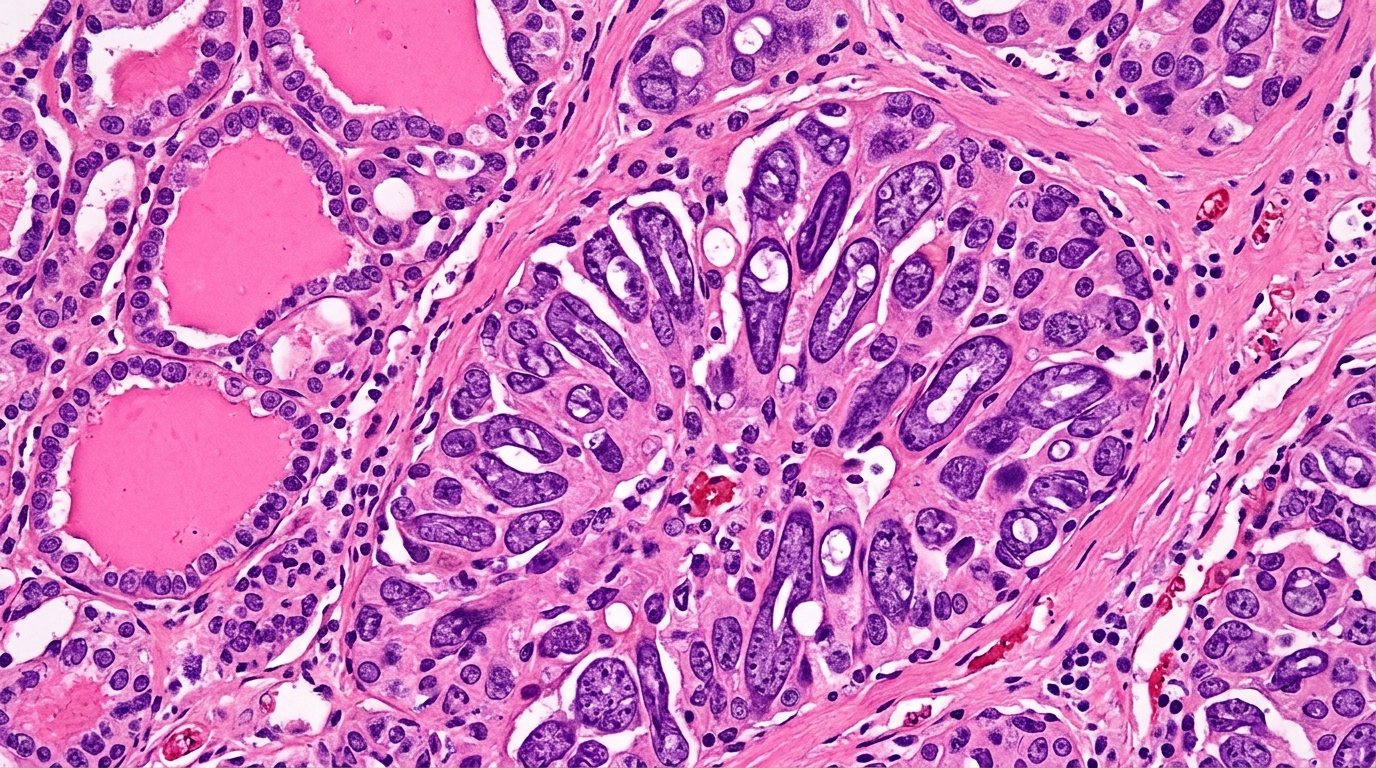
The study, published in Clinical Epigenetics, focuses on a specific subset of this aggressive malignancy characterized by the loss of the ARID1A gene. By utilizing integrative computational methods, the team aimed to investigate the synthetic lethal dependency between ARID1A-deficient cells and EZH2, the catalytic subunit of the Polycomb Repressive Complex 2. This work serves as a theoretical exploration of drug-target interactions in a cancer type with limited therapeutic options, rather than a clinical trial or direct efficacy assessment.
Anaplastic thyroid carcinoma is described in the source material as a rare and highly aggressive form of cancer, often resistant to standard treatments due to rapid metastasis. The study highlights a potential vulnerability in cases where ARID1A, a core subunit of the SWI/SNF chromatin remodeling complex, is lost. This loss creates a dependency on EZH2, which belongs to the opposing PRC2 complex. Although tazemetostat was previously approved for certain cancers, recent safety concerns and market withdrawal have limited its direct clinical use. Consequently, the authors positioned the drug as a characterized EZH2 inhibitor suitable for mechanistic interrogation of the ARID1A-EZH2 axis in a computational framework.
The research employed network pharmacology to identify key molecular targets central to the progression of ARID1A-deficient thyroid cancer. Through this analysis, the researchers identified five hub targets: EZH2, EGFR, MAPK1, GSK3B, and CYP3A4. These targets were selected based on their centrality in the biological networks associated with the disease state. The study then proceeded to evaluate the interaction between tazemetostat and these specific proteins to understand the potential scope of the drug’s activity beyond its primary intended target.
Molecular docking simulations were used to predict the binding affinity of tazemetostat to the five identified targets. The results indicated favorable binding predictions for all five proteins. The docking scores, which estimate the free energy of binding, ranged from ΔG = −9.04 kcal/mol for EZH2 to −13.27 kcal/mol for EGFR.
To assess the stability of these predicted interactions over time, the researchers conducted molecular dynamics simulations. The simulations supported overall pose stability across the complexes, meaning the drug remained bound to the target proteins throughout the simulated duration. However, the study noted target-dependent variability between the three replicas of each simulation. Statistical analysis revealed the strongest inter-replica consistency for EZH2 and MAPK1, indicating that the binding mode for these targets was highly reproducible in the models.
In contrast, the complexes involving CYP3A4, EGFR, and GSK3B showed significant differences at the replica level, despite maintaining stable overall trajectory behavior.
The authors conclude that their findings support the use of tazemetostat as a mechanistic computational probe for investigating EZH2-centered vulnerability in ARID1A-deficient anaplastic thyroid cancer. The predicted binding to EZH2 and additional cancer-relevant proteins suggests a potential for polypharmacology. However, the study explicitly states that docking and molecular dynamics simulations demonstrate binding stability rather than confirmed functional inhibition or pathway modulation. The computational results do not prove that the drug effectively inhibits these targets in a biological context or that this leads to therapeutic benefit.
Experimental validation is identified as a necessary next step to establish the biological significance of these predicted interactions. The study serves as a theoretical foundation for future laboratory investigations, highlighting specific targets and binding characteristics that warrant empirical testing.
Subject of Research: Computational evaluation of tazemetostat binding in ARID1A-deficient anaplastic thyroid cancer
Article Title: Integrative computational evaluation of tazemetostat for ARID1A-deficient anaplastic thyroid cancer via predicted polypharmacology and epigenetic target engagement
Article References: Haoyong, Z., & Cheng, Q. (2026). Integrative computational evaluation of tazemetostat for ARID1A-deficient anaplastic thyroid cancer via predicted polypharmacology and epigenetic target engagement. Clinical Epigenetics. https://doi.org/10.1186/s13148-026-02222-w
Image Credits: AI Generated
DOI: 10.1186/s13148-026-02222-w
Keywords: anaplastic thyroid cancer, tazemetostat, ARID1A, EZH2, molecular docking, molecular dynamics, polypharmacology, computational biology, epigenetics, network pharmacology, Integrative, computational
Cite Scienmag News
Nathaniel Bowman. (November 8, 2026). Computational Study Models Tazemetostat Binding in Thyroid Cancer. Scienmag. https://scienmag.com/computational-study-models-tazemetostat-binding-in-thyroid-cancer/
Nathaniel Bowman. "Computational Study Models Tazemetostat Binding in Thyroid Cancer." Scienmag, 8 November 2026, https://scienmag.com/computational-study-models-tazemetostat-binding-in-thyroid-cancer/. Accessed 9 November 2026.
Nathaniel Bowman. "Computational Study Models Tazemetostat Binding in Thyroid Cancer." Scienmag. November 8, 2026. https://scienmag.com/computational-study-models-tazemetostat-binding-in-thyroid-cancer/




