


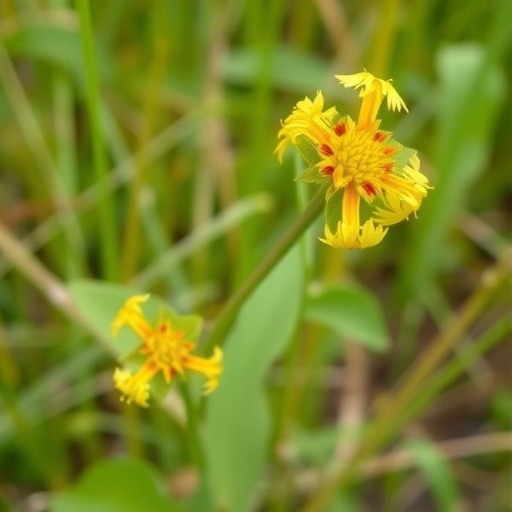
In the face of the mounting challenges posed by climate change, a recent study unveils a fascinating twist in the ecological narrative of tall goldenrod (Solidago altissima), a wildly prolific wildflower native to North America. While climate change is widely expected to diminish agricultural crop yields and disrupt natural communities, emerging evidence now suggests that warming and drought conditions could paradoxically enhance the vigor and reproductive success of goldenrod plants that are heavily infested by gall-inducing insects. This discovery provides a nuanced understanding of how complex biotic interactions may reshape species dominance and community dynamics under future climate scenarios.
Tall goldenrod is a quintessential component of North American grasslands and roadside ecosystems, renowned for its dense clusters of bright yellow flowers that flourish in late summer. Beyond its visual prominence, goldenrod serves as a host to a suite of insect species, many intricately linked through parasitic or mutualistic relationships. Among these inhabitants is the goldenrod bunch gall midge (Rhopalomyia solidaginis), a diminutive fly whose larvae induce the formation of tumor-like galls—elongated deformations on the plant’s stems—effectively hijacking the goldenrod’s developmental machinery to fashion a protective nursery. This complex insect-plant interaction historically restrains goldenrod growth and reproduction, playing a critical role in maintaining ecological balance.
Researchers led by Emily Parker and Phoebe Zarnetske at Michigan State University’s Ecology, Evolution, and Behavior program embarked on a pioneering experimental investigation to decipher how future climatic stresses, including elevated temperature and drought, might modulate the delicate interplay between goldenrod and its galling insects. Utilizing innovative field manipulations at the Kellogg Biological Station Long-Term Ecological Research Site in Michigan, the team simulated predicted summer warming by enclosing patches of prairie in transparent open-top chambers and mimicked drought conditions by selectively excluding rainfall through plexiglass roofing. This multifaceted design allowed them to observe plant and insect responses under combined environmental pressures over two growing seasons.
Contrary to conventional expectations that biotic stressors intensify under climate extremes, the study’s results revealed a remarkable alleviation of galling damage effects under elevated temperatures. Specifically, gall-infested goldenrod stems—which under ambient conditions suffered from reduced seed mass and decreased likelihood of seed production—displayed a reversal of these disadvantages when subjected to warming. Seed mass disparities between galled and non-galled plants diminished, and the probability of reproduction equalized, suggesting that warming mitigates the energetic costs imposed by the gall midges. Intriguingly, the combined effect of warming and drought further amplified this trend, pointing to a complex synergy between abiotic factors.
In addition to reproductive metrics, the study also documented dramatic changes in plant morphology and biomass. Gall-induced stunting, evident as a roughly seven-centimeter height reduction under normal conditions, was eliminated under warming, with galled plants even surpassing the stature of their gall-free counterparts. Biomass production followed a similar pattern; warmed galled plants accrued significantly more aboveground mass—16% greater than non-galled plants—while the combined warming and drought treatment elevated their biomass advantage to an impressive 39%. Such results indicate that climate warming enhances goldenrod growth despite continued insect herbivory, challenging assumptions about the compound impacts of stress.
Meanwhile, the gall-inducing midges themselves appeared unaffected by environmental manipulations, maintaining consistent infestation levels regardless of temperature and moisture regime. This decoupling of insect population dynamics from plant performance under climate stress paints a picture of shifting plant-insect resource allocation strategies, where the plant gains a relative edge perhaps through enhanced metabolic and physiological processes stimulated by warming. Previous investigations by the authors have linked rising temperatures to increased enzymatic activity and elongated growing seasons in goldenrod and other plant species, findings that harmonize with the present observations.
The ecological implications of these findings are profound. Tall goldenrod is renowned for its aggressive colonizing behavior, rapidly expanding via both seed dispersal and rhizomatous growth. It also exudes allelopathic chemicals that suppress neighboring plant species, consolidating its dominance across diverse habitats. If climate change fosters conditions that bolster gall-infested goldenrod growth and reproduction, this invasive potential may be further exacerbated, enabling goldenrod to outcompete and displace a broader suite of plant species. Such shifts could cascade through ecological networks, potentially altering pollinator interactions and habitat availability for other organisms.
This research underscores the importance of considering multi-stressor effects and species interactions when predicting ecological responses to climate change. “You can’t just look at species individually to understand how they will respond to climate change,” Zarnetske emphasized, highlighting the necessity to incorporate the broader biotic context—friends and foes alike—into models forecasting future ecosystems. By experimentally simulating realistic climate scenarios and accounting for biotic interactions, the work provides a critical advance in resilience and invasibility studies.
While the findings paint a somewhat optimistic view of gall-infested goldenrod thriving under warming, the authors caution that accumulating environmental stressors may eventually exceed the tolerance limits even of dominant species. The dynamic interplay between herbivory, climate stress, and plant growth may yield thresholds beyond which populations decline or community composition restructures dramatically. However, for the foreseeable future, the data suggest that tall goldenrod’s aggressive expansion could intensify, with potential consequences for grassland biodiversity and ecosystem functioning.
It is worth noting that despite their notoriety, goldenrods are not major contributors to seasonal allergies as often believed. The real culprit is ragweed (Ambrosia spp.), which blooms concurrently but disperses far more allergenic pollen. Public understanding of these distinctions can aid in better managing plant-related health concerns alongside ecological conservation efforts.
This research, stemming from a collaboration supported by the National Science Foundation and hosted at Michigan State University’s Kellogg Biological Station, exemplifies how integrative biology can unravel the complexities of climate-biome interactions. By shining light on the nuanced responses of species to global environmental change, it informs conservation strategies aiming to preserve ecological balance and anticipate shifts in species dominance under evolving climatic landscapes.
Cite Scienmag News
Sloane Callahan. (April 6, 2026). Climate Change Could Boost Growth of This Aggressive Prairie Plant. Scienmag. https://scienmag.com/climate-change-could-boost-growth-of-this-aggressive-prairie-plant/
Sloane Callahan. "Climate Change Could Boost Growth of This Aggressive Prairie Plant." Scienmag, 6 April 2026, https://scienmag.com/climate-change-could-boost-growth-of-this-aggressive-prairie-plant/. Accessed 3 September 2026.
Sloane Callahan. "Climate Change Could Boost Growth of This Aggressive Prairie Plant." Scienmag. April 6, 2026. https://scienmag.com/climate-change-could-boost-growth-of-this-aggressive-prairie-plant/


