


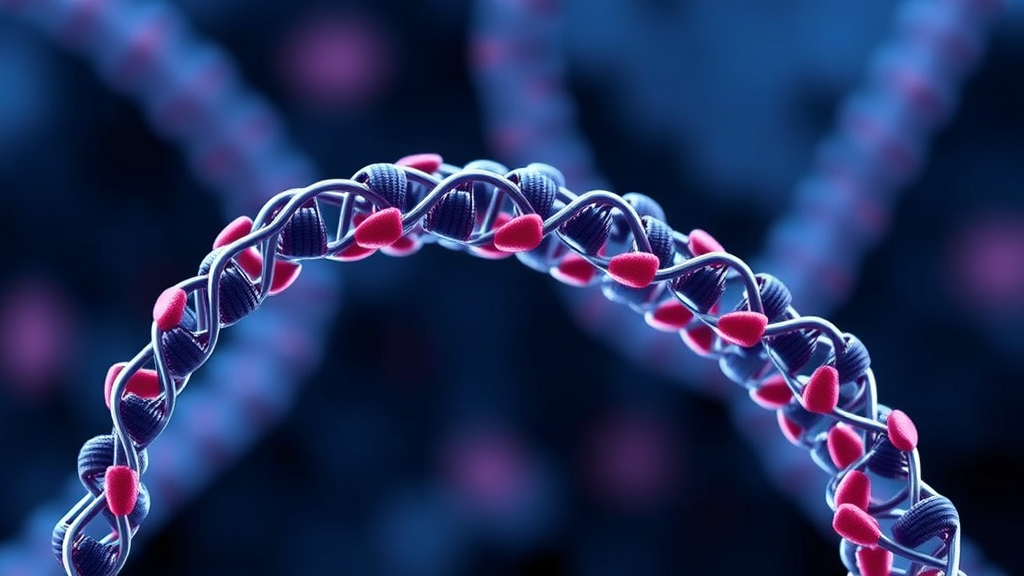
Cancer has long been understood as a disease of the genome, driven by mutations and copy-number changes that accumulate as tumors evolve. But a new review published in the journal Molecular Cancer argues that one of the most notorious players in tumor genetics, extrachromosomal DNA, or ecDNA, has been badly underestimated. Far from being a simple vehicle that carries extra copies of cancer-driving genes, ecDNA appears to function as a dynamic regulatory platform that physically and chemically reprograms how a cancer cell’s genome is read. The authors, led by Bi-xia Liu, Lu Zhou and Shuzhen Lai with senior correspondence from Lei Jiang, Jin Chang and Lisha Zha, synthesize recent advances suggesting that these tiny circular DNA molecules reshape chromatin accessibility, enhancer activity, three-dimensional genome organization and ultimately the entire transcriptional output of malignant cells.
Extrachromosomal DNA first attracted attention decades ago when researchers noticed strange, ring-shaped DNA fragments floating outside the chromosomes of tumor cells. Unlike chromosomal DNA, ecDNA is structurally independent, frequently circular and acentromeric, meaning it lacks the centromere structures that normally ensure chromosomes are distributed evenly during cell division. This absence has profound consequences. During mitosis, ecDNA molecules are inherited through noncanonical behaviors that allow unequal segregation between daughter cells, meaning one daughter cell can receive a windfall of oncogene copies while the other receives few or none. The review emphasizes that this non-Mendelian inheritance pattern also permits coordinated co-inheritance, in which multiple ecDNA species carrying different oncogenes and regulatory elements travel together through cell generations, allowing advantageous combinations of genes and regulatory states to persist and propagate within a tumor population.
The classical view of ecDNA centered on copy-number biology: more copies of an oncogene such as MYC or EGFR meant more messenger RNA and more oncogenic protein, fueling aggressive growth. The new synthesis argues that this framing misses the most consequential part of the story. ecDNA molecules carry not just genes but enhancers, the short DNA sequences that act as volume controls for gene expression. Because ecDNA is circular, enhancers that were once distant from their target genes on linear chromosomes can be brought into immediate physical proximity, rewiring enhancer-oncogene communication in ways that linear DNA cannot easily achieve. The review describes how ecDNA can hijack pre-existing enhancers, activate noncanonical regulatory elements that would normally remain silent, and thereby transform a raw genome rearrangement event into genuine epigenetic innovation.
At the physical level, ecDNA does not float passively in the nucleus. Advanced imaging and genomic mapping studies summarized in the review show that ecDNA molecules cluster together into transcriptionally active nuclear hubs, dense assemblies where multiple circular molecules and their target genes on chromosomes converge. These hubs behave like condensate-associated structures, membrane-less compartments that concentrate transcription machinery, transcription factors and co-activators at extraordinarily high local concentrations. The result is a hyperactive transcriptional factory that can drive oncogene expression to levels unattainable through ordinary chromosomal regulation. In this sense, ecDNA-positive tumor cells are not merely carrying extra genetic cargo; they are constructing an entirely new layer of nuclear architecture dedicated to amplifying and fine-tuning oncogenic signaling.
This architectural rewiring has direct consequences for chromatin itself. The review details how ecDNA reshapes chromatin accessibility, the degree to which DNA is physically open and available to transcription factors. ecDNA tends to maintain an unusually open chromatin state, rich in active histone marks, which keeps its passenger enhancers and promoters in a perpetually transcription-ready configuration. Because ecDNA hubs can also contact chromosomal targets, this openness can extend to the ordinary genome, altering which chromosomal genes are switched on or off. Through these mechanisms, ecDNA generates transcriptional plasticity, the capacity of a tumor cell to shift its gene-expression program rapidly in response to changing conditions, whether that condition is a drug, an immune attack or a change in nutrient supply.
That plasticity feeds directly into some of the most clinically feared phenomena in oncology. The review positions ecDNA as a key driver of intratumoral heterogeneity, the coexistence of genetically and epigenetically distinct cell populations within a single tumor. Because ecDNA segregates unequally during mitosis, daughter cells diverge quickly in oncogene dosage and regulatory state, generating a diverse portfolio of cellular phenotypes from a single founding lineage. This diversity provides abundant raw material for clonal evolution: when chemotherapy eliminates cells with one regulatory configuration, subpopulations with different ecDNA compositions and enhancer landscapes survive and repopulate the tumor. The same logic applies to metastatic adaptation, where disseminated cells must reprogram their transcriptional identity to colonize new tissues, and to therapeutic resistance, where ecDNA-mediated enhancer rewiring can rapidly upregulate drug targets or bypass inhibited pathways.
Yet the very features that make ecDNA so powerful for the tumor may also constitute its Achilles’ heel. The review highlights that the high transcriptional burden carried by ecDNA creates a form of genomic stress known as transcription-replication conflict. When the transcription machinery and the DNA replication machinery collide on the same stretch of DNA, the resulting collisions can stall replication forks and generate DNA damage. ecDNA-positive cells, with their extraordinarily high transcriptional output, may live permanently near the threshold of tolerable transcription-replication interference. This dependence suggests selective vulnerabilities that could be exploited therapeutically: drugs that further stress transcription or replication, or that disrupt the specialized regulatory architecture of ecDNA hubs, might preferentially harm ecDNA-rich tumors while sparing normal cells.
The authors also point to the dependence of ecDNA-positive tumors on the integrity of their nuclear hubs and condensates as a second class of vulnerability. If transcriptional output in these tumors relies on the physical coalescence of ecDNA molecules and their associated regulatory factors, then interventions that dissolve or destabilize those assemblies, for example by targeting condensate-forming proteins or the chromatin regulators that maintain open chromatin on ecDNA, could collapse the tumor’s oncogenic transcription program. Similarly, because ecDNA inheritance depends on noncanonical mitotic behaviors rather than centromeres, the machinery that distributes ecDNA during cell division represents another potential point of attack. None of these strategies has yet produced approved therapies, but the review frames them as a conceptual frontier for precision oncology, in which treatment decisions could one day be guided by mapping a tumor’s ecDNA complement and its regulatory architecture.
Perhaps the most significant contribution of the review is conceptual. By shifting the focus from copy-number biology to regulatory biology, the authors reframe ecDNA not as a passive amplifier of oncogenes but as an active platform for epigenetic reprogramming, a mobile, self-perpetuating module that converts structural genome chaos into functional transcriptional diversity. This reframing has implications for how scientists model tumor evolution, how pathologists assess tumor aggressiveness and how drug developers search for targets in the least stable, most adaptable corners of the cancer genome. As long-read sequencing, spatial genomics and chromatin mapping technologies mature, the ability to read a tumor’s ecDNA landscape may become as routine as today’s copy-number profiling, opening a window onto the epigenetic strategies that cancers use to survive everything medicine throws at them.
The review, published open access in Molecular Cancer, was supported by the Shandong Provincial Traditional Chinese Medicine Science and Technology Project and the Health Commission of Jiangxi Province. Its authors span institutions across China, including Nanchang University, Hunan University, Naval Medical University and Shandong First Medical University, reflecting the rapidly growing international effort to understand the nonchromosomal genome of cancer. What emerges from their synthesis is a picture of tumors that are not just collections of mutated genes but ecosystems of mobile regulatory elements, and of ecDNA as the engine that keeps those ecosystems adaptable, heterogeneous and, for now, one step ahead of treatment.
Subject of Research: The role of extrachromosomal DNA as a regulatory platform for epigenetic reprogramming in cancer
Article Title: Extrachromosomal DNA as a platform for epigenetic reprogramming in cancer
Article References: Liu, B.-X., Zhou, L., Lai, S., Han, X., Dai, X.-J., Liu, R., Wang, Y., Chen, D., Wei, J., Hu, H., Zu, W., Jiang, L., Chang, J., & Zha, L. (2026). Extrachromosomal DNA as a platform for epigenetic reprogramming in cancer. Molecular Cancer. https://doi.org/10.1186/s12943-026-02789-1
Image Credits: AI Generated
DOI: 10.1186/s12943-026-02789-1
Keywords: extrachromosomal DNA, ecDNA, epigenetic reprogramming, chromatin accessibility, enhancer rewiring, transcriptional plasticity, tumor evolution, intratumoral heterogeneity, therapeutic resistance, nuclear hubs, precision oncology, Molecular Cancer
Cite Scienmag News
Nathaniel Bowman. (September 20, 2026). Circular DNA Emerges as an Epigenetic Engine Driving Cancer’s Rapid Adaptation. Scienmag. https://scienmag.com/circular-dna-emerges-as-an-epigenetic-engine-driving-cancers-rapid-adaptation/
Nathaniel Bowman. "Circular DNA Emerges as an Epigenetic Engine Driving Cancer’s Rapid Adaptation." Scienmag, 20 September 2026, https://scienmag.com/circular-dna-emerges-as-an-epigenetic-engine-driving-cancers-rapid-adaptation/. Accessed 4 October 2026.
Nathaniel Bowman. "Circular DNA Emerges as an Epigenetic Engine Driving Cancer’s Rapid Adaptation." Scienmag. September 20, 2026. https://scienmag.com/circular-dna-emerges-as-an-epigenetic-engine-driving-cancers-rapid-adaptation/


