


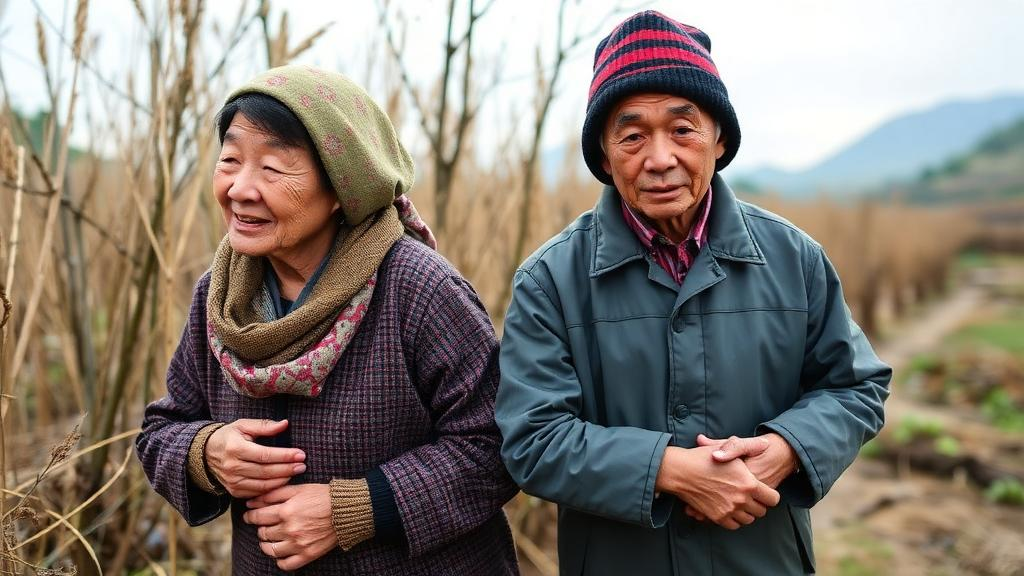
In the villages of rural Fujian Province, a quiet demographic experiment in family care is underway, and its results are sobering. As hundreds of millions of working-age Chinese have migrated to cities over the past four decades, the older adults left behind have absorbed responsibilities that no formal system has claimed. A new qualitative study published in the International Journal for Equity in Health examines one of the heaviest of these burdens: elderly parents who serve as the primary, and often only, caregivers for their adult sons and daughters with schizophrenia. The research, conducted by Yubing Chen and Sheng Bao of Jinan University, offers a rare longitudinal view of how decades of caregiving reshape what it means to grow old.
The researchers interviewed 14 older caregivers in depth, using semi-structured interviews and a life course framework, which treats individual biographies as sequences of transitions and turning points shaped by wider social forces. They then applied reflexive thematic analysis, a method in which two researchers independently coded the transcripts and iteratively refined themes while remaining alert to how their own assumptions might color interpretation. The approach is well suited to a question that cannot be answered by surveys alone: not how many older parents care for adults with schizophrenia, but what that care does to a life over time.
The first major finding concerns how these parents came to occupy the caregiver role at all. Contrary to any assumption that filial duty falls automatically on the shoulders of the elderly, the study found that caregiving assignments emerged from a family-level division of labor and negotiation. Younger and middle-aged relatives, pressed by the economic necessity of migration, could not sustain both a livelihood in the city and daily care of a relative with severe mental illness. Through a process the authors describe as compromise, responsibility gravitated toward the parent who remained in the village. The caregiver was not chosen so much as left standing when everyone else had been pulled away by the demands of the household economy.
This mechanism matters because it reframes the problem. If the concentration of care on older parents were simply a cultural expression of filial piety, the policy response might be limited to supporting tradition. But the interviews suggest something more structural: the household’s need to survive economically forces a triage in which the least mobile, least employable family member, the aging parent, becomes the de facto care infrastructure. The caregiving arrangement is thus a symptom of migration-driven labor markets colliding with the absence of community mental health services.
The second theme addresses the interrupted biography of the adult child. In the expected script of rural family life, children mature, marry, work, and eventually become a source of support for their parents in old age. Schizophrenia, typically emerging in early adulthood, severed that trajectory. Parents who had anticipated a gradual release from intensive parenting found themselves instead locked into it, administering medication, managing relapses, watching for signs of self-harm, and shielding their children from stigma. The developmental clock that should have moved the parent toward a lighter role in later life instead ran in reverse, pulling them back into responsibilities they had expected to shed.
To make this disrupted trajectory livable, many caregivers turned to fatalistic beliefs. The study found that framing the child’s illness as fate, destiny, or karmic consequence served a psychological function, allowing parents to locate meaning in a situation they could neither change nor escape. This is not resignation in a passive sense; the researchers describe it as an active interpretive resource that sustains daily caregiving. Yet it also reveals how thin the available supports are. When meaning must be manufactured from fatalism rather than from institutional help, the gap between need and provision becomes visible in the most intimate corners of family life.
The third and most striking theme concerns death. As physical strength declines, these caregivers face a question that most elderly people never have to confront so directly: who will care for my child when I am gone? The study found that anxiety about care continuity after death led some participants to develop unconventional expectations about the order of dying. Rather than hoping for longevity, some expressed a wish to outlive their children, so that their sons or daughters would never be left without a caregiver. Inverting the natural order of mortality becomes, for these parents, an act of protection. It is a finding that should unsettle any reader, because it exposes a form of suffering that standard measures of caregiver burden do not capture: the dread of dying before the person who depends on you can be safely handed over to someone else.
The life course perspective gives these findings their analytical force. Rather than treating aging and caregiving as static states, the framework shows how one event, the onset of schizophrenia in a young adult, cascades through decades of family history, redirecting migrations, marriages, retirements, and ultimately the meaning of death itself. The older caregivers in this study are not simply old people doing hard work; they are people whose entire later biography has been reorganized around an illness that struck a generation earlier. Their expectations about aging, their sense of when they might rest, and even their hopes about the timing of their own deaths have all been bent around the caregiving role.
The authors draw a clear policy conclusion: long-term care for people with schizophrenia in rural China currently falls mainly on older parents, and this is unsustainable. As these caregivers age, the system they constitute, informal, unpaid, and irreplaceable, will fail without deliberate intervention. The study points toward a sustainable community support system that distributes caregiving responsibility fairly among families, communities, and public services. Concretely, that would imply rural mental health outreach, respite care, community-based rehabilitation, and financial mechanisms that do not force families to choose between earning a living and caring for a relative. The alternative is a predictable wave of care crises as today’s caregivers reach the limits of their strength.
Beyond China, the study speaks to a global pattern. Rapid urbanization and labor migration across much of Asia, Africa, and Latin America leave older adults as the default caregivers for relatives with severe mental illness wherever formal services are thin. The Fujian interviews document, in fine grain, what that default costs: not only physical exhaustion and financial strain, but a fundamental distortion of what old age is supposed to be. The parents in this study did not choose their role, and they cannot lay it down. The research makes a compelling case that the rest of society, in China and elsewhere, must now decide whether that arrangement is acceptable, or whether the final years of millions of older adults should be returned to them.
Subject of Research: Life course experiences of left-behind older parents caring for adult children with schizophrenia in rural China
Article Title: Aging while caregiving: a life course qualitative study of left-behind older parents caring for adult children with schizophrenia in rural China
Article References: Chen, Y., & Bao, S. (2026). Aging while caregiving: a life course qualitative study of left-behind older parents caring for adult children with schizophrenia in rural China. International Journal for Equity in Health, 25(1), Article 207. https://doi.org/10.1186/s12939-026-03015-6
Image Credits: AI Generated
DOI: 10.1186/s12939-026-03015-6
Keywords: schizophrenia, family caregivers, left-behind older adults, rural China, life course, mental health, caregiving burden, labor migration, health equity, qualitative research, aging, community support
Cite Scienmag News
Beatrice Stafford. (October 4, 2026). In Rural China, Aging Parents Carry the Lifelong Burden of Caring for Adult Children With Schizophrenia. Scienmag. https://scienmag.com/in-rural-china-aging-parents-carry-the-lifelong-burden-of-caring-for-adult-children-with-schizophrenia/
Beatrice Stafford. "In Rural China, Aging Parents Carry the Lifelong Burden of Caring for Adult Children With Schizophrenia." Scienmag, 4 October 2026, https://scienmag.com/in-rural-china-aging-parents-carry-the-lifelong-burden-of-caring-for-adult-children-with-schizophrenia/. Accessed 4 October 2026.
Beatrice Stafford. "In Rural China, Aging Parents Carry the Lifelong Burden of Caring for Adult Children With Schizophrenia." Scienmag. October 4, 2026. https://scienmag.com/in-rural-china-aging-parents-carry-the-lifelong-burden-of-caring-for-adult-children-with-schizophrenia/


