

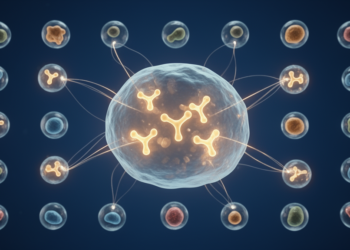
Massive phosphoproteome atlas maps kinase activity across 33 human cell lines
Researchers have built a phosphoproteome atlas covering more than 200,000 phosphorylation sites across 33 human cell lines, enabling faster phosphoproteomics ...
Researchers have built a phosphoproteome atlas covering more than 200,000 phosphorylation sites across 33 human cell lines, enabling faster phosphoproteomics ...

A new commentary argues that lung nodule localisation is entering a precision era, as stabilised fluorescent matrices aim to solve ...
A study of 156 patients in Xinjiang, China, links a specific KSHV K15 gene variant to aggressive Kaposi sarcoma through ...
A longitudinal spatial multi-omics study reveals how the tumor microenvironment in EGFR-mutant lung cancer remodels in distinct stages as patients ...
A study of nearly 40,000 cancer patients found that age-based germline genetic testing policies would miss about 72 percent of ...
A new Nature Reviews Clinical Oncology review synthesizes epidemiological, trial and mechanistic evidence to argue that structured exercise is emerging ...
The MOSAIC consortium has profiled more than 2,700 tumor samples with spatial and single-cell multi-omics to build a standardized public ...
Sanford Burnham Prebys scientist Lukas Chavez has won the 2026 AWS Children's Health Innovation Award to build Leitstern, an AI-powered ...
The new global phase III AFT-70 NAVIGATE trial will test whether ultrasensitive Signatera MRD blood monitoring can safely guide CDK4/6 ...
Researchers have developed CALT-GNN, a graph neural network that combines cross-attention-based multi-omics integration with long-tail expert routing to improve cancer ...

Embark on a thrilling journey of discovery with Scienmag.com—your ultimate source for cutting-edge breakthroughs. Immerse yourself in a world where curiosity knows no limits and tomorrow’s possibilities become today’s reality!