


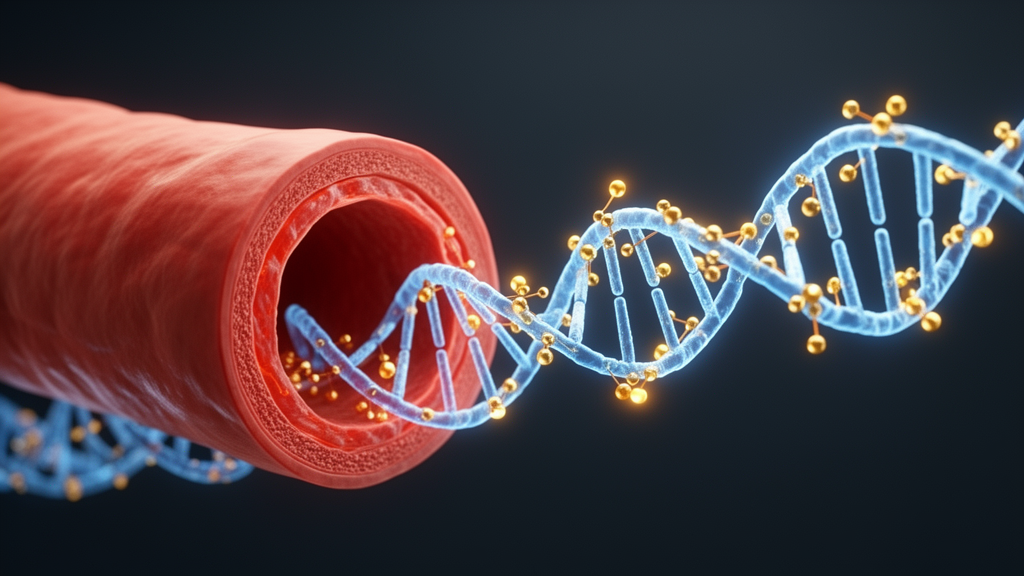
Aortic dissection is one of the most lethal emergencies in cardiovascular medicine. The condition begins when a tear opens in the innermost layer of the aorta, allowing blood to surge into the vessel’s middle layer and carve out a second, false channel. With an estimated annual incidence of three to five cases per 100,000 people, acute dissection carries high mortality in its early phase, and surgery remains the only reliably effective treatment. A new review published in Frontiers in Cell and Developmental Biology argues that a chemical tag on RNA molecules, known as N6-methyladenosine or m6A, may influence how this disease develops, and that manipulating the tag could eventually open a path toward targeted drugs that currently do not exist.
M6A is the most abundant internal modification found in the RNA of eukaryotic cells. It involves the addition of a methyl group to the sixth nitrogen atom of adenine, and it appears not only on messenger RNA but also on transfer RNA, ribosomal RNA, microRNA, circular RNA and long noncoding RNA. The mark changes the fate of the molecules that carry it, affecting splicing, export from the nucleus, stability, translation and the production of microRNAs. Because of this reach, m6A has been implicated in embryonic development, cancer and neurodegeneration, and a growing body of work now connects it to cardiovascular disease, including the formation, progression and rupture of aortic dissection.
The modification is controlled by three classes of proteins. Writers, led by the METTL3-METTL14-WTAP complex, install the methyl marks; METTL3 acts as the catalytic subunit while METTL14 improves substrate recognition and WTAP anchors the complex in the nucleus. Erasers, principally FTO and ALKBH5, remove the marks, making the process reversible. Readers, including the YTH domain family and proteins such as IGF2BP1/2/3 and members of the HNRNP family, recognize methylated sites and determine the consequences for each RNA. When any of these regulators are misexpressed, the balance of RNA methylation across thousands of transcripts can shift, with effects that differ from one cell type to the next.
The review, written by a team of cardiothoracic surgery researchers in China, gathers evidence that m6A regulators behave abnormally in dissection and can either promote or restrain the disease depending on the transcript, the reader protein and the cell type involved. One of the clearest examples concerns cell death. In aortic tissue from patients, the writer KIAA1429 is decreased while the eraser ALKBH5 is increased. In mice infused with angiotensin II, restoring KIAA1429 promoted the conversion of pri-miR-143-3p into mature miR-143-3p in an m6A-dependent manner, which stimulated vascular smooth muscle cell proliferation, reduced endothelial cell apoptosis and eased the disease, whereas ALKBH5 overexpression produced the opposite effect.
Ferroptosis, an iron-dependent form of cell death driven by lipid peroxidation, has emerged as another m6A-controlled process in the aortic wall. METTL3 is upregulated in the aorta of patients with Stanford type A dissection and correlates negatively with SLC7A11 and FSP1, two proteins that suppress ferroptosis. Overexpressing METTL3 accelerated the decay of the mRNAs encoding these protective proteins in an m6A-dependent way, promoting ferroptosis in human arterial smooth muscle cells and worsening dissection in mice treated with beta-aminopropionitrile. Separately, METTL3 was reported to methylate the long noncoding RNA NORAD, lowering its expression through the reader YTHDF2; because NORAD normally stabilizes the mRNA for the antioxidant enzyme GPX4, its loss removes another brake on ferroptosis. The authors also describe evidence that METTL3 recruits YTHDF2 to destabilize NOTCH1 mRNA, pushing smooth muscle cells from a quiescent contractile state into a synthetic state that degrades the extracellular matrix, a hallmark step in wall weakening.
Immune mechanisms add a further layer. Macrophages in the aortic wall can polarize toward a pro-inflammatory M1 state or an anti-inflammatory M2 state, and dissection is generally associated with an M1 shift. The writer RBM15 is highly expressed in aortic tissue from patients with dissection, and in rat models its overexpression enhanced glycolysis by upregulating GLUT1 and HK2 in an m6A-dependent manner, driving macrophages toward the M1 phenotype and accelerating disease. Oxidative stress may also be involved: the reader YTHDC1 is reduced in aortic tissue from patients, and knocking it down in cultured endothelial cells increased reactive oxygen species production and lowered superoxide dismutase 2 expression, hinting at a protective role that has not yet been fully tested in animals.
The review extends the same logic to the major risk factors for dissection. Roughly 80 percent of patients who develop the condition are estimated to have hypertension, and METTL3 expression and global m6A levels are elevated in the arteries of hypertensive patients and angiotensin II-treated mice; methylating the ADAM17 mRNA promotes its export from the nucleus, cleavage of ACE2, vasoconstriction and higher blood pressure. In atherosclerosis, which affects about 31 percent of dissection patients, macrophage-specific deletion of METTL3 in mice reduced inflammatory signaling and plaque formation, while METTL14-driven methylation of FOXO1 and UCHL5 mRNAs aggravated endothelial inflammation. In obesity, m6A regulators including FTO, ALKBH5, METTL14 and IGF2BP3 modulate fat cell formation and the browning of white adipose tissue in animal studies. In aortic aneurysm, elevated global m6A levels and increased YTHDF3 expression track with disease severity, and METTL14 or WTAP promoted smooth muscle cell ferroptosis and apoptosis through methylated target mRNAs.
These converging findings suggest diagnostic and therapeutic possibilities, though the authors are careful to note how preliminary they remain. A database analysis found that the eraser FTO and the reader IGF2BP1 were dysregulated in dissection samples and showed relatively good accuracy in a diagnostic prediction model, but no m6A-based biomarker has been validated in prospective clinical studies. On the therapeutic side, small-molecule inhibitors already exist: STM2457, a first-in-class catalytic inhibitor of METTL3, has suppressed macrophage activation and plaque formation in atherosclerosis models and eased pulmonary arterial hypertension in experimental settings, while RSM3 and KH12 promote METTL3 degradation and the ALKBH5 inhibitor IOX1 protected against atherosclerosis in preclinical work. Natural compounds such as coptisine chloride and curcumin also modulate METTL3, and microRNAs including miR-145 and miR-186-5p, which target YTHDF2 and METTL3 respectively, have shown protective effects in dissection models.
None of these strategies has yet been tested in clinically relevant models of aortic dissection itself, and the review outlines substantial obstacles before any could reach patients. Because m6A decorates a vast range of RNA molecules, the specificity and safety of interventions are uncertain; systemic delivery risks off-target disruption of methylation in healthy tissues; cross-talk among different RNA modifications could produce unforeseen effects; and the feasibility of combining m6A-targeting drugs with standard treatments such as blood pressure control has not been assessed. Most mechanistic evidence rests on angiotensin II or beta-aminopropionitrile mouse models and cultured vascular smooth muscle cells, with human validation limited to small observational tissue samples. Even so, the picture that emerges is striking: a single, reversible chemical tag on RNA appears to sit at the junction of cell death, inflammation, oxidative stress and wall remodeling that together determine whether the aorta holds or tears. If future animal studies and early trials confirm the promise suggested by this early-phase research, the enzymes that write and erase m6A could become the first genuinely molecular drug targets for a disease that medicine has so far been able to treat only with a scalpel.
Subject of Research: The role of N6-methyladenosine RNA modification in the mechanisms and potential treatment of aortic dissection
Article Title: The emerging role of m6A in aortic dissection: from molecular mechanisms to therapeutic potential
Article References: She, C.-Q., Long, C.-Z., Lyv, X.-L., Lei, Z.-W., Kuang, W.-A., Deng, H., Yi, M.-L., Cai, S.-W., Yu, X.-H., Peng, Y., & Feng, Y.-G. (2026). The emerging role of m6A in aortic dissection: from molecular mechanisms to therapeutic potential. Frontiers in Cell and Developmental Biology, 14, Article 1906074. https://doi.org/10.3389/fcell.2026.1906074
Image Credits: AI Generated
DOI: 10.3389/fcell.2026.1906074
Keywords: aortic dissection, m6A, RNA modification, epigenetics, METTL3, ferroptosis, vascular smooth muscle cells, hypertension, atherosclerosis, macrophage polarization, aortic aneurysm, drug targets
Cite Scienmag News
Juliet Wilcox. (October 23, 2026). Chemical Tags on RNA May Steer the Course of Aortic Dissection. Scienmag. https://scienmag.com/chemical-tags-on-rna-may-steer-the-course-of-aortic-dissection/
Juliet Wilcox. "Chemical Tags on RNA May Steer the Course of Aortic Dissection." Scienmag, 23 October 2026, https://scienmag.com/chemical-tags-on-rna-may-steer-the-course-of-aortic-dissection/. Accessed 23 October 2026.
Juliet Wilcox. "Chemical Tags on RNA May Steer the Course of Aortic Dissection." Scienmag. October 23, 2026. https://scienmag.com/chemical-tags-on-rna-may-steer-the-course-of-aortic-dissection/


