


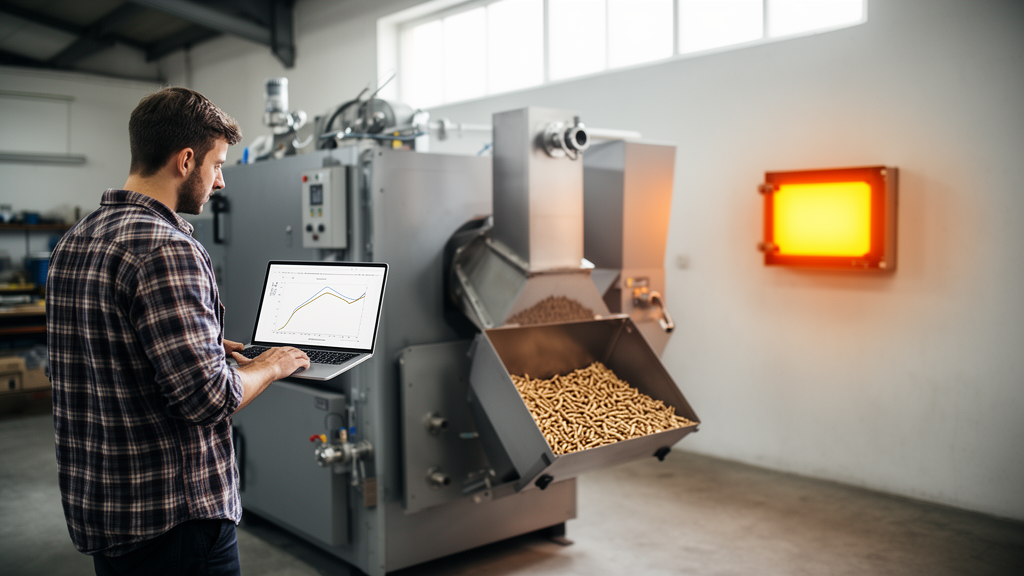
A long-term field study of a biomass-fired boiler system has found that the simplest forecasting model often outperformed more sophisticated machine-learning approaches when predicting the temperature of a thermal storage tank minutes to hours ahead. The research, which analysed operational data from a real plant, focused on the P1 thermal-storage-tank temperature and evaluated forecasts at 60-, 120-, and 180-minute horizons, a range chosen to capture the system’s pronounced thermal delays.
Characterising those delays proved difficult. Robust cross-correlation analysis showed only statistically detectable but weak associations between the storage-tank temperature and combustion-related operational inputs. Daily lag estimates displayed broad and heterogeneous distributions, meaning the boiler could not be described by a single deterministic response time. This thermal heterogeneity is precisely what complicates operational warning systems, since the plant’s response to combustion changes arrives at unpredictable intervals.
When the team benchmarked competing models, increasing complexity did not necessarily improve performance. A Linear autoregressive (AR) model achieved the lowest test RMSE and highest R-squared at all three horizons. Its RMSE values were 1.3774, 2.1605, and 2.6182 degrees Celsius at 60, 120, and 180 minutes respectively, with R-squared values of 0.7809, 0.4616, and 0.2104. The steady decline in accuracy with longer horizons reflects the strong persistence of the thermal system, where recent measurements carry most of the predictive information.
The study also revealed a trade-off between pointwise accuracy and coverage of delayed thermal responses. Lag coverage increased as the forecasting horizon lengthened, but predictive accuracy progressively decreased, indicating that no single horizon is universally optimal. Operators therefore face a choice between sharper short-term predictions and broader, less precise coverage of the system’s delayed behaviour.
A retrospective out-of-band warning analysis underscored this tension. XGBoost recall fell from 0.5343 at 60 minutes to 0.1761 at 120 minutes and just 0.0538 at 180 minutes, while specificity rose from 0.9095 to 0.9546 and 0.9854. In other words, longer-horizon forecasts became increasingly conservative, flagging fewer future out-of-band states but doing so with fewer false alarms.
The authors caution that multi-horizon forecasts should be interpreted as predictive risk indicators rather than evidence of causal improvements in boiler control or operational performance. For thermally delayed biomass systems, the practical message is that simple temporal models remain highly competitive, and that warning thresholds must be tuned to each horizon’s distinct accuracy and coverage profile.
Subject of Research: Multi-horizon forecasting of thermal-storage-tank temperature in a thermally delayed biomass-fired boiler system
Article Title: Multi-horizon forecasting for decision support in a thermally delayed biomass-fired boiler system
Article References: Park, S., Yang, J., Kim, S., Hwang, K., Lee, J., & Ryu, S. (2026). Multi-horizon forecasting for decision support in a thermally delayed biomass-fired boiler system. PLOS One, 21(10), e0361121. https://doi.org/10.1371/journal.pone.0361121
Image Credits: AI Generated
DOI: 10.1371/journal.pone.0361121
Keywords: biomass boiler, thermal storage, forecasting, autoregressive model, XGBoost, machine learning, time-series analysis, thermal lag, decision support, out-of-band warning, Multi-horizon, decision
Cite Scienmag News
Faith Mcneil. (October 23, 2026). Simple Models Beat Complex Ones at Forecasting a Thermally Delayed Biomass Boiler. Scienmag. https://scienmag.com/simple-models-beat-complex-ones-at-forecasting-a-thermally-delayed-biomass-boiler/
Faith Mcneil. "Simple Models Beat Complex Ones at Forecasting a Thermally Delayed Biomass Boiler." Scienmag, 23 October 2026, https://scienmag.com/simple-models-beat-complex-ones-at-forecasting-a-thermally-delayed-biomass-boiler/. Accessed 23 October 2026.
Faith Mcneil. "Simple Models Beat Complex Ones at Forecasting a Thermally Delayed Biomass Boiler." Scienmag. October 23, 2026. https://scienmag.com/simple-models-beat-complex-ones-at-forecasting-a-thermally-delayed-biomass-boiler/


