


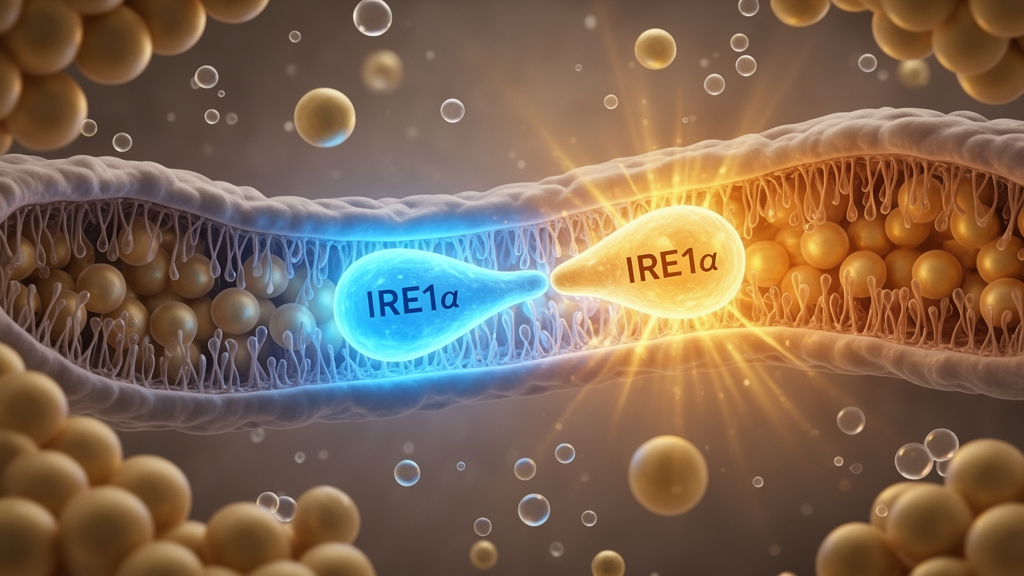
Deep inside nearly every cell in the body, a molecular quality-control machine decides between life and death. When proteins fail to fold properly in the endoplasmic reticulum (ER), the cell’s protein-manufacturing hub, a stress-response program called the unfolded protein response (UPR) swings into action to restore order. A new review published in Molecular Biology Reports argues that one branch of this program, the IRE1α/XBP1 pathway, sits at the very crossroads of type 2 diabetes mellitus (T2DM) and could become the foundation for a fundamentally new class of disease-modifying drugs.
The stakes could hardly be higher. According to the review, led by Olabisi Tajudeen Obafemi of the University of South Africa and colleagues, the global number of people living with diabetes surged from 200 million in 1990 to 830 million in 2022. Type 2 diabetes accounts for roughly 90 to 95 percent of those cases and is defined by insulin resistance paired with an insufficient compensatory surge of insulin. Persistent high blood glucose progressively damages the vascular, renal, neurological, ocular and cardiovascular systems, generating enormous morbidity and healthcare expenditure. Current drugs, including sodium-glucose cotransporter 2 inhibitors and glucagon-like peptide-1 receptor agonists, mostly manage glucose downstream of the underlying cellular damage.
The authors contend that upstream stress-response pathways deserve far more therapeutic attention because they lie closer to the molecular origins of the disease. Among these, the IRE1α/XBP1 arm of the UPR is the most evolutionarily conserved, meaning that findings in model organisms often translate more readily to human biology. IRE1α is a transmembrane protein with a stress-sensing domain inside the ER lumen and kinase plus endoribonuclease (RNase) domains facing the cytoplasm. Under resting conditions, the chaperone GRP78, also known as BiP, keeps IRE1α inactive. When misfolded proteins accumulate, GRP78 detaches to handle them, allowing IRE1α to oligomerize and trans-autophosphorylate, thereby switching on its RNase domain.
That RNase activity performs one of the most remarkable feats in molecular biology: the unconventional splicing of X-box binding protein 1 (XBP1) mRNA. IRE1α excises a 26-nucleotide intron from XBP1 mRNA in the cytoplasm, producing a frameshift that generates the spliced transcription factor XBP1s. Once in the nucleus, XBP1s switches on genes for ER-associated protein folding, quality control, ER expansion, lipid biosynthesis and enhanced secretory capacity. In its adaptive mode, the pathway is a lifeline, expanding the cell’s folding factory to meet demand. But when ER stress becomes chronic, the same machinery turns destructive, engaging regulated IRE1-dependent decay (RIDD), which degrades essential transcripts, and recruiting inflammatory stress kinases.
The review details how this dual personality plays out across metabolically active tissues. In the liver, XBP1s suppresses gluconeogenesis by promoting the degradation of the transcription factor FOXO1, improving glucose tolerance, while fasting signals phosphorylate hepatic IRE1α at serine 724 to enhance gluconeogenic genes independently of XBP1s. In adipose tissue, XBP1s maintains adipocyte differentiation through the C/EBP family of transcription factors. In pancreatic beta cells, glucose-induced XBP1 splicing expands the machinery needed for proinsulin folding and secretion while limiting oxidative stress; beta-cell-specific XBP1 deficiency reduces insulin granules and weakens glucose-stimulated insulin secretion. Even skeletal muscle uses the pathway adaptively after injury to support regeneration.
Trouble begins when glucotoxicity and lipotoxicity sustain IRE1α signaling beyond its adaptive window. Chronic hyperglycemia hyperactivates IRE1α in beta cells, suppressing insulin gene expression and degrading insulin mRNA through RIDD, converting a protective response into secretory failure. Meanwhile, IRE1α recruits the adaptor protein TRAF2 and activates c-Jun N-terminal kinase (JNK), which phosphorylates insulin receptor substrate-1 on inhibitory serine residues. This blocks downstream PI3K/AKT signaling, reduces GLUT4-mediated glucose uptake and drives systemic insulin resistance. In skeletal muscle, XBP1 and ATF6 upregulate the phosphatase SKIP, further attenuating insulin-stimulated glucose uptake. The result is a feed-forward loop: excess nutrients fuel ER stress, stress kinases blunt insulin action, insulin resistance increases beta-cell workload, and the extra biosynthetic burden deepens ER stress.
The inflammatory consequences may be the most striking. The review describes how hyperactivated IRE1α lowers levels of microRNA-17, which normally represses thioredoxin-interacting protein (TXNIP). Stabilized TXNIP mRNA then promotes activation of the NLRP3 inflammasome, triggering caspase-1-mediated maturation of the inflammatory cytokines IL-1β and IL-18. IRE1α/TRAF2 signaling also activates NF-κB, elevating TNF-α, IL-6 and IL-1β and sustaining the low-grade metabolic inflammation that characterizes obesity and T2DM. The pathway even intersects oxidative stress signaling: acute oxidative stress induces IRE1α sulfenylation and activates an IRE1α–p38–NRF2 antioxidant axis, while in diabetic nephropathy a persistent XBP1–HRD1 axis ubiquitinates NRF2 and strips away renal antioxidant protection.
What elevates the review beyond mechanism is its synthesis of preclinical pharmacology on both sides of the pathway. On the activation side, the small molecule IXA4 selectively boosted adaptive IRE1/XBP1s signaling in diet-induced obese mice, reprogramming the hepatic transcriptome to reduce glucose production and steatosis without triggering RIDD. A successor compound, IXA62, extended activity to kidney and lung and increased glucose-stimulated insulin release. Modest hepatic XBP1s overexpression improved hyperglycemia in insulin-resistant mice partly through FOXO1 degradation, and p38-mediated enhancement of XBP1s activity restored euglycemia in severely obese diabetic mice. In adipose tissue, XBP1s overexpression promoted high-molecular-weight adiponectin multimerization and improved insulin sensitivity in lean and ob/ob mice.
On the inhibition side, kinase-inhibiting RNase attenuators (KIRAs) dampen the maladaptive outputs of IRE1α. In mice lacking Bax inhibitor-1, an endogenous negative regulator of IRE1α, excessive RNase activity drove NLRP3 inflammasome activation, beta-cell death and hyperglycemia; the RNase inhibitor STF-083010 reversed beta-cell failure and normalized the metabolic phenotype, and in obese mice it improved glucose tolerance while suppressing inflammatory adipose-tissue macrophages. More recently, KIRA8 restored sphingosine-1-phosphate lyase activity, improved AKT phosphorylation and glucose uptake in muscle cells, and ameliorated glucose metabolism in high-fat-diet-fed animals. Even a pomegranate flower polyphenol extract showed antidiabetic effects linked to inhibition of the hepatic IRE1α–XBP1–CHOP stress axis.
The authors are careful to stress that the pathway’s intrinsic bidirectionality creates a narrow therapeutic window: success will demand tissue-, dose-, duration- and output-selective modulation rather than blanket activation or suppression. Key unanswered questions include the stage-specific thresholds separating adaptive from harmful signaling, head-to-head comparisons of XBP1s activators, RNase inhibitors and kinase-domain modulators in the same models, and how well animal findings extrapolate to human disease. Still, the strategic position of IRE1α/XBP1 at the intersection of ER proteostasis, insulin signaling, inflammation, oxidative stress and beta-cell survival makes it, in the reviewers’ assessment, a credible next-generation target, one that could intervene where diabetes begins rather than merely where its symptoms end.
Subject of Research: The role of the IRE1α/XBP1 unfolded protein response pathway in type 2 diabetes and its potential as a therapeutic target
Article Title: Targeting the IRE1α/XBP1 pathway in type 2 diabetes mellitus: from ER stress signaling to therapeutic opportunity
Article References: Obafemi, O. T., Ayeleso, A. O., Ekundayo, B. E., Obafemi, B. A., Adewale, O. B., Lebelo, S. L., & Ntwasa, M. (2026). Targeting the IRE1α/XBP1 pathway in type 2 diabetes mellitus: from ER stress signaling to therapeutic opportunity. Molecular Biology Reports, 53(1), Article 1688. https://doi.org/10.1007/s11033-026-12876-7
Image Credits: AI Generated
DOI: 10.1007/s11033-026-12876-7
Keywords: IRE1α, XBP1, unfolded protein response, endoplasmic reticulum stress, type 2 diabetes, insulin resistance, pancreatic beta cells, JNK signaling, NLRP3 inflammasome, RIDD, drug targets, metabolic disease
Cite Scienmag News
Drew Townsend. (October 9, 2026). Cellular Stress Switch IRE1α Emerges as Next-Generation Target for Type 2 Diabetes. Scienmag. https://scienmag.com/cellular-stress-switch-ire1%ce%b1-emerges-as-next-generation-target-for-type-2-diabetes/
Drew Townsend. "Cellular Stress Switch IRE1α Emerges as Next-Generation Target for Type 2 Diabetes." Scienmag, 9 October 2026, https://scienmag.com/cellular-stress-switch-ire1%ce%b1-emerges-as-next-generation-target-for-type-2-diabetes/. Accessed 9 October 2026.
Drew Townsend. "Cellular Stress Switch IRE1α Emerges as Next-Generation Target for Type 2 Diabetes." Scienmag. October 9, 2026. https://scienmag.com/cellular-stress-switch-ire1%ce%b1-emerges-as-next-generation-target-for-type-2-diabetes/


