


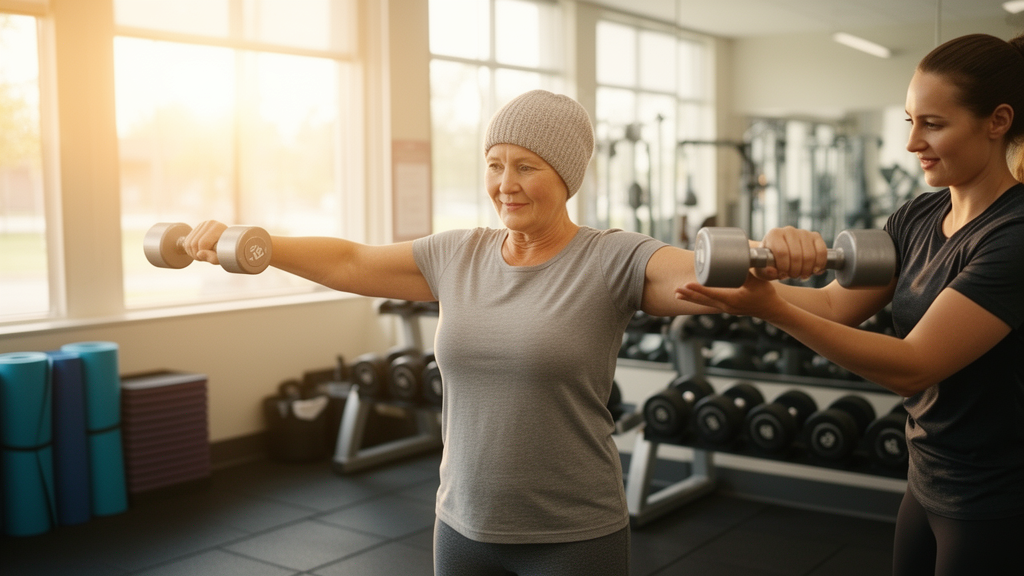
Only about one in five cancer survivors in the United States meets the recommended dose of muscle-strengthening activity, yet a new study suggests the appetite for it is far larger than the participation rate implies. In a mixed methods survey of 556 post-treatment survivors published in Supportive Care in Cancer, nearly 68 percent said they would be interested in joining a strength-training program designed specifically for people with a cancer history, and more than 98 percent agreed or said maybe that survivors should be doing this kind of exercise at all. The gap between interest and behavior is precisely what the research team, led by Julia Pincever and Siobhan M. Phillips of Northwestern University Feinberg School of Medicine, set out to understand.
The scientific case for resistance exercise in this population is substantial. Cancer and its treatments strip away lean mass and muscular strength while fat mass and frailty risk climb, and low muscle mass after treatment is linked to worse clinical outcomes. Structured strength training has been associated in prior work with reduced anxiety and fatigue, better sleep, improved physical function, higher self-esteem, greater strength capacity, and a lower risk of falls. Emerging data even suggest that more muscle-strengthening activity may be tied to reduced cancer mortality and recurrence. That is why the American College of Sports Medicine recommends that survivors perform full-body muscle-strengthening activity at least two days per week, a threshold only 19.2 percent of survivors report reaching, compared with roughly 31 percent of women and 40 percent of men without a cancer history.
To capture what survivors actually want, the researchers recruited participants from Northwestern Medicine electronic medical records, sampling in proportions similar to the U.S. survivor population by cancer type and age. Eligible participants were adults at least 18 years old with non-metastatic cancer, no more than five years since diagnosis, at least three months past the end of primary treatment, with internet access and English literacy. Of 759 people who consented, 556 provided complete data on the intervention preferences questionnaire. The average participant was 56.5 years old, 53.6 percent were female, and the most common diagnoses were breast, prostate, lung, colon, and endometrial cancers. Notably, 99.1 percent owned a smartphone, a detail that matters for the technology-supported programs the team had in mind.
Activity levels were measured with validated instruments. The short form of the Muscle-Strengthening Exercise Questionnaire captured frequency, duration, intensity, and the types of resistance work performed, with a test-retest reliability ranging from 0.76 to 0.91. A modified Godin Leisure-Time Exercise Questionnaire estimated weekly minutes of moderate-to-vigorous aerobic activity. In this sample, participants averaged 1.7 days per week of strength work for about 20 minutes per session and 174 minutes of weekly aerobic activity. About a third, 33.6 percent, met both the strength and aerobic guidelines, while 34.7 percent met neither, and 45.3 percent reported no muscle-strengthening activity at all. The sample was more active than population-based estimates, a limitation the authors acknowledge, since people drawn to a study about exercise are plausibly more active to begin with.
The preference data paint a detailed portrait of an ideal program. Participants wanted medium-intensity sessions, 70.3 percent favoring that level, mixing light weights with high repetitions and heavier loads with lower repetitions. Nearly half were willing to train three to four days per week for 20 to 39 minutes, and 68.7 percent preferred one longer daily session over several shorter ones. Free weights were the most popular modality at 65.3 percent, followed by combinations of free weights and resistance bands, yoga, resistance bands alone, and balance exercises. On timing, the highest endorsement, 92.6 percent, went to starting a program six months to one year after treatment, though more than 70 percent expressed interest at every point along the cancer care continuum.
Technology figured prominently in the results. Almost half of participants, 47.7 percent, preferred a hybrid intervention combining in-person and technology-supported elements, while the remainder split between fully in-person and fully remote formats. For digital delivery, on-demand video was the top choice at 47.8 percent, with a live-plus-on-demand combination close behind. Wearable devices such as fitness trackers were the most favored way to receive feedback on progress, and 57.7 percent wanted feedback on exercise form. Interest in commercially available connected strength equipment was surprisingly high: 65.1 percent were willing to try Tonal, 58.1 percent Peloton, and 55.8 percent Tempo. More than 94 percent said they would use a fitness app if given free access, and 35.8 percent were already using one. Willingness to pay, however, was modest, with 82.4 percent capping spending at zero to fifty dollars per month.
Regression analyses revealed that preferences were not uniform across the population. Women rated one-on-one and live group videoconference sessions, text messages, and emails as more helpful than men did. White participants and non-Hispanic participants generally rated in-person group sessions, activity trackers, electronic health record integration, and buddy systems as less helpful than their counterparts did. Older age predicted lower enthusiasm for nearly every digital feature, including apps, videos, trackers, and smart equipment. Higher income was associated with lower ratings of social networking integration and personalized messaging, while participants with lower household income valued those features more. Treatment history also mattered: surgery recipients rated one-on-one in-person sessions and smart equipment more favorably, and those who had radiation valued smart equipment and program buddies more than those who had not.
The qualitative arm added depth. Thirty participants, randomly selected and stratified so that half met the strength guidelines, completed semi-structured interviews lasting 20 to 45 minutes over Zoom. Transcripts were coded iteratively by multiple team members using consensus review in Dedoose, yielding five themes. Participants believed strength training could restore pre-diagnosis functioning and prevent further decline; they described multilevel barriers including motivation, unfamiliarity with equipment and technique, physical health issues, time, gym access, and cost; prior experience shaped what they were willing to try; they craved support and accountability, particularly from peers who understood the cancer experience; and they demanded flexible, convenient, personalized programming with clear instruction on modifications and progression to avoid overexertion and injury.
Several findings distinguish strength training from general aerobic exercise preferences documented in earlier studies. While most prior preference research found survivors favor unsupervised, home-based activity, roughly half of this sample wanted some supervision, most often from an exercise specialist in person, and about half wanted instruction somewhere other than home, such as a fitness club or cancer center. Nearly 90 percent wanted some form of one-on-one coaching. The authors interpret this as evidence that resistance exercise, perceived as more complex and equipment-dependent than walking or running, may require more guidance to feel safe and feasible, especially for survivors with comorbid conditions worried about injury.
The study has limits worth noting. Recruitment came from a single academic medical center, the sample was highly educated, and although 38 percent of participants were non-White or Hispanic, consistent with national figures, the findings may not generalize to community settings or socioeconomically disadvantaged survivors. Self-reported activity measures carry misclassification risk, and the survey presented no visuals or prototypes, which may have affected how participants interpreted questions. Still, the central message is clear and actionable: survivors across activity levels want strength-training interventions that are accessible, encouraging, flexible, and tailored to their circumstances, and the wide variability in feature preferences argues for involving survivors directly in designing and testing programs. Only one intervention to date has incorporated connected strength equipment with survivors, so the space for innovation, from hybrid coaching models to app-based form feedback, remains wide open. Future work, the authors conclude, must determine which features are truly feasible, engaging, and cost-effective for raising adherence and improving health outcomes in this growing population, projected to exceed 22 million Americans within the next decade.
Subject of Research: Cancer survivors' interests and preferences for muscle-strengthening activity interventions
Article Title: Cancer survivors’ interests and preferences for muscle-strengthening activity interventions
Article References: Pincever, J., Frey, J., Solk, P., Reading, J. M., Wang, S., Freeman, H., Wolter, M., Hickey, B., Wang, L., Webb, F., Walker, F. M., Desai, R., & Phillips, S. M. (2026). Cancer survivors’ interests and preferences for muscle-strengthening activity interventions. Supportive Care in Cancer, 34(11), Article 1078. https://doi.org/10.1007/s00520-026-11312-7
Image Credits: AI Generated
DOI: 10.1007/s00520-026-11312-7
Keywords: cancer survivors, muscle-strengthening activity, resistance training, exercise preferences, survivorship, physical activity guidelines, technology-supported interventions, mixed methods, Supportive Care in Cancer, Northwestern University, behavioral medicine, rehabilitation
Cite Scienmag News
Nathaniel Bowman. (October 9, 2026). Most Cancer Survivors Want Strength Training, But Only a Fraction Get It. Scienmag. https://scienmag.com/most-cancer-survivors-want-strength-training-but-only-a-fraction-get-it/
Nathaniel Bowman. "Most Cancer Survivors Want Strength Training, But Only a Fraction Get It." Scienmag, 9 October 2026, https://scienmag.com/most-cancer-survivors-want-strength-training-but-only-a-fraction-get-it/. Accessed 9 October 2026.
Nathaniel Bowman. "Most Cancer Survivors Want Strength Training, But Only a Fraction Get It." Scienmag. October 9, 2026. https://scienmag.com/most-cancer-survivors-want-strength-training-but-only-a-fraction-get-it/


