


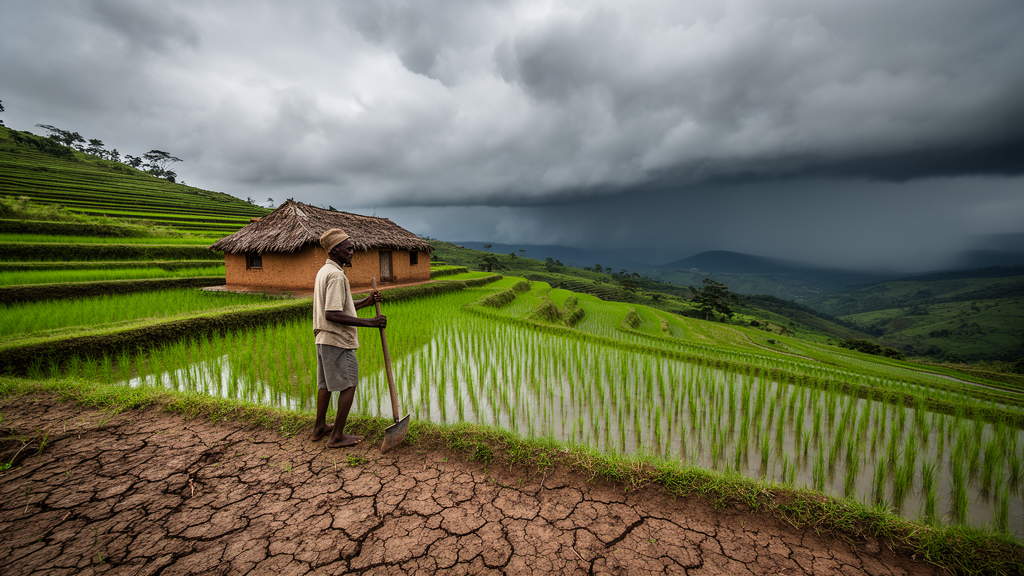
In the smallholder villages of rural Madagascar, the households that face the greatest threat from cyclones and droughts are often not the ones best prepared to withstand them. A new study published in the journal Regional Environmental Change has documented a striking disconnect between how much climate risk farming families are exposed to, how much risk they believe they face, and how ready they actually are to absorb a shock. The research, conducted by a team from the International Livestock Research Institute and collaborators, suggests that the assumptions underlying much of climate adaptation policy—that awareness drives action, and that exposure drives awareness—may be fundamentally flawed in the world’s most vulnerable farming systems.
The study focused on two regions that could hardly be more different in the hazards they present. The Sava region in northeastern Madagascar lies squarely in the path of tropical cyclones that sweep in from the Indian Ocean, battering vanilla farms and rice paddies with destructive winds and flooding rains. Atsimo Andrefana in the southwest, by contrast, endures chronic drought, with erratic and declining rainfall slowly eroding the productivity of semi-arid croplands. By comparing these two contrasting hazard environments, the researchers were able to ask whether the relationship between exposure, perception, and preparedness follows a consistent logic, or whether local economic and social structures override the simple geography of risk.
To answer that question, the team surveyed 245 households selected through a stratified sampling design, ensuring that the sample captured the diversity of livelihoods and exposure conditions within each region. Rather than relying on any single measure, the researchers constructed three distinct analytical instruments. A composite Exposure Index quantified the physical hazards each household faced, drawing on both environmental data and household reports of past shocks. Perceived risk was measured through questions about the likelihood and severity of future climate events, capturing the psychological dimension of hazard. And preparedness was assessed through a multidimensional Shock Readiness Index that combined productive assets, access to credit, and financial buffers—the concrete resources a family could mobilize when disaster strikes.
The results revealed a pattern the authors describe as a decoupling of the three dimensions. In cyclone-prone Sava, households reported both the highest exposure and the highest perceived risk, yet scored lowest on preparedness. The reasons were structural rather than psychological. Many Sava households depend on specialized, crop-based livelihoods—particularly vanilla, a high-value but fragile cash crop whose fortunes rise and fall with both weather and volatile global prices. This specialization concentrates risk rather than spreading it. Compounding the problem, families in Sava faced limited access to credit and severe liquidity constraints, meaning that even when they understood the dangers, they lacked the financial machinery to build buffers against them.
Atsimo Andrefana told the opposite story. Households in the drought-prone southwest perceived less risk than their cyclone-exposed counterparts in the north, yet demonstrated comparatively higher levels of preparedness. The key difference lay in the structure of their livelihoods. Families in Atsimo Andrefana maintained diversified income streams and, crucially, held wealth in the form of livestock—zebu cattle and goats that function as convertible assets, a walking savings account that can be liquidated quickly when crops fail. This finding carries a provocative implication: preparedness in smallholder systems may depend less on how frightened people are and more on whether their economic lives are organized in ways that allow them to act.
Perhaps the most policy-relevant result concerns early warning systems. Across both regions, access to early warning information showed only a limited association with actual preparedness. In other words, knowing that a cyclone is coming or that a drought is likely does relatively little good when a household has no savings to draw on, no credit to access, and no way to protect or relocate its assets. The authors interpret this as evidence that information alone has limited influence where response options are constrained by structural poverty. This finding resonates with a growing body of international research on the risk perception paradox, which has repeatedly found that heightened awareness of hazards does not automatically produce protective behavior, particularly among populations with the fewest resources.
The methodological contribution of the study is as significant as its substantive findings. By integrating a physical exposure measure, a psychological perception measure, and a structural readiness measure within a single household-level framework, the researchers created what they call an exposure-readiness typology. This diagnostic tool classifies households according to their combined risk profiles, allowing practitioners and policymakers to distinguish, for example, between households that are highly exposed but unprepared and those that are moderately exposed but resilient. Such differentiation matters because the interventions appropriate for each group differ profoundly: the former may need emergency financial instruments and asset protection, while the latter may need little more than maintenance of existing diversification strategies.
Madagascar provides an especially compelling setting for this research. The island is routinely ranked among the countries most vulnerable to climate change, with its smallholder farmers facing extreme exposure to agricultural risks ranging from cyclones and floods to droughts and locust outbreaks. Previous studies have documented social-ecological traps in southwestern Madagascar that hinder rural development, and recent work has explored how climate perceptions among northeastern farmers shape adaptive behavior. The new study builds on this literature but departs from it by refusing to treat perception as the central variable. Instead, it places structural capacity—the assets, credit, and liquidity that determine what a household can actually do—at the center of the analysis, and treats perception as one factor among several that may or may not align with it.
The implications extend well beyond Madagascar’s borders. Across tropical smallholder regions, from the Sahel to South Asia, hundreds of millions of farming families face intensifying climate variability with thin margins for error. If preparedness does not systematically track exposure in these systems, then adaptation strategies built primarily on risk communication and awareness campaigns may systematically miss their targets. The study’s authors argue that strengthening structural capacity through improved financial access, livelihood diversification, and institutional support will be critical to narrowing preparedness gaps—not only in Madagascar but in climate-exposed rural systems worldwide. In practice, this could mean expanding rural credit markets, developing insurance products suited to smallholder agriculture, and supporting the livestock and off-farm income streams that give households options when harvests fail.
The research also carries a caution for the rapidly expanding global investment in early warning infrastructure. The United Nations has championed multi-hazard early warning systems as a cornerstone of disaster risk reduction, and such systems undeniably save lives. But the Madagascar findings suggest that warnings are only one link in a chain that must also include the financial and material means to respond. A family that receives a cyclone warning but has no savings, no insurance, and no safe place to store its assets can do little more than brace itself. As climate hazards intensify across the developing world, the study’s central lesson is likely to grow only more urgent: the households that need resilience most are often those least equipped to build it, and closing that gap will require changing economic structures, not just changing minds.
Subject of Research: The relationship between climate hazard exposure, risk perception, and household preparedness in smallholder farming systems in rural Madagascar
Article Title: Decoupling exposure, risk perception, and preparedness in smallholder systems: evidence from rural Madagascar
Article References: Joseph, J. E., Umutoni, C., Raharison, J., Whitbread, A. M., & Wane, A. (2026). Decoupling exposure, risk perception, and preparedness in smallholder systems: evidence from rural Madagascar. Regional Environmental Change, 26(4), Article 214. https://doi.org/10.1007/s10113-026-02707-7
Image Credits: AI Generated
DOI: 10.1007/s10113-026-02707-7
Keywords: climate risk, Madagascar, smallholder farmers, risk perception, preparedness, early warning systems, livelihood diversification, Shock Readiness Index, cyclones, drought, credit access, climate adaptation
Cite Scienmag News
Sloane Callahan. (October 9, 2026). Awareness Is Not Action: Madagascar Study Reveals Why the Most Exposed Farmers Prepare the Least. Scienmag. https://scienmag.com/awareness-is-not-action-madagascar-study-reveals-why-the-most-exposed-farmers-prepare-the-least/
Sloane Callahan. "Awareness Is Not Action: Madagascar Study Reveals Why the Most Exposed Farmers Prepare the Least." Scienmag, 9 October 2026, https://scienmag.com/awareness-is-not-action-madagascar-study-reveals-why-the-most-exposed-farmers-prepare-the-least/. Accessed 9 October 2026.
Sloane Callahan. "Awareness Is Not Action: Madagascar Study Reveals Why the Most Exposed Farmers Prepare the Least." Scienmag. October 9, 2026. https://scienmag.com/awareness-is-not-action-madagascar-study-reveals-why-the-most-exposed-farmers-prepare-the-least/


