


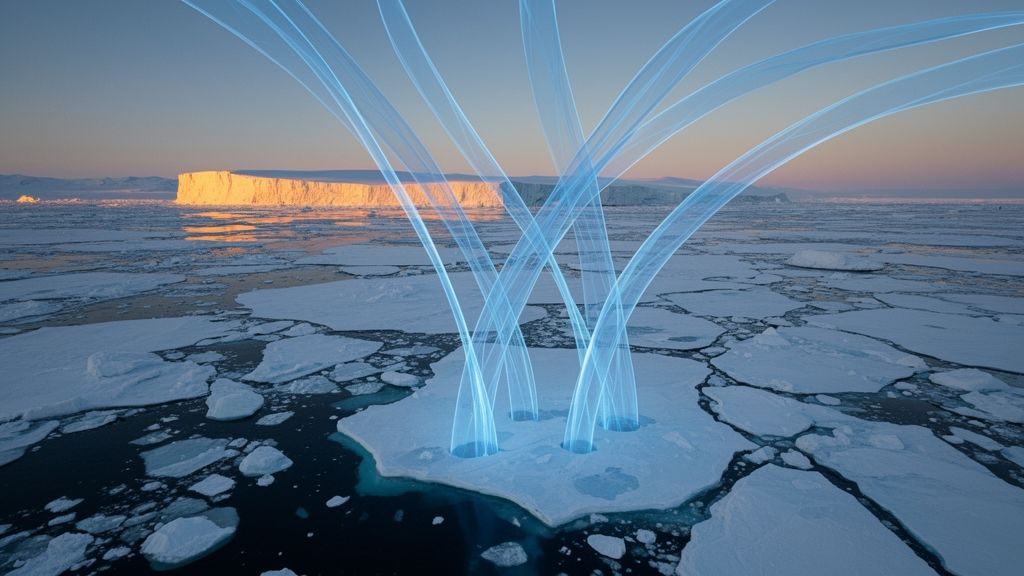
Antarctica is losing ice, and all that melting ice is dumping fresh water into the Southern Ocean. It sounds like a simple story: more fresh water at the surface, more sea ice forming above it. But a landmark new study published in The Cryosphere reveals that when eleven of the world’s leading climate models were fed exactly the same dose of Antarctic meltwater, they produced dramatically different answers about what happens to the sea ice above. The finding exposes a hidden source of uncertainty in climate projections that could reshape how scientists interpret the future of the frozen continent’s surrounding seas.
The research, led by Andrew G. Pauling of the University of Otago and the Antarctic Research Centre at Victoria University of Wellington, is the first coordinated multi-model study of how Antarctic sea ice responds to meltwater from ice sheet mass loss. The work emerged from the Southern Ocean Freshwater Input from Antarctica initiative, known as SOFIA, a CMIP7-endorsed model intercomparison project designed to standardize how the world’s climate modeling groups test the effects of this missing ingredient. The motivation is stark: virtually none of the state-of-the-art models in CMIP6, the suite of simulations underpinning current climate assessments, actually include meltwater entering the Southern Ocean from a shrinking Antarctic ice sheet.
That omission matters because the meltwater flux is real and growing. A 2021 review of Earth’s ice mass imbalance estimated that the Antarctic ice sheet and its ice shelves lost mass at a rate of 395 plus or minus 99 gigatonnes per year between 1994 and 2017, accelerating to 509 plus or minus 186 gigatonnes per year over 2010 to 2016. In most climate models, including every CMIP6 participant, ice sheet mass balance is simply enforced, meaning freshwater input to the ocean can only change in step with precipitation falling on the continent. In the real world, ice is also lost at the coast through basal melting of ice shelves and iceberg calving, processes that models largely cannot represent because they lack interactive ice sheets.
To isolate the effect of this missing fresh water, the SOFIA team designed a deliberately idealized experiment called antwater. Eleven models, comprising 43 ensemble members in total, were each run for 100 years with a constant meltwater flux of 0.1 sverdrup, equivalent to about 3,154 gigatonnes per year, injected at the ocean surface and spread evenly across all grid cells immediately adjacent to the Antarctic coastline. That amount is larger than today’s observed melt rates, but it is comparable to projected mid-to-late twenty-first century fluxes, and the uniformity was the point: by giving every model an identical perturbation under pre-industrial conditions, any differences in response must come from the models themselves rather than from differing forcing scenarios.
The headline result is deceptively simple. Antarctic sea ice area increased in all of the models. But the magnitude of that increase ranged from 0.71 to 4.14 million square kilometers in the annual mean, a spread of nearly a factor of six. For context, the observed annual-mean Antarctic sea ice area over the satellite era from 1979 to 2024 is about 8.7 million square kilometers. In other words, one model barely noticed the meltwater while another grew an ice pack nearly half the size of the real one. Sea ice volume told a similar story, rising by between roughly 380 and 7,590 cubic kilometers across models, with a multi-model mean increase of 42 percent.
The physical mechanism behind the growth is stratification. Meltwater is fresh and therefore less dense than the salty water it enters, so it pools near the surface and strengthens the vertical density gradient of the water column. That cap suppresses the upward mixing of relatively warm water from depth, allowing the surface to cool more readily to freezing point and ice to expand. The team quantified this using a modified stratification index, summing density differences from the surface down to 500 meters, and found a statistically significant relationship between how much a model’s stratification increased and how much its sea ice grew. Models whose water columns became more stratified grew more ice.
Open-ocean deep convection emerged as another crucial player. In several models, vast chimneys of water in the Weddell and Ross seas mix to depths exceeding 2,000 meters, dredging warm water to the surface and melting ice. When meltwater was added, convection shut down almost completely in models including CanESM5, GFDL-CM4, GFDL-ESM4 and GISS-E2-1-G, and sea ice surged. Conversely, the two models with no deep convection at all, AWI-ESM-1-REcoM and CESM2, showed the weakest sea ice responses. The GFDL-ESM4 model even carried a fingerprint of its control-run behavior: a large Weddell Sea polynya in years 50 to 70 of the control simulation vanished under meltwater forcing, producing an apparent spike in the ice response that was really an artifact of the missing convective opening.
Timing and geography varied too. Fitting an exponential curve to each model’s response, the team found time constants ranging from under one year to nearly 70 years, with most models settling between 5 and 20 years and a multi-model mean of 10.2 years. In most models the ice increase was largest around the September annual maximum and smallest at the February minimum, consistent with the idea that winter freezing, which requires cooling a deeper layer of water, is more sensitive to the stratifying effect of fresh water than the summer melt season. Spatially, the strongest concentration increases appeared near the ice edge in the Ross Sea and the Amundsen and Bellingshausen Seas, while several models showed meltwater flowing from the Antarctic Peninsula into the South Atlantic, following the coastal currents anticlockwise around the continent before separating at the Peninsula’s tip.
The study’s authors caution that the idealized experiment is a controlled sensitivity test, not a realistic simulation. Real meltwater enters the ocean unevenly, concentrated in the Amundsen Sea sector, and mostly at depth through ice shelf basal melting, which accounted for 68 percent of the melt from shrinking ice shelves between 1997 and 2021. The experiment also omits the latent heat that melting ice extracts from the ocean. Atmospheric feedbacks, which recent analyses show can generate large-scale circulation responses to Antarctic freshening, add further complexity. Upcoming SOFIA tiers will test historical and future meltwater estimates and probe the effects of realistic spatial and vertical distributions of the freshwater input.
What the study makes unmistakably clear is that a single model’s response to Antarctic meltwater cannot be taken at face value. The spread in the results was dominated by model uncertainty rather than internal variability, and much of that spread traces back to each model’s background climate: its mean-state sea ice area and volume, its ocean stratification, and its tendency toward deep convection. As meltwater from Antarctica continues to grow through this century, getting these background states right will be essential for projecting the fate of Antarctic sea ice, a system that influences Southern Ocean heat and carbon uptake, marine ecosystems, and even tropical rainfall patterns through atmospheric teleconnections. The missing meltwater, once an afterthought in climate modeling, is now impossible to ignore.
Subject of Research: Multi-model climate model ensemble study of the Antarctic sea ice response to meltwater from Antarctic ice sheet mass loss
Article Title: Antarctic sea ice response to meltwater due to Antarctic ice sheet mass loss in a multi-model ensemble
Article References: Pauling, A. G., Smith, I. J., Martin, T., Ridley, J. K., Stevens, D. P., Thomas, M., Beadling, R. L., Danek, C., Hattermann, T., Li, Q., Marshall, J., Muilwijk, M., Purich, A., & Swart, N. C. (2026). Antarctic sea ice response to meltwater due to Antarctic ice sheet mass loss in a multi-model ensemble. The Cryosphere, 20(10), 5761-5783. https://doi.org/10.5194/tc-20-5761-2026
Image Credits: AI Generated
Keywords: Antarctic sea ice, meltwater, Antarctic ice sheet, Southern Ocean, climate models, SOFIA, CMIP6, ocean stratification, deep convection, sea ice area, The Cryosphere, model intercomparison
Cite Scienmag News
Sloane Callahan. (October 9, 2026). Same Meltwater, Wildly Different Ice: Models Split on Antarctic Sea Ice Future. Scienmag. https://scienmag.com/same-meltwater-wildly-different-ice-models-split-on-antarctic-sea-ice-future/
Sloane Callahan. "Same Meltwater, Wildly Different Ice: Models Split on Antarctic Sea Ice Future." Scienmag, 9 October 2026, https://scienmag.com/same-meltwater-wildly-different-ice-models-split-on-antarctic-sea-ice-future/. Accessed 9 October 2026.
Sloane Callahan. "Same Meltwater, Wildly Different Ice: Models Split on Antarctic Sea Ice Future." Scienmag. October 9, 2026. https://scienmag.com/same-meltwater-wildly-different-ice-models-split-on-antarctic-sea-ice-future/


