


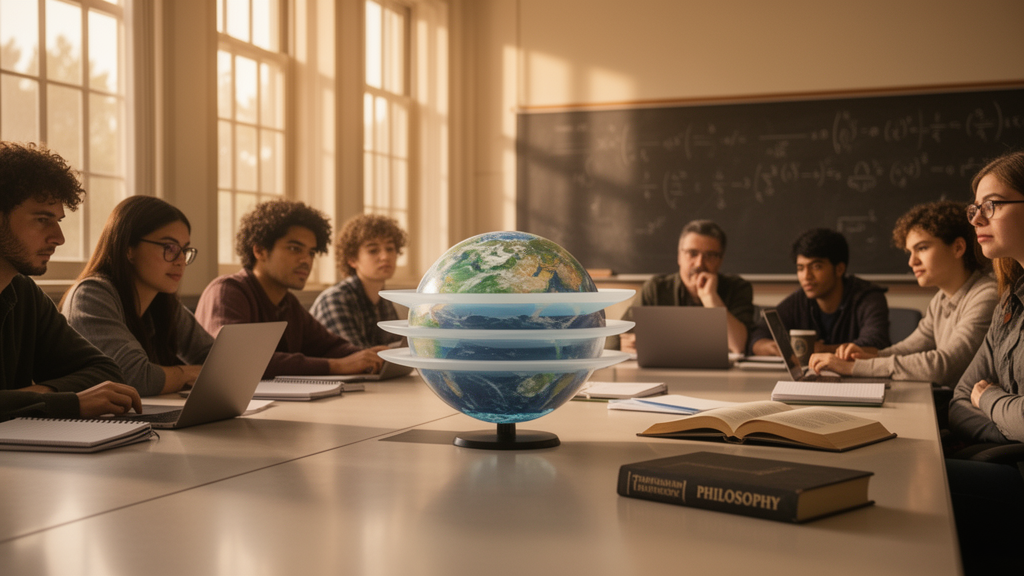
Climate models have long been presented to students as physics translated into computer code: a set of differential equations describing the circulation of the atmosphere and oceans, discretised on a grid and solved step by step on supercomputers. A new study published in Geoscience Communication by Ulrike Proske of Wageningen University and Martin Staab, now at SYRTE at the Observatoire de Paris, argues that this picture is dangerously incomplete. General circulation models, the authors contend, are not neutral instruments. They are powerful actors that shape how societies understand climate change, and they are in turn shaped by the habits, contexts and values of the people who build them. If that is true, then modelling courses must teach more than numerical discretisation and radiative transfer. They must also teach the motivations, uncertainties and societal embeddedness of the modelling enterprise itself.
To test whether such an interdisciplinary education is feasible, the two researchers developed a fifty-hour course called “Hello world! From numerical programming to complex climate models”, which they taught at a two-week summer camp in Papenburg, Germany, for especially motivated high-school students aged fifteen to eighteen. The camp, organised by the non-profit JGW e.V., focuses on sustainability and climate change, and its participants attend voluntarily after being nominated by their teachers. Although the participants were still in school, the course was deliberately pitched at bachelor’s university level, requiring no prior coding experience. The authors taught the course four times between 2022 and 2025, refining it after each iteration, and used the 2024 edition, with seventeen students, as the basis for a formal evaluation. Their methodological framework was design-based research, an approach from education studies in which a teaching module is developed, tested and improved in iterative cycles, much like a prototype in engineering.
The course content falls into two broad themes. The first builds the technical foundations of numerical modelling from the ground up. Students begin with differential equations describing simple physical systems, learn to find analytical solutions by educated guessing, and quickly discover the limits of that method. They are then introduced to the Euler method, the most basic scheme for solving ordinary differential equations numerically, and practice it by hand, computing the trajectory of a logarithmic spiral with pen, paper and a calculator. Two lessons emerge from this exercise: the numerical solution deviates from the exact analytical one, and it demands far more computational steps. That realisation motivates the turn to computers. Students then learn the basics of Python through a tutorial notebook and write their own program simulating a simplified greenhouse effect, before exploring real climate model code and the IPCC Interactive Atlas, which displays actual model output for different variables and emission scenarios.
The second theme turns the lens around. Students construct a timeline showing how climate models co-evolved with historical events, and discuss how the global view propagated by models was co-produced with particular political and scientific contexts. They learn about three competing visions of climate model development, drawn from the science studies literature: the representative vision, in which the model is a copy of the real climate system; the predictive vision, which prioritises accurate forecasts; and the heuristic vision, which treats models as tools for generating understanding. These visions can reinforce one another, but they can also conflict, for instance when models become so detailed and representative that they are too complex to understand, eroding their heuristic value. Students also grapple with philosophical analyses of distributed epistemic agency and generative entrenchment, and the course closes with a fish bowl discussion in which participants argue assigned positions, ranging from disinterested scientific neutrality to activism, on the role of climate scientists in public debate.
To evaluate what students actually learned, the authors designed a reflective exercise that was integrated into the course flow rather than appended to it. After key modules, students were given five minutes to write down, in text, notes or pictures, which ideas were spinning in their heads, and then a further five minutes to record how they had thought about those concepts beforehand. This a posteriori and a priori pairing was repeated across three assessed rounds, each followed by a short plenary discussion. The written responses were then analysed with inductive, open-coded content analysis using the QualCoder software. Intercoder reliability was checked by having the second author independently assign codes to seventeen randomly sampled quotations; for fifteen of them, at least one code matched directly. The authors are candid that the coding is interpretative, and they also disclose their positionality: both are deeply involved with the summer camp, one as a former participant and project leader, and neither is an educational research specialist.
The results show that students’ reflections tracked the course content closely, indicating that the learning aligned with the teaching goals. Climate model development was among the most prominent topics, with students highlighting model structure, parameterisations and uncertainties. A visualisation of climate model genealogy, showing how different generations of models are related by shared code, proved especially memorable and was repeatedly cited in discussions. The competing modelling visions also featured strongly, and two students went beyond the taught material to suggest that the plurality of visions leads to more diverse science, an idea that echoes published arguments in favour of climate model hierarchies. Perhaps most strikingly, students began reflecting on how science itself works, a topic the course never explicitly treated. One participant described the “chaotic scientific work” behind research, noting that the everyday life of science is far less polished than papers make it seem, while another wondered how many feelings of success one experiences in climate modelling.
The exercise did surface one cautionary finding. Working with the IPCC Interactive Atlas, students investigated how different time frames and emission scenarios influence answers to scientific questions. This treatment appears to have combined with pre-existing anxieties about misinformation, itself a recurring theme in German schools, to produce the idea that scenarios can be, or even are, used to manipulate. One student wrote that by choosing different scenarios one can easily manipulate people. The authors interpret this as a conflation of subjectivity within the scientific process with deliberate manipulation, and they responded in the following year by introducing scenarios more rigorously, detailing their scientific basis and the interpretive care they demand. They frame the episode as a microcosm of a dilemma familiar to science and technology studies: criticising the human foundations of science without fuelling the impression that its results, including the reality of climate change, are up for negotiation.
On the question of whether the interdisciplinary content would overwhelm students, the answer was a clear no. The authors had expected protest or disorientation, akin to the “disorienting dilemmas” documented in interdisciplinary engineering education, particularly since a participant in an earlier edition had reported that learning about the role of values in science shook her belief in objective science. Yet in 2024 no such crisis appeared. The authors suspect that students without a full academic socialisation into positivist ideals are simply less shaken when those ideals are complicated, and that while students absorb the knowledge readily, they may not immediately integrate it into their belief systems. Students reported that climate models, previously “unimaginable”, became concrete and comprehensible, that naming concepts made them tangible, and that they had underestimated the complexity of models. One participant’s evolving questions captured the trajectory: from wondering how much of climate modelling is logically deducible, to doubting whether a “perfect” climate model is even possible, to asking whether more precise models would actually change human action.
The study’s contribution is both practical and conceptual. The authors do not claim to have validated their course as an ideal template, and they acknowledge limitations, including participant bias and the difficulty of isolating individual thought processes from the general course progression. But they have demonstrated that a climate modelling course can be interdisciplinary from the start, teaching differential equations and Euler schemes alongside philosophy of science and the sociology of prediction, without producing confusion or resistance. All teaching materials are openly shared on Zenodo, and the course schedule is published in the paper’s appendix, providing lecturers with a concrete template for weaving critical reflection into technical instruction. In a field where models carry enormous authority over policy and public discourse, the authors’ conclusion is simple and timely: the next generation of modelers should learn not only how to build these powerful tools, but also when, why and for whom they are built.
Subject of Research: Interdisciplinary education in climate modelling combining numerical methods with philosophy of science and science and technology studies
Article Title: Hello world! An interdisciplinary climate modelling course
Article References: Proske, U., & Staab, M. (2026). Hello world! An interdisciplinary climate modelling course. Geoscience Communication, 9(2), 239-259. https://doi.org/10.5194/gc-9-239-2026
Image Credits: AI Generated
Keywords: climate modelling, interdisciplinary education, general circulation models, design-based research, philosophy of science, science and technology studies, numerical methods, Euler method, climate scenarios, values in science, Geoscience Communication, science education
Cite Scienmag News
Katie Riggs. (October 9, 2026). Teaching Climate Models as Human Artefacts: A Course That Blends Physics and Philosophy. Scienmag. https://scienmag.com/teaching-climate-models-as-human-artefacts-a-course-that-blends-physics-and-philosophy/
Katie Riggs. "Teaching Climate Models as Human Artefacts: A Course That Blends Physics and Philosophy." Scienmag, 9 October 2026, https://scienmag.com/teaching-climate-models-as-human-artefacts-a-course-that-blends-physics-and-philosophy/. Accessed 9 October 2026.
Katie Riggs. "Teaching Climate Models as Human Artefacts: A Course That Blends Physics and Philosophy." Scienmag. October 9, 2026. https://scienmag.com/teaching-climate-models-as-human-artefacts-a-course-that-blends-physics-and-philosophy/


