


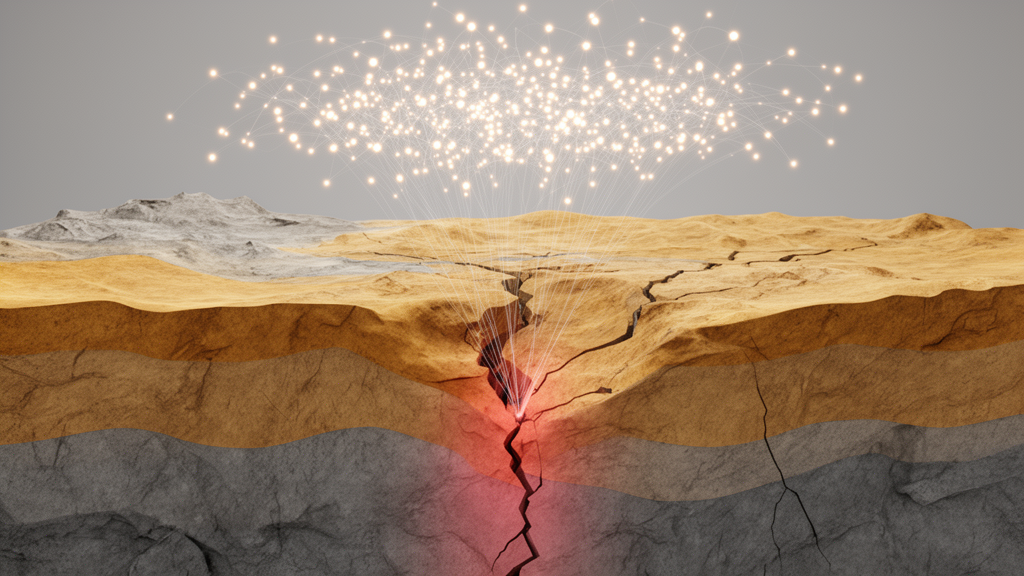
Beneath the rolling hills of the Biga Peninsula in western Anatolia, the Earth’s crust tells a story of ancient oceans, colliding continents, and lingering heat. A new study published in Nonlinear Processes in Geophysics has now read that story with unprecedented clarity, using an algorithm inspired by the flocking of birds to fuse two fundamentally different types of geophysical data into a single, self-consistent picture of the crust. The work, led by Ersin Büyük of Gümüşhane University together with Ekrem Zor and Mustafa Cengiz Tapırdamaz of the TÜBİTAK Marmara Research Center, introduces a Pareto-based multi-objective particle swarm optimization framework, or Pareto–MOPSO, for the joint inversion of magnetotelluric and Rayleigh wave dispersion data, and applies it to delineate the crustal structure of the southeastern Biga Peninsula near Çanakkale, Türkiye.
The challenge the researchers set out to solve is one of the most stubborn in geophysics: how to combine measurements of electrical resistivity with measurements of seismic shear-wave velocity when the two properties are not reliably linked by any universal physical law. Electrical resistivity, probed by the magnetotelluric method, responds dramatically to tiny fractions of interconnected conductive material such as saline fluids or clay-rich alteration products. Seismic velocity, constrained by the dispersion of Rayleigh surface waves, is governed instead by the elastic framework of the rock matrix and responds to large volumes of material. A small conductive phase can transform bulk resistivity while leaving seismic velocities almost untouched, and vice versa. Traditional joint inversion schemes often force these parameters into artificial correspondence, either by penalizing differences in their spatial gradients through cross-gradient constraints or by imposing petrophysical relationships whose physical meaning cannot be guaranteed in a given geological setting.
The Turkish team’s solution sidesteps this trap entirely. Their framework couples the two datasets only structurally, through shared layer thicknesses estimated by the optimization itself, while leaving resistivity and velocity free to rise or fall independently within each layer. The engine of the method is particle swarm optimization, a global search technique introduced by Kennedy and Eberhart in 1995, in which a swarm of candidate models, the particles, communicates and learns from one another, each adjusting its position through the model space according to its own best solution so far and the best solution found by the entire swarm. Unlike derivative-based methods such as Gauss–Newton inversion, which depend heavily on the starting model and can become trapped in local minima, the swarm explores the search space globally. Crucially, the team embedded this search within Pareto optimality, a concept borrowed from economics, which replaces the awkward business of weighting different objective functions against each other with a rigorous definition of dominance: one solution dominates another only if it is at least as good on every objective and better on at least one.
In practice, the objective space has three axes: the misfit of the magnetotelluric apparent resistivity and phase data, the misfit of the Rayleigh wave dispersion curve, and a smoothness term that encourages piecewise-smooth layered models without requiring a subjective regularization parameter. The result of the search is not a single best model but a Pareto front, an entire family of non-dominated solutions that maps the trade-offs between competing objectives. From this archive the researchers extract a utopia solution, the member closest to the origin of the misfit space, and a compromise solution that also balances smoothness, and they summarize uncertainty by computing depth-wise P10–P90 percentile envelopes and a Pareto-median profile across the ensemble. This ensemble approach offers something traditional single-model inversions cannot: an honest, quantitative picture of where the data constrain the Earth tightly and where multiple alternative structures remain admissible.
Before touching real field data, the team subjected the method to a battery of synthetic experiments. They built coupled scenarios in which low-resistivity layers coincided with low-velocity layers, and two kinds of decoupled scenarios in which an anomaly appeared in only one physical parameter. They added Gaussian noise ranging from zero to forty percent and repeated the inversions with different numbers of layers, from eight to twenty-two, to test how sensitive the results were to parameterization choices. The synthetic models, with forty-seven free parameters including sixteen layers of resistivity and velocity plus fifteen shared thicknesses, were recovered with remarkable fidelity in the noise-free coupled case, and the decoupled tests delivered perhaps the most important methodological finding: the inversion did not manufacture a spurious low-velocity counterpart to a purely electrical anomaly, nor a phantom conductor where only a velocity anomaly existed. The framework preserved parameter-specific sensitivity rather than imposing false cross-property correspondence.
The noise and layering experiments also revealed an instructive asymmetry. As noise increased, the misfit of the Rayleigh wave dispersion objective deteriorated faster than that of the magnetotelluric objective, yet the ensemble uncertainty in the recovered resistivity models grew far more than in the velocity models. In other words, Rayleigh wave data are more sensitive to noise in the data space, while magnetotelluric data are more vulnerable to trade-offs in the model space, particularly between resistivity and layer thickness. Layering tests showed that neither too few nor too many layers served the inversion well: coarse parameterizations smoothed away genuine structure, while fine ones multiplied ambiguity without improving the fit. An intermediate parameterization of roughly twelve to eighteen layers produced the most stable and representative Pareto front, a lesson the authors carried directly into their field work. A benchmark comparison against a traditional Gauss–Newton joint inversion reinforced the case for the new approach: the deterministic method plateaued after about fifty iterations, converged on an overly smoothed velocity model that missed key contrasts, and required more wall-clock time, 1020.70 seconds against 525.64 seconds for Pareto–MOPSO on the same fourteen-core machine.
With the method validated, the team turned to the southeastern Biga Peninsula, a region of extraordinary tectonic complexity where the Kazdağ metamorphic complex, Oligo-Miocene granitoids, volcanic cover units, and active geothermal systems all jostle within a crust shaped by the closure of the Neo-Tethys Ocean and subsequent north–south extension. The seismic data came from Rayleigh wave dispersion curves extracted using the two-station method from recordings of a magnitude 6.5 earthquake that struck Italy on 30 October 2016, roughly 1200 kilometers away, captured by permanent broadband stations of the Disaster and Emergency Management Presidency. The magnetotelluric data were acquired at two stations, GURE and KULC, using a Metronix ADU-07e receiver over forty-eight-hour deployments, with the impedance tensor processed through the open-source SigMT package and the rotationally invariant effective impedance formulation applied consistently from synthetic tests to field inversions.
The joint inversion of the field datasets, tested across six different layer configurations and distilled into preferred twenty-layer and sixteen-layer solutions, resolved distinct crustal zones whose character differs strikingly between the two profiles. Along the granitoid-dominated KEp profile, the upper crust down to about ten kilometers is markedly resistive, a feature the sensitivity tests showed to be essential: replacing this zone with lower resistivities inflated the total magnetotelluric misfit by roughly 268 percent. Below that, from about ten to twenty kilometers, both resistivity and shear-wave velocity drop together, by an order of magnitude and about fourteen percent respectively, defining a mid-crustal zone that is both conductive and mechanically weakened. The team interprets this as a fault-controlled, highly fractured and thermally weakened granitoid domain, consistent with independent seismic noise tomography and with structural studies of brittle deformation in the region’s cooling plutons. Along the GBp profile, which crosses continental sediments and volcanic units near the Güre geothermal field, the anomaly instead sits shallower, at roughly four to ten kilometers depth, where low resistivity and low velocity coincide in a corridor the authors attribute to hydrothermal alteration and fluid-bearing fracture networks rather than to any compact melt body.
The study’s conclusions reach beyond one peninsula. It demonstrates that a multi-objective swarm framework can jointly invert datasets with fundamentally different physical sensitivities, without imposing petrophysical links, without subjective weighting of objective functions, and without dependence on a starting model, while returning an ensemble that quantifies uncertainty transparently. It also delivers a practical diagnostic: the geometry of the Pareto archive and the position of representative solutions relative to the uncertainty envelope reveal whether a feature is robustly constrained or noise-sensitive. The authors are careful to note that their one-dimensional results provide a first-order view of the crust, that the deepest layers remain poorly resolved, and that receiver function studies will be needed to constrain the lower crust and Moho. But as a demonstration that nature-inspired optimization can turn two incompatible physical dialects into one coherent conversation about the deep Earth, the work marks a significant step forward, and its open MATLAB codes and processed datasets, released on Zenodo, invite the community to extend the approach to two and three dimensions, additional datasets such as gravity and seismic refraction, and the adaptive parameterizations that will be essential as the method scales up.
Subject of Research: Pareto-based multi-objective particle swarm optimization for joint inversion of magnetotelluric and Rayleigh wave dispersion data to image crustal structure in western Anatolia
Article Title: Structural joint modeling of magnetotelluric data and Rayleigh wave dispersion curves using Pareto-based particle swarm optimization: an example to delineate the crustal structure of the southeastern part of the Biga Peninsula in western Anatolia
Article References: Büyük, E., Zor, E., & Tapırdamaz, M. C. (2026). Structural joint modeling of magnetotelluric data and Rayleigh wave dispersion curves using Pareto-based particle swarm optimization: an example to delineate the crustal structure of the southeastern part of the Biga Peninsula in western Anatolia. Nonlinear Processes in Geophysics, 33(2), 267-302. https://doi.org/10.5194/npg-33-267-2026
Image Credits: AI Generated
Keywords: joint inversion, magnetotelluric, Rayleigh wave dispersion, particle swarm optimization, Pareto optimality, crustal structure, Biga Peninsula, western Anatolia, geothermal, shear-wave velocity, electrical resistivity, multi-objective optimization
Cite Scienmag News
Reid Dalton. (October 9, 2026). Swarm Intelligence and Pareto Optimization Reveal Hidden Crustal Weak Zones in Western Anatolia. Scienmag. https://scienmag.com/swarm-intelligence-and-pareto-optimization-reveal-hidden-crustal-weak-zones-in-western-anatolia/
Reid Dalton. "Swarm Intelligence and Pareto Optimization Reveal Hidden Crustal Weak Zones in Western Anatolia." Scienmag, 9 October 2026, https://scienmag.com/swarm-intelligence-and-pareto-optimization-reveal-hidden-crustal-weak-zones-in-western-anatolia/. Accessed 9 October 2026.
Reid Dalton. "Swarm Intelligence and Pareto Optimization Reveal Hidden Crustal Weak Zones in Western Anatolia." Scienmag. October 9, 2026. https://scienmag.com/swarm-intelligence-and-pareto-optimization-reveal-hidden-crustal-weak-zones-in-western-anatolia/


